
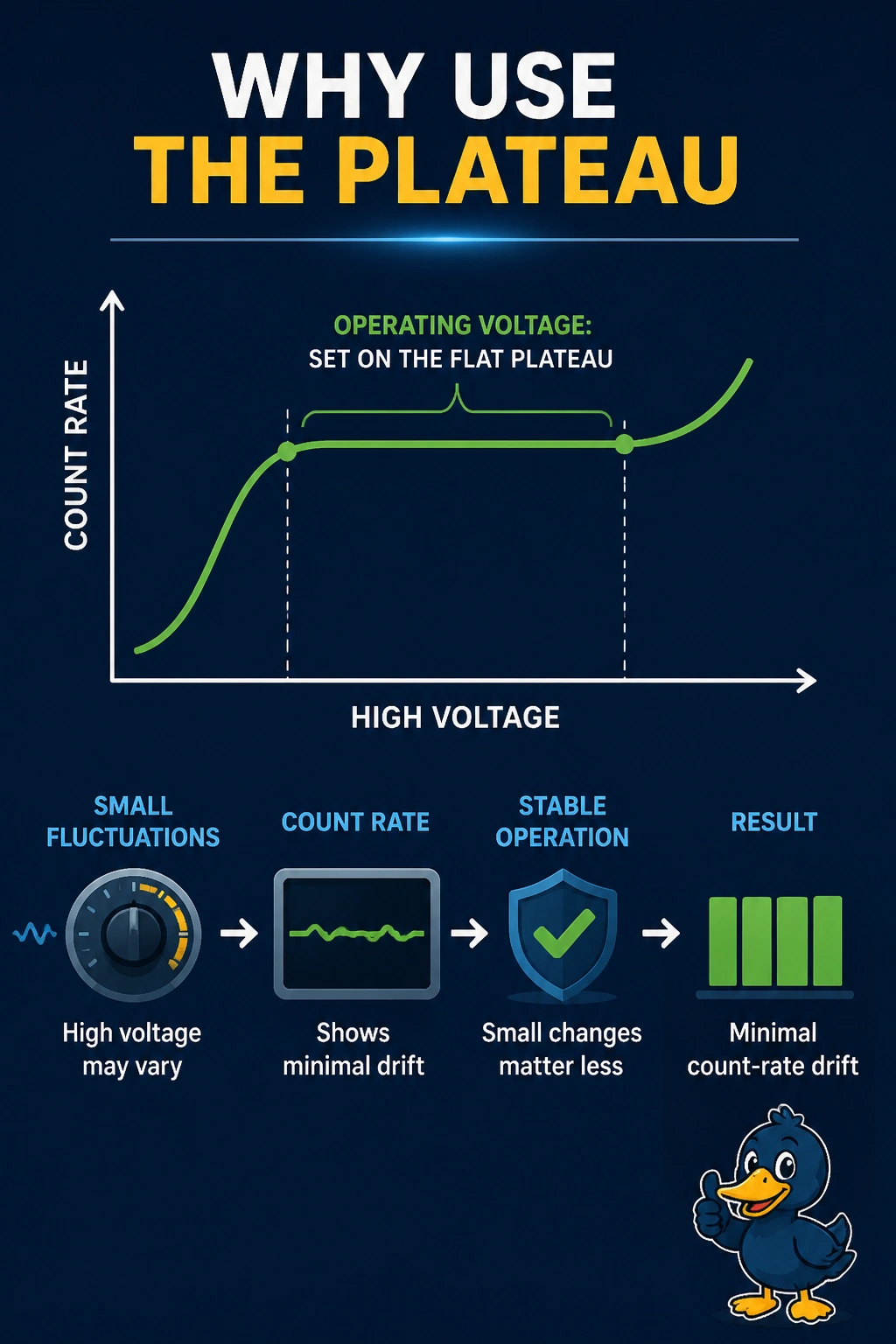
When setting up a Geiger-Mueller (GM) counting system, a technician determines the plateau curve and sets the high voltage on the flat region just above the knee. Why is the operating voltage placed on this plateau rather than in the steep threshold region?
Select an answer to reveal the explanation.
Short Explanation
Parking your GM high voltage on the plateau is like driving on a flat highway instead of a steep hill—tiny power-supply bumps barely change your count rate. The trap is thinking the plateau lets you resolve gamma energies or eliminates dead time, neither of which a GM tube can do.
Full Explanation
On a Geiger-Mueller plateau, every ionizing event that triggers a Townsend avalanche spreads along the entire anode wire and produces a saturated pulse of uniform amplitude, so small high-voltage fluctuations produce minimal count-rate drift. By contrast, operating on the steep threshold slope below the knee causes minor voltage changes to alter detection efficiency dramatically. The claim that gamma photon energies can be resolved into distinct photopeak channels fails because a GM detector produces identical pulse heights regardless of incident radiation energy or particle type. The statement that detector dead time drops to zero so high-rate counts need no correction is incorrect because GM tubes have substantial dead time caused by the positive-ion sheath around the anode, requiring correction at elevated count rates. Likewise, primary ion pairs are collected without any gas-multiplication avalanche describes the ionization chamber region at much lower voltage, not the Geiger-Mueller region. As a caveat, setting the voltage too high near the end of the plateau shortens tube life and risks continuous discharge. For an operational check, plot the plateau slope periodically and verify that the selected voltage sits in the flat lower-third region above the knee.
Prefer to study offline? Printable PDF study book + test engine ($7.50, unofficial). These questions stay free here.