
Under NRC 10 CFR 20.1003, at what tissue depth is the deep-dose equivalent (DDE) evaluated for external whole-body exposure?
Select an answer to reveal the explanation.
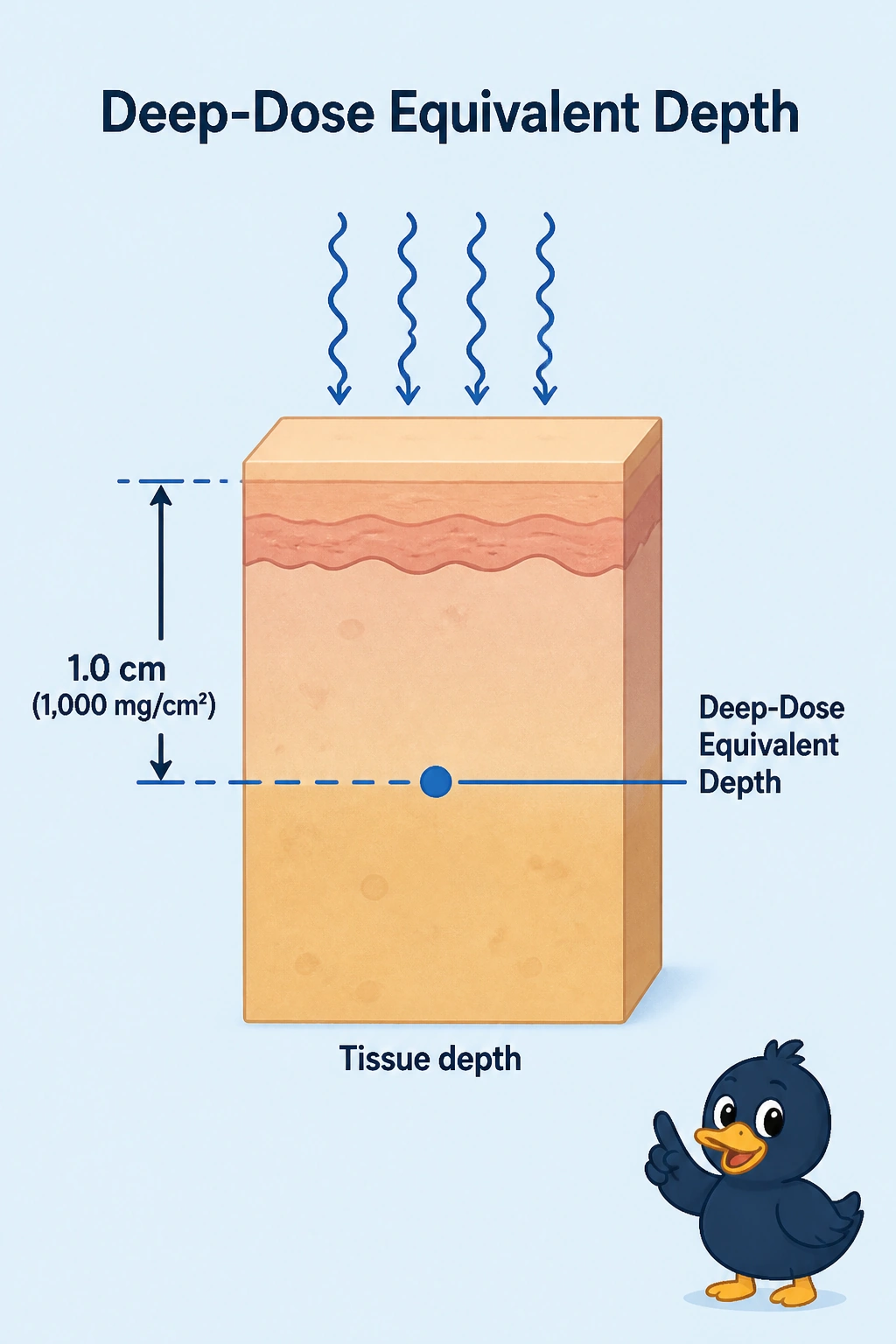
Short Explanation
Think of deep-dose equivalent as measuring how far penetrating radiation punches into your whole body, not just how it grazes the surface. The trap is mixing up the shallow skin depth or the eye lens depth with the deeper whole-body standard under NRC rules.
Full Explanation
Under NRC 10 CFR 20.1003, deep-dose equivalent (DDE) applies to external whole-body exposure and is evaluated At a tissue depth of 1.0 centimeter (1,000 mg/cm²). This depth represents the approximate thickness of superficial tissue shielding the blood-forming organs and deep internal structures from penetrating photons and high-energy particles. By contrast, At a tissue depth of 0.007 centimeters (7 mg/cm²) for skin defines the shallow-dose equivalent (SDE), which evaluates weakly penetrating beta and low-energy X-ray doses to the basal cell layer of the epidermis. Similarly, At a tissue depth of 0.3 centimeters (300 mg/cm²) for lens defines the lens dose equivalent (LDE), representing the depth of the crystalline lens of the eye. At a tissue depth of 10.0 centimeters (10,000 mg/cm²) core is not an NRC regulatory tissue depth and would underestimate doses to organs nearer the body surface. An important exam caveat is that dosimeter badges use specific filter thicknesses to mimic these exact density-thickness values when estimating DDE, LDE, and SDE. As an operational check, review your processor's dosimetry accreditation report to confirm that the badge algorithm reports DDE at 1,000 mg/cm².
Prefer to study offline? Printable PDF study book + test engine ($7.50, unofficial). These questions stay free here.