
Why does liquid scintillation counting (LSC) achieve substantially higher detection efficiency for Tritium (H-3, 18.6 keV maximum beta energy) than a standard thin-window Geiger-Mueller or gas-flow proportional detector?
Select an answer to reveal the explanation.
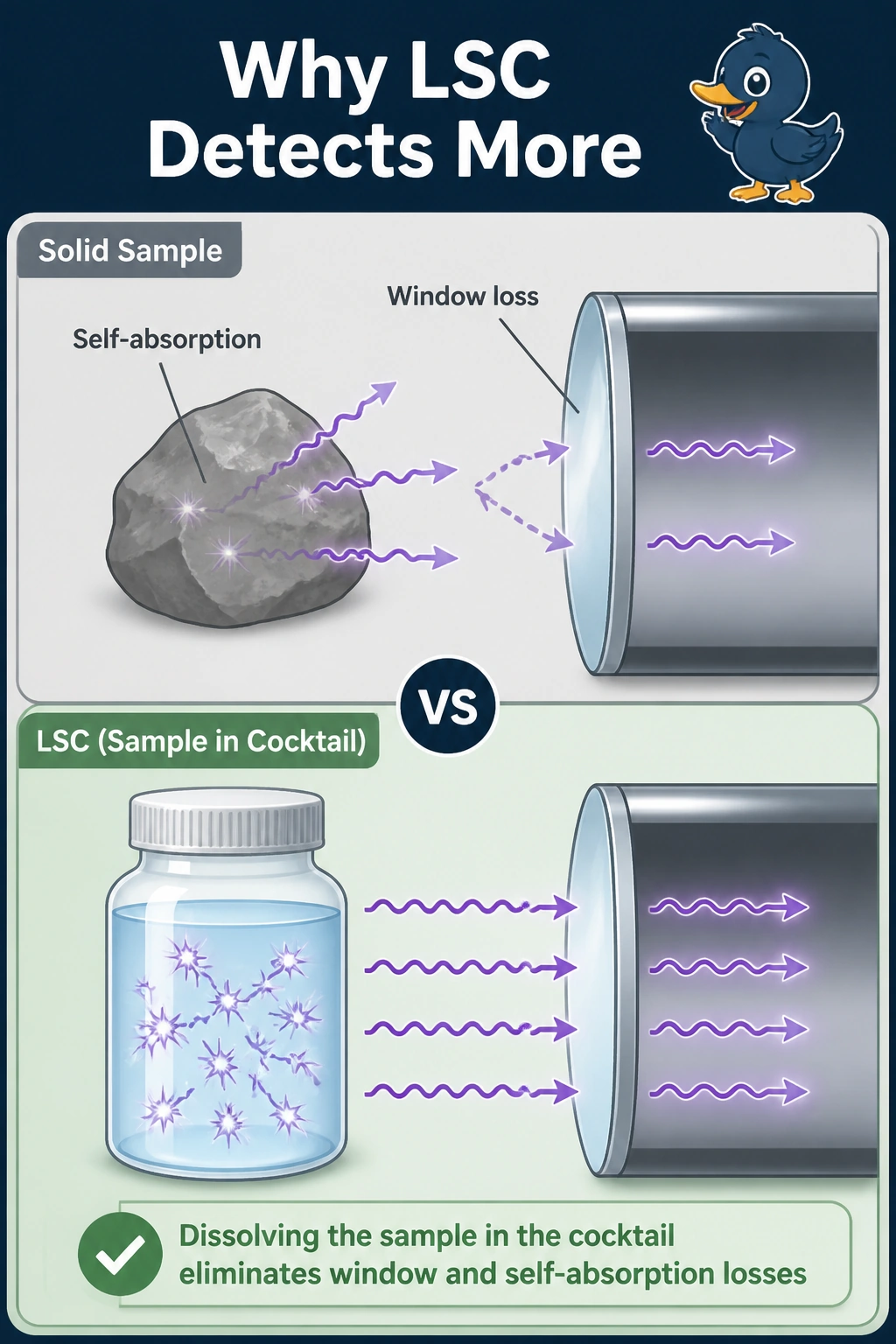
Short Explanation
Tritium betas are so weak—averaging under 6 keV—that even a paper-thin detector window or a drop of water stops them cold. Liquid scintillation solves this by putting your sample right inside the scintillating cocktail so virtually every decay reaches the fluor. The trap is confusing light emission in an organic cocktail with gas-tube avalanches or positron annihilation.
Full Explanation
Tritium (H-3) emits pure beta particles with a maximum energy of 18.6 keV and an average energy near 5.7 keV, which cannot penetrate standard detector entrance windows or even thin sample layers. In liquid scintillation counting (LSC), Dissolving the sample in the cocktail eliminates window and self-absorption losses because the radionuclide is in intimate molecular contact with the solvent and organic fluors, providing nearly 4-pi detection geometry. Excited solvent molecules transfer energy to the fluor, emitting tiny light pulses counted by opposing photomultiplier tubes. The liquid fluor multiplies avalanches using a high-voltage Townsend discharge is incorrect because Townsend gas avalanches occur in gas-filled proportional and Geiger-Mueller tubes, not liquid scintillators. The organic solvent converts low-energy beta particles into 511 keV gamma rays is false because 511 keV annihilation photons require positron emission, whereas tritium decays by beta-minus emission. The vial geometry provides a higher-density solid crystal than sodium iodide crystals is wrong because LSC uses a low-density liquid organic cocktail rather than a high-density inorganic crystal. As an operational caveat, chemical or color quenching can reduce light output and shift the spectrum. Always run quench-correction standards and check for photoluminescence before reporting results.
Prefer to study offline? Printable PDF study book + test engine ($7.50, unofficial). These questions stay free here.