
Why must a high-purity germanium (HPGe) gamma spectroscopy detector be cooled to liquid nitrogen temperature during operation?
Select an answer to reveal the explanation.
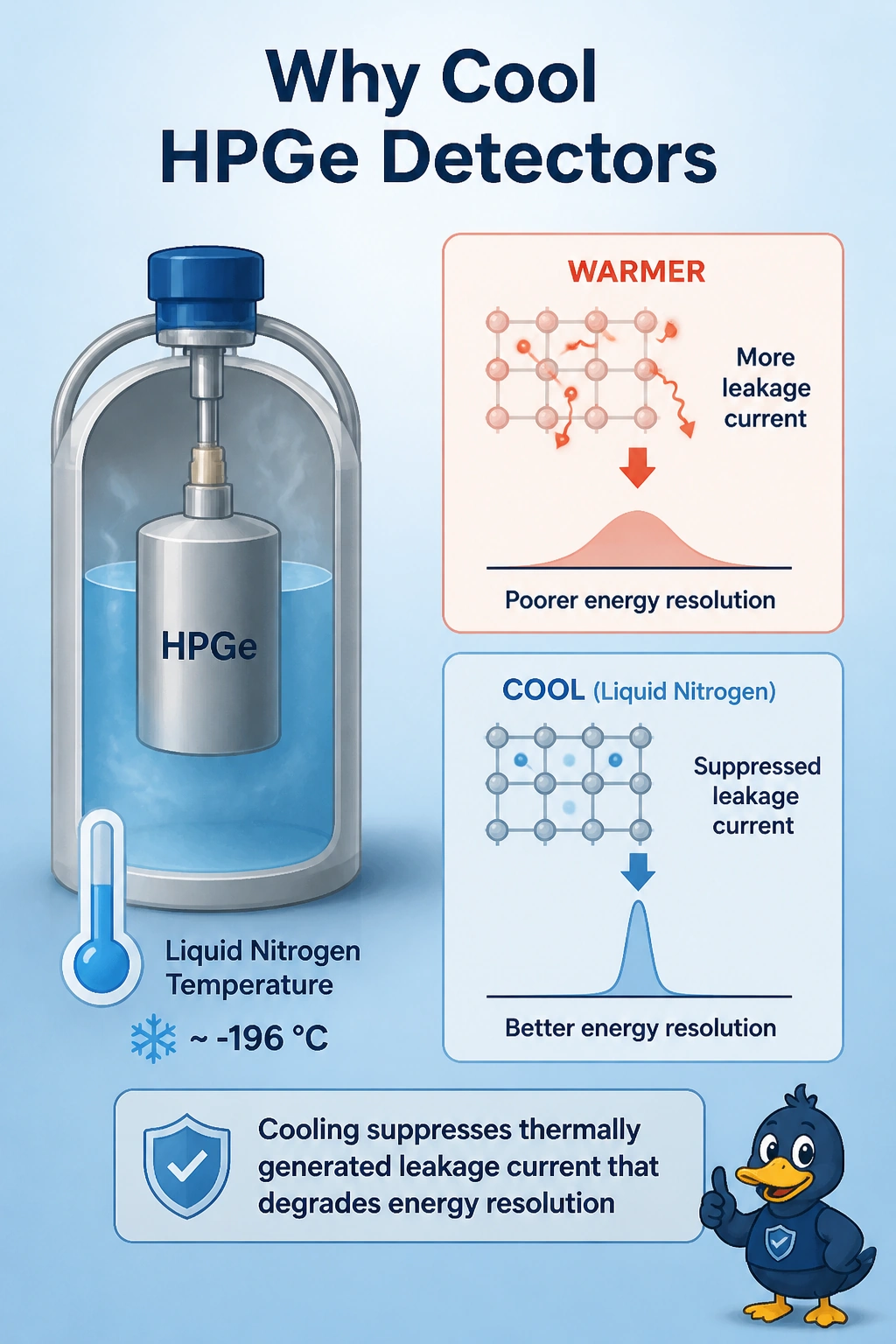
Short Explanation
Picture trying to hear a quiet whisper inside a noisy crowd: you have to quiet the background chatter first. When you operate an HPGe detector, the trap is thinking liquid nitrogen protects the outside housing rather than quieting thermal noise inside the crystal.
Full Explanation
Germanium has a narrow semiconductor band gap of roughly 0.7 eV, so at room temperature thermal energy excites large numbers of electrons across the gap into the conduction band. Cooling the crystal to liquid nitrogen temperature (77 K) is required To suppress thermally generated leakage current that degrades energy resolution, allowing the small charge pulses produced by gamma interactions to be measured cleanly without electronic noise drowning out closely spaced photopeaks. To freeze atmospheric moisture outside the aluminum endcap window is incorrect because condensation or frost on the outer cryostat is an unwanted side effect of vacuum loss, not the purpose of cooling. To increase the physical density of germanium for higher Compton scattering fails because thermal contraction barely alters crystal density, and photoelectric absorption rather than Compton scattering is preferred for photopeak spectroscopy. To prevent incident gamma photons from ionizing the crystal lattice is wrong because gamma ionization of the crystal is the exact signal the detector needs to measure. As a caveat, HPGe crystals can be stored warm when unbiased, but applying high voltage without full liquid nitrogen cooling can damage the preamplifier or crystal. Always confirm cryostat temperature or liquid nitrogen level before applying detector bias.
Prefer to study offline? Printable PDF study book + test engine ($7.50, unofficial). These questions stay free here.