
A radiochemistry sample initially contains 80 mCi of Radionuclide A (physical half-life 2.0 hours) and 40 mCi of Radionuclide B (physical half-life 6.0 hours). What is the total combined activity of the sample after 6.0 hours?
Select an answer to reveal the explanation.
Short Explanation
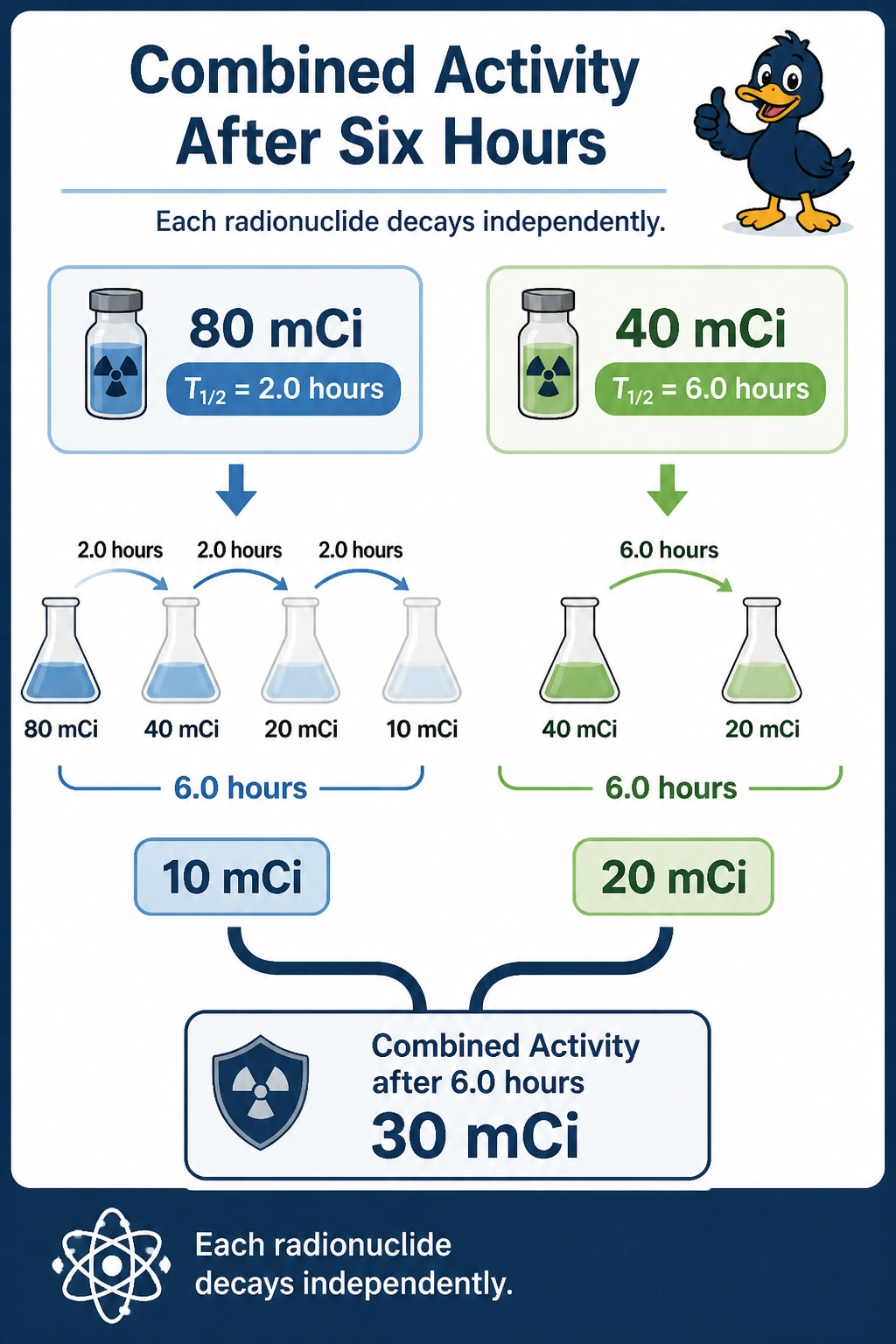
Think of two separate hourglasses sitting side by side: tipping them over at the same time does not make the sand in one affect the other. Each radionuclide in a mixture decays on its own clock, so you calculate each component separately and add the remaining activities together. Your trap is averaging the half-lives or assuming the faster-decaying isotope vanishes completely.
Full Explanation
Radioactive decay is a nuclear process unaffected by the presence of other isotopes, so the total activity of a mixture is the sum of each component's independent exponential decay. Over 6.0 hours, the 2.0-hour half-life nuclide undergoes three half-lives, dropping from 80 mCi to 10 mCi (80 / 8). Over the same 6.0 hours, the 6.0-hour half-life nuclide undergoes one half-life, dropping from 40 mCi to 20 mCi (40 / 2). Adding them gives "30 mCi, because each radionuclide decays independently according to its own half-life." The choice "15 mCi, because the two radionuclides decay together using an averaged 4.0-hour half-life." fails because exponential decay rates cannot be combined by averaging half-lives. The option "40 mCi, because only the shorter-lived radionuclide loses activity over 6.0 hours." wrongly treats the longer-lived isotope as stable during the interval. Likewise, "20 mCi, because the shorter-lived radionuclide decays completely before 6.0 hours." ignores the 10 mCi still remaining after three half-lives. As a caveat, if one radionuclide is the parent of the other rather than an independent mixture, daughter ingrowth must be modeled with Bateman equations. For an operational check, recount the sample at a later time and verify the composite decay curve matches the sum of both half-lives.
Prefer to study offline? Printable PDF study book + test engine ($7.50, unofficial). These questions stay free here.