
An undisturbed sealed source contains a parent radionuclide with a 10-day physical half-life that decays 100 percent into a radioactive daughter with a 1.0-day physical half-life. Once transient equilibrium is established, how do their activities compare?
Select an answer to reveal the explanation.
Short Explanation
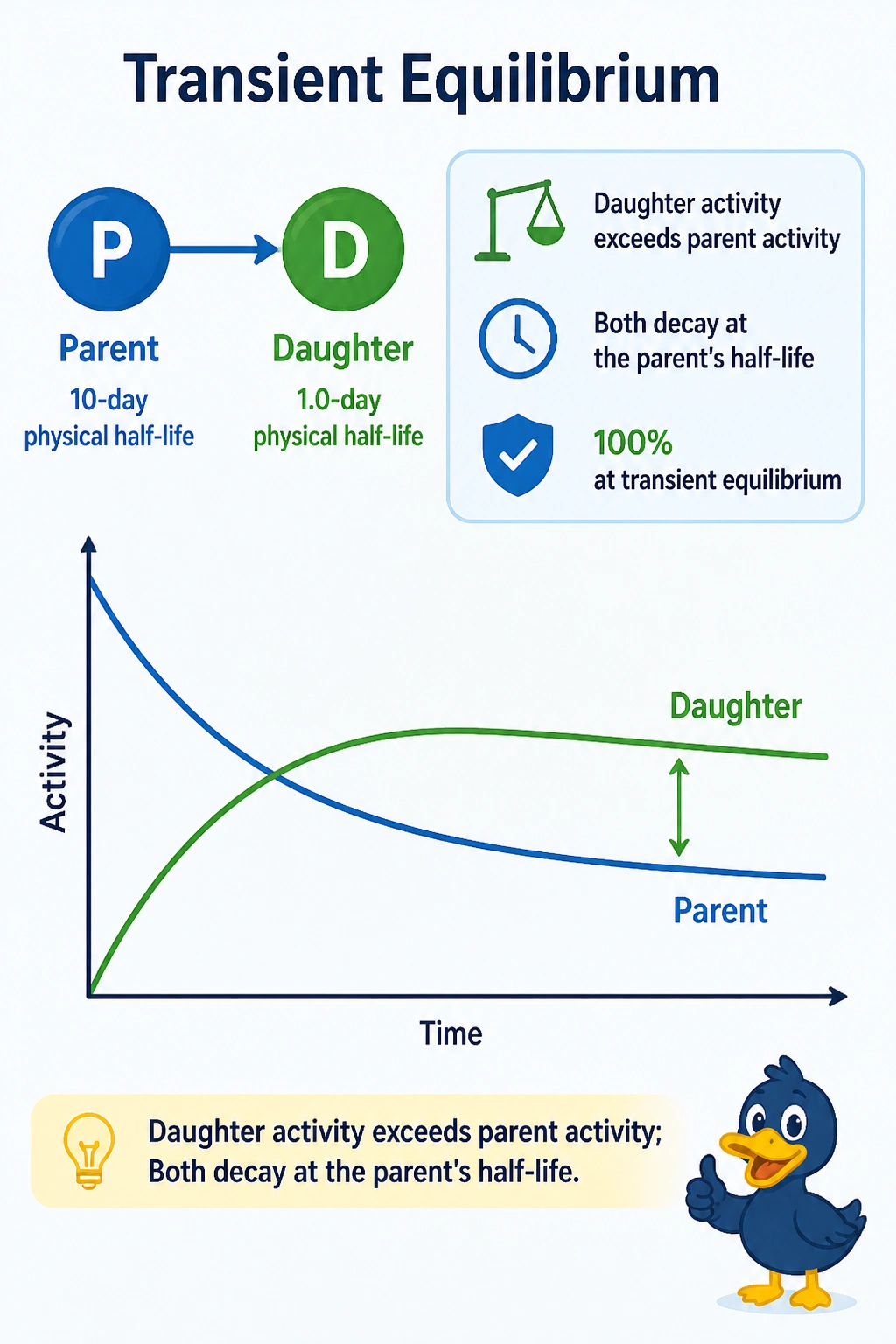
Transient equilibrium is like a fast runner following a slightly slower pacemaker: once they hit steady stride, the daughter actually carries slightly more activity than the parent. Because the parent's 10-day half-life is longer than the daughter's 1.0-day half-life, you see daughter activity exceed parent activity while both decay at the parent's rate. The trap is thinking daughter activity equals parent activity, which only happens in secular equilibrium.
Full Explanation
When a parent radionuclide has a moderately longer half-life than its radioactive daughter (T1/2,parent > T1/2,daughter), the pair reaches transient equilibrium after several daughter half-lives. Selecting Daughter activity exceeds parent activity and both decay at the parent's half-life is correct because the Bateman equation simplifies to A_daughter = A_parent x [T1/2,parent / (T1/2,parent - T1/2,daughter)] = A_parent x (10 / 9) = 1.11 x A_parent, so the daughter activity is about 11 percent higher than the parent and both decrease with the 10-day parent half-life. Selecting Daughter activity equals parent activity and both decay at the daughter's half-life is wrong on both counts: equality only occurs in secular equilibrium, and the parent controls the combined decay rate. Selecting Daughter activity remains lower than parent activity and decays at its own half-life violates the transient equilibrium ratio when branching is 100 percent and misidentifies the controlling half-life. Selecting Daughter activity equals parent activity exactly and remains constant over many decades describes secular equilibrium with an extremely long-lived parent, not a 10-day parent. As an exam caveat, if a parent branches only partially to the daughter (for example, less than 100 percent yield), the daughter activity can be lower than total parent activity even in transient equilibrium. As an operational check, wait several daughter half-lives after chemical separation before assuming equilibrium ratios during bioassay or waste characterization.
Prefer to study offline? Printable PDF study book + test engine ($7.50, unofficial). These questions stay free here.