
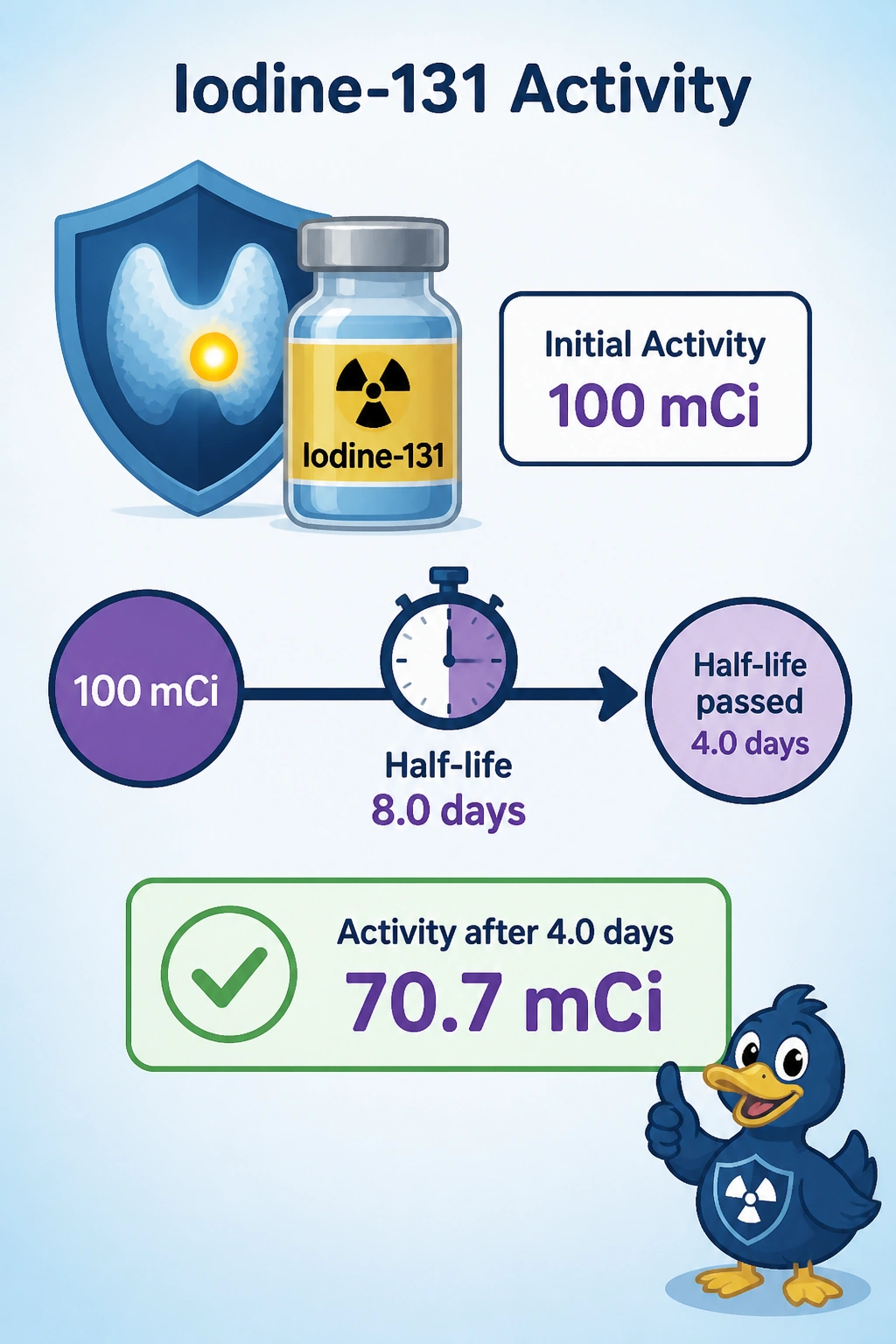
A nuclear medicine laboratory receives a 100 mCi shipment of Iodine-131, which has a physical half-life of 8.0 days. How much activity remains in the vial after exactly 4.0 days?
Select an answer to reveal the explanation.
Short Explanation
Radioactive decay curves downward like a ski slope, not a straight ramp, so halfway to one half-life you still have just over 70 percent left. The trap is splitting the difference linearly at 75 mCi or confusing four days with a full eight-day half-life.
Full Explanation
Because radioactive decay is exponential, the remaining activity after 4.0 days—which is 0.5 of an 8.0-day half-life—equals 100 mCi multiplied by 0.5 raised to the 0.5 power, yielding 70.7 mCi from exponential decay over half a half-life. Choosing 75.0 mCi by linearly interpolating halfway to one half-life treats an exponential curve as a straight line between 100 mCi and 50 mCi, which slightly overestimates remaining activity. Selecting 50.0 mCi because half of the initial activity decays in four days mistakes half of the half-life duration for a full 8.0-day half-life. Picking 25.0 mCi from applying two sequential half-life reductions corresponds to 16.0 days of decay rather than 4.0 days. As a caveat, when calculating patient or biological clearance of Iodine-131 inside the body, you must use the effective half-life rather than the physical half-life alone. Before preparing a dose or shipping a decay-corrected source, always enter the exact elapsed time into the exponential decay formula and cross-check the vial assay in a calibrated dose calibrator.
Prefer to study offline? Printable PDF study book + test engine ($7.50, unofficial). These questions stay free here.