
A radiochemistry laboratory uses a calibration source with a physical half-life of 10.0 days. What is the mean life (average lifetime) of an individual radioactive atom in this source?
Select an answer to reveal the explanation.
Short Explanation
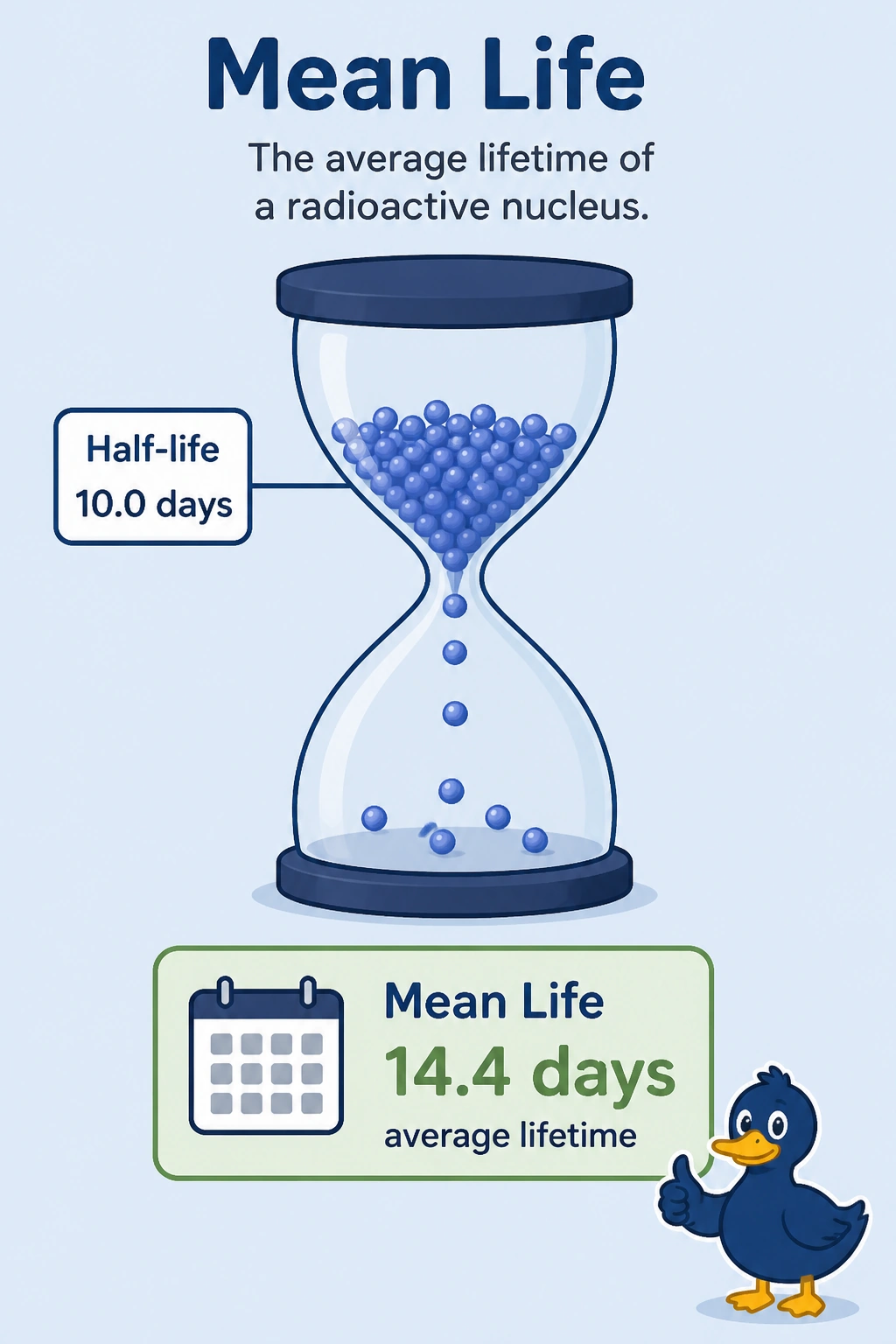
Think of mean life like the average lifespan of a fleet of cars rather than the time until half the fleet breaks down. Because the decay rate slows exponentially, the average atom survives longer than one half-life, so you divide by 0.693 rather than multiplying or halving.
Full Explanation
Mean life, also called average lifetime, equals the reciprocal of the exponential decay constant, which works out to the physical half-life divided by the natural logarithm of two (0.693). Dividing 10.0 days by 0.693 yields 14.4 days average lifetime because the remaining fraction of atoms decays exponentially, creating a long tail of nuclei that survive well past one half-life. Selecting 6.93 days average lifetime reverses the operation by multiplying 10.0 days by 0.693 instead of dividing. Choosing 20.0 days average lifetime simply doubles the half-life, confusing two half-lives (25 percent remaining) with the exponential mean (36.8 percent remaining). Selecting 5.00 days average lifetime halves the half-life, which would only hold if decay proceeded at a constant linear rate until zero. As a caveat, mean life applies strictly to a single pure radionuclide species and does not represent the effective lifetime of a multi-nuclide mixture or an internally deposited isotope with biological clearance. For an operational check, confirm that at one mean life (14.4 days), approximately 36.8 percent (1/e) of the original activity remains when logging source decay records.
Prefer to study offline? Printable PDF study book + test engine ($7.50, unofficial). These questions stay free here.