
A Technetium-99m radiopharmaceutical sample has an initial activity of 640 mCi. Given a physical half-life of 6.0 hours, how much activity remains after 24 hours?
Select an answer to reveal the explanation.
Short Explanation
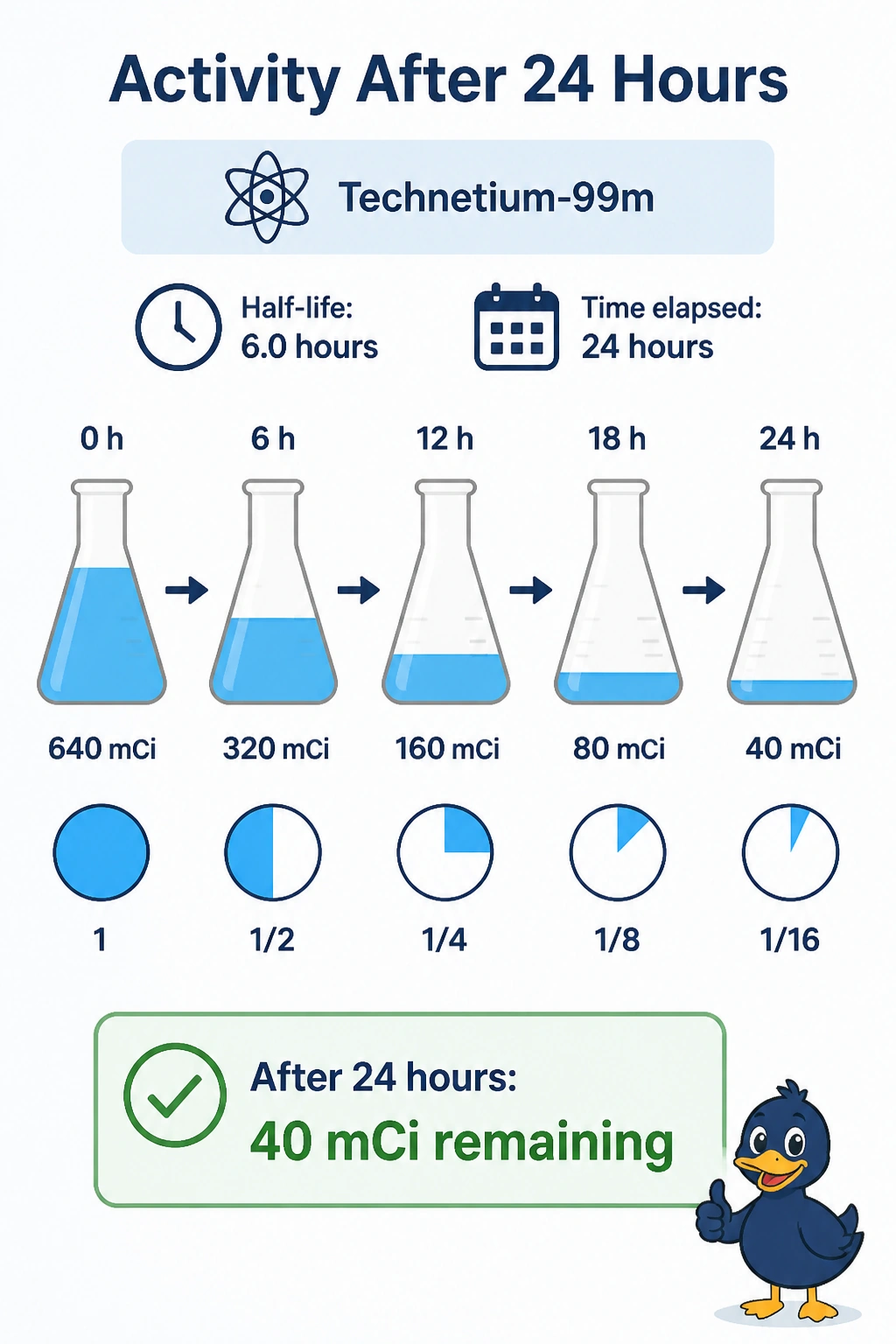
Half-life problems are just counting how many times you cut the pile in half. Twenty-four hours divided by 6.0 hours gives you four halvings, so count down: 320, 160, 80, and 40. The common trap is dividing 640 directly by 4 instead of by 2 raised to the fourth power.
Full Explanation
Radioactive decay over an integer number of half-lives follows A = A_0 * (0.5)^n, where n is the elapsed time divided by the physical half-life. Dividing 24 hours by 6.0 hours gives n = 4 half-lives. Raising 0.5 to the fourth power equals 1/16, and multiplying 640 mCi by 1/16 yields 40 mCi remaining. Selecting 80 mCi remaining corresponds to only 3 half-lives (18 hours), stopping one halving too early. Selecting 160 mCi remaining results from dividing the initial 640 mCi linearly by 4 instead of applying four successive halvings (2^4 = 16). Selecting 20 mCi remaining activity overshoots by one extra half-life, representing 5 half-lives (30 hours) instead of 24 hours. As a caveat, this calculation tracks physical decay only; inside a patient or open biological system, effective half-life also incorporates biological clearance. Operationally, always verify the assay time and decay-correct the activity in a dose calibrator before administering a radiopharmaceutical or releasing decayed waste.
Prefer to study offline? Printable PDF study book + test engine ($7.50, unofficial). These questions stay free here.