
In low-level radioactivity counting, why is the Lower Limit of Detection (LLD) set higher than the Critical Level (Lc) for the same counting system and time?
Select an answer to reveal the explanation.
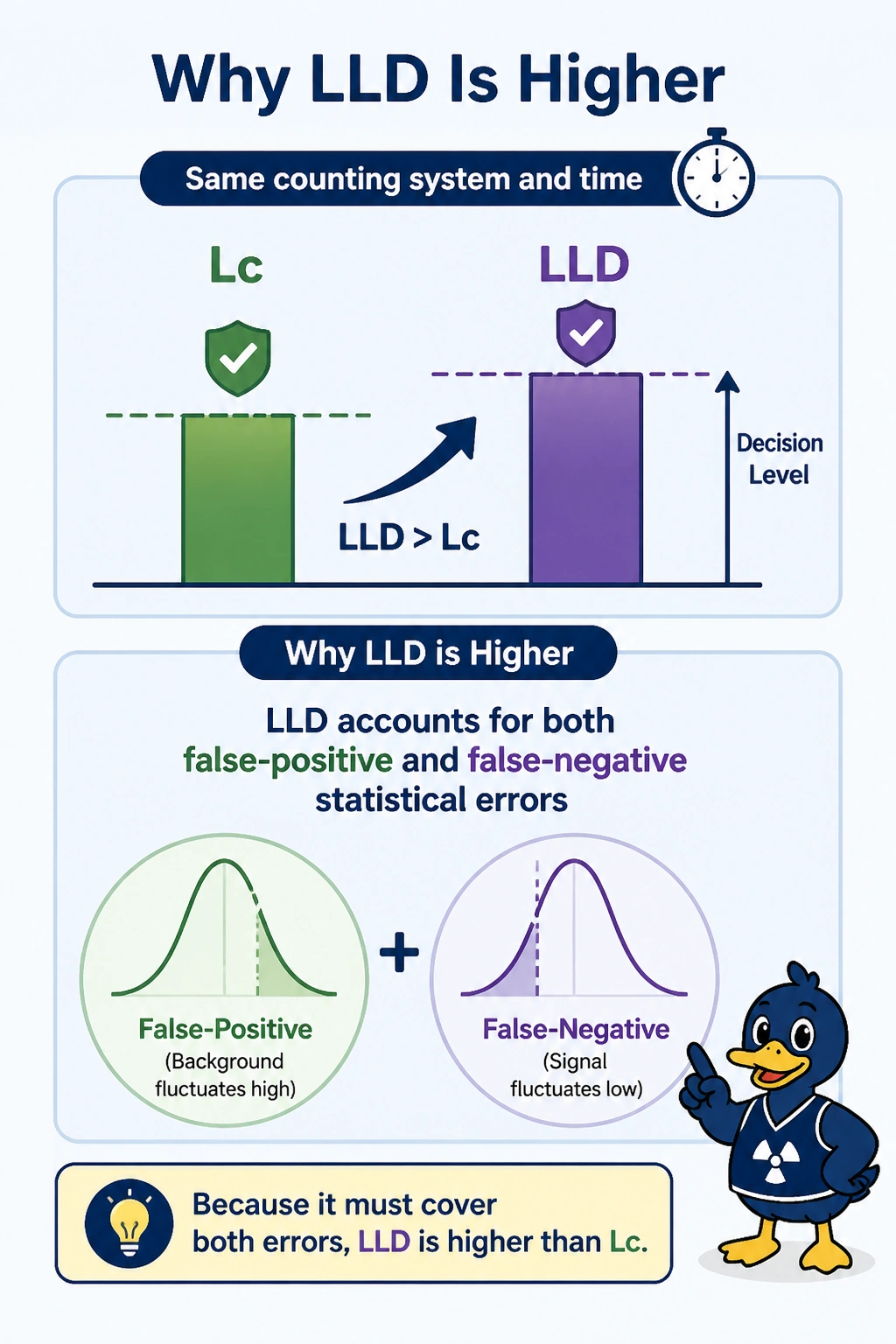
Short Explanation
Setting Lc is like setting a smoke alarm threshold so burnt toast rarely triggers it, while LLD is how much real smoke guarantees the alarm goes off. When you interpret detection limits, the trap is confusing the decision threshold for a single count with true detection capability.
Full Explanation
The Critical Level (Lc) is a decision threshold derived solely from background variability to limit false-positive results (Type I error, typically 5 percent) when a true blank is counted. By contrast, LLD accounts for both false-positive and false-negative statistical errors: it represents the smallest true net signal that will exceed Lc with high probability (typically 95 percent, limiting Type II false-negative error to 5 percent), making LLD roughly twice Lc for well-known backgrounds. LLD includes a fixed regulatory safety factor of ten above background counts is incorrect because LLD is calculated from Poisson counting statistics and chosen error probabilities, not an arbitrary multiplier of ten. Lc applies only to alpha counting while LLD applies strictly to gamma spectroscopy fails because both Lc and LLD are general statistical metrics used across alpha, beta, and gamma counting systems. Lc ignores background counts whereas LLD requires subtracting cosmic-ray events is wrong because both Lc and LLD depend directly on the background count distribution. As a caveat, Minimum Detectable Activity (MDA) converts LLD from counts into activity units using detector efficiency, sample volume, and count time. Verify both Lc and MDA on laboratory count sheets before reporting a sample as below detection limits.
Prefer to study offline? Printable PDF study book + test engine ($7.50, unofficial). These questions stay free here.