
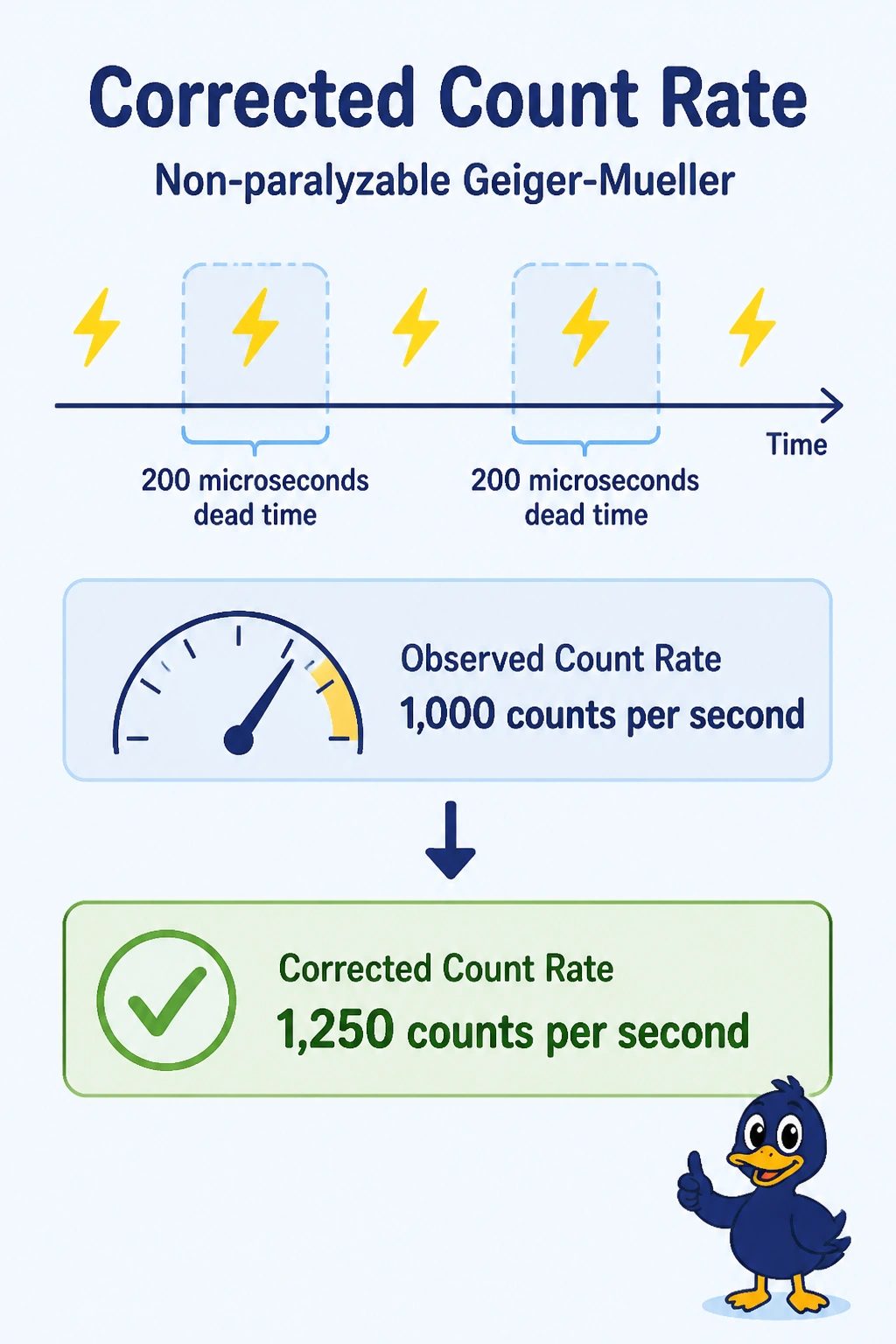
A non-paralyzable Geiger-Mueller counting system has a resolving dead time of 200 microseconds and records an observed count rate of 1,000 counts per second. What is the dead-time-corrected true count rate?
Select an answer to reveal the explanation.
Short Explanation
During 20 percent of every second, your detector is blind while recovering from pulses, so it only catches 80 percent of the true events. Dividing the observed 1,000 counts per second by 0.80 recovers the true rate of 1,250 counts per second. Watch out for the classic trap of multiplying by 1.20 instead—that undercorrects because pulses arrive during dead time too.
Full Explanation
For a non-paralyzable detector with dead time tau and observed rate R, the true rate equals R divided by (1 minus R times tau), yielding 1,250 counts per second. Here, multiplying 1,000 counts per second by 0.000200 seconds shows the detector is dead for 0.20 of each second and live for 0.80 of each second; dividing 1,000 by 0.80 gives 1,250 counts per second. The result 800 counts per second is wrong because it multiplies by 0.80 instead of dividing, making the corrected rate lower than the observed rate. The result 1,200 counts per second is a common approximation trap that adds 20 percent (multiplying by 1.20) rather than dividing by the 0.80 live-time fraction. The result 5,000 counts per second mistakenly divides the observed 1,000 counts per second by the 0.20 dead-time fraction instead of the 0.80 live-time fraction. As an analytical caveat, this simple formula applies only to non-paralyzable behavior; paralyzable systems suffer extended dead time at high rates and can even fold over toward zero. Operationally, verify the system's dead time with paired-source measurements and avoid counting high-activity samples where dead-time losses exceed roughly 10 to 20 percent.
Prefer to study offline? Printable PDF study book + test engine ($7.50, unofficial). These questions stay free here.