
A technician collects ten consecutive 1-minute counts of a long-lived check source on a laboratory scaler and runs a chi-square test. The resulting chi-square value falls far above the expected upper critical limit. What does this indicate?
Select an answer to reveal the explanation.
Short Explanation
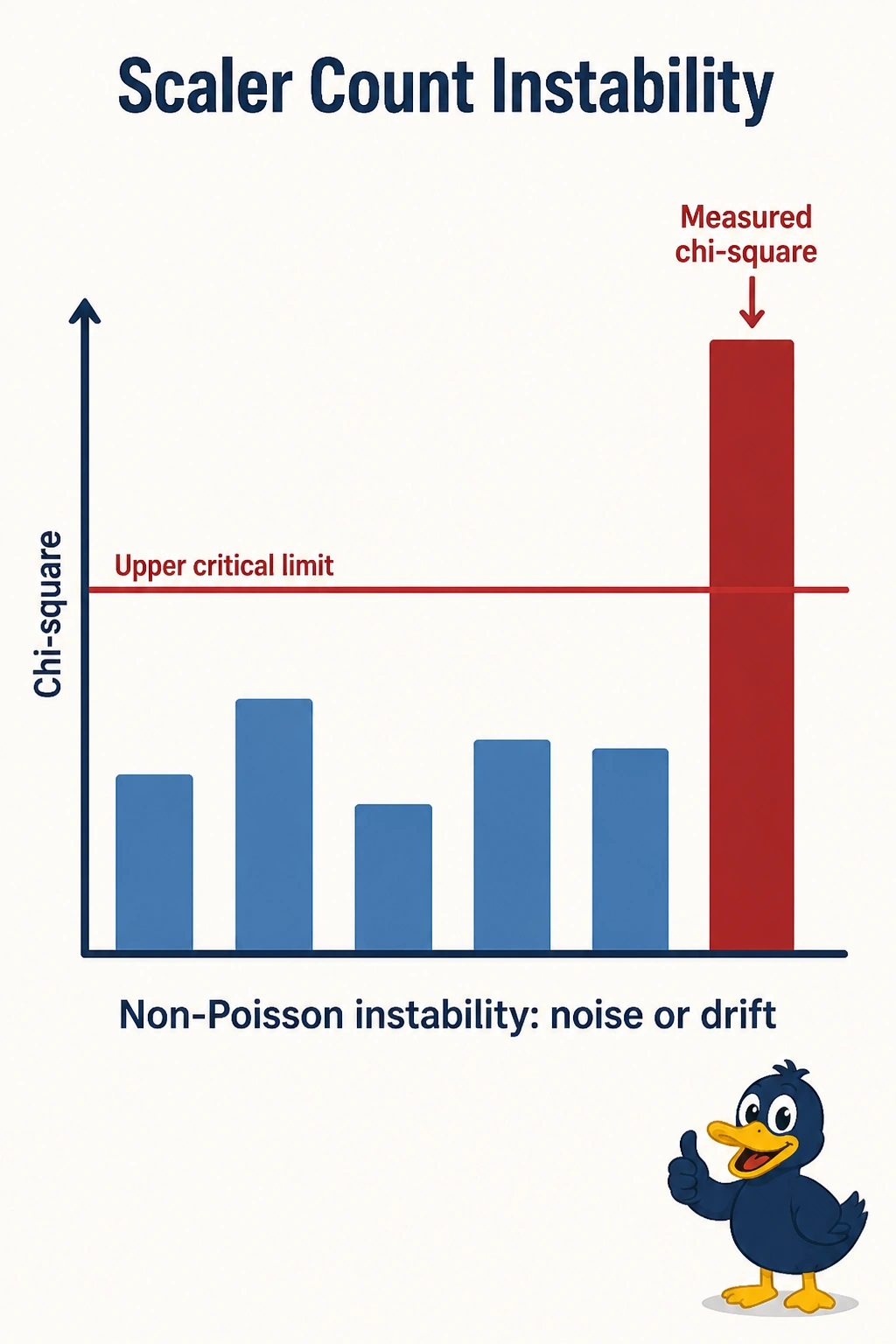
Your chi-square test checks whether the scaler’s count-to-count scatter matches nature’s built-in Poisson variation. When chi-square is far above the upper limit, the extra scatter points to instability such as electronic noise or drift—not significant decay of the long-lived source.
Full Explanation
Non-Poisson instability such as electronic noise or drift is present because, for true Poisson radioactive decay, the sample variance should be close to the mean count. A chi-square value far above the upper critical limit means the spread among consecutive counts is much wider than random decay statistics predict. Significant decay of the long-lived check source in ten minutes is not a plausible explanation; rapid decay would also tend to produce a downward trend rather than excessive erratic scatter. Ideal Poisson decay scatter would produce a chi-square value near the degrees of freedom and within the expected critical limits, not far above the upper limit. A background count rate that is too low to measure reliably is not indicated, because this test evaluates dispersion among repeated gross check-source counts, not whether the background is detectable. As an exam caveat, a chi-square value below the lower critical limit is also abnormal: suppressed variation can indicate dead-time clipping or a stuck scaler. As a practical check, inspect the cables, verify high-voltage stability, and repeat the ten-count chi-square test before using the scaler for sample analysis.
Prefer to study offline? Printable PDF study book + test engine ($7.50, unofficial). These questions stay free here.