
A technician uses a handheld alpha scintillation probe to perform a direct surface survey on a pump housing covered with a thin film of hydraulic oil and moisture. Why can this direct measurement significantly underestimate the true alpha surface activity?
Select an answer to reveal the explanation.
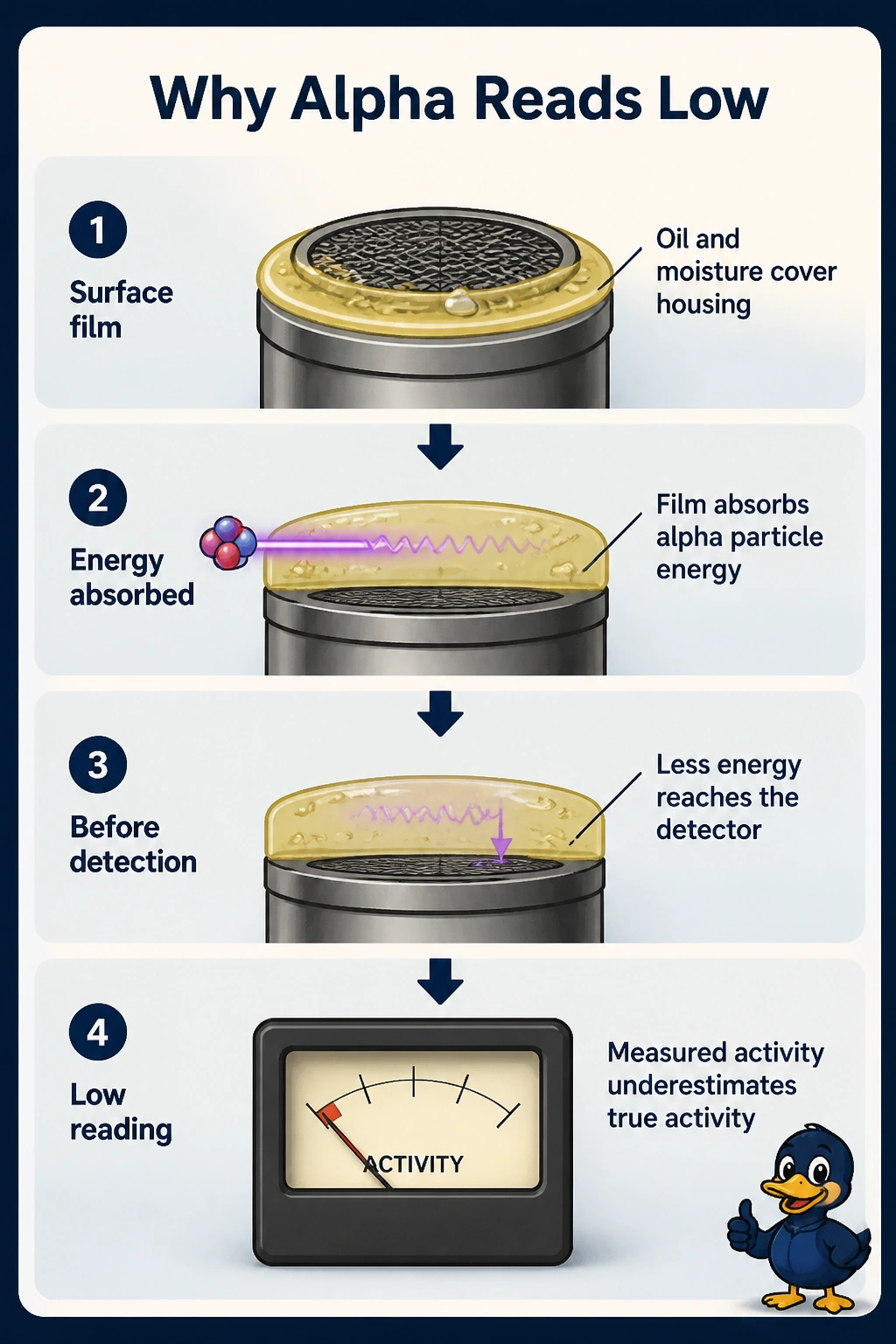
Short Explanation
Alpha particles have such short range that even a thin coat of oil or water acts like a brick wall between the surface and your probe. Watch out for the trap of blaming chemical quenching of a sealed scintillation crystal when the real culprit is simple physical absorption.
Full Explanation
Because alpha particles carry a +2 charge and large mass, they lose energy rapidly over very short distances in matter, so even a microscopic layer of surface liquid or grease stops them completely. On a wet or greasy pump housing, oil and moisture absorb alpha particle energy before it reaches the detector, causing the meter to read artificially low or zero despite significant contamination beneath the film. Hydrocarbon vapors quench the zinc sulfide phosphor and block all light pulses is incorrect because a ZnS(Ag) scintillation crystal is sealed behind a thin aluminized Mylar window and does not rely on fill-gas quenching. Beta particles in the oil film saturate the probe's high-voltage power supply fails because ZnS(Ag) alpha probes are discriminatively insensitive to beta-gamma radiation and low-level contamination does not collapse power supplies. Alpha particles scatter backward off steel and miss the probe's thin window is wrong because heavy alpha particles travel in straight tracks with minimal backscatter. As a caveat, porous concrete, rust, or paint can cause the same self-absorption bias. For an operational check, collect dry smear wipes where appropriate, dry damp surfaces or smears before counting, and inspect the probe window for pinholes or oil fouling.
Prefer to study offline? Printable PDF study book + test engine ($7.50, unofficial). These questions stay free here.