
A scaler records 10,000 total counts during a 10-minute measurement of a long-lived sample. Assuming Poisson counting statistics, what is the one-sigma standard deviation of the total count?
Select an answer to reveal the explanation.
Short Explanation
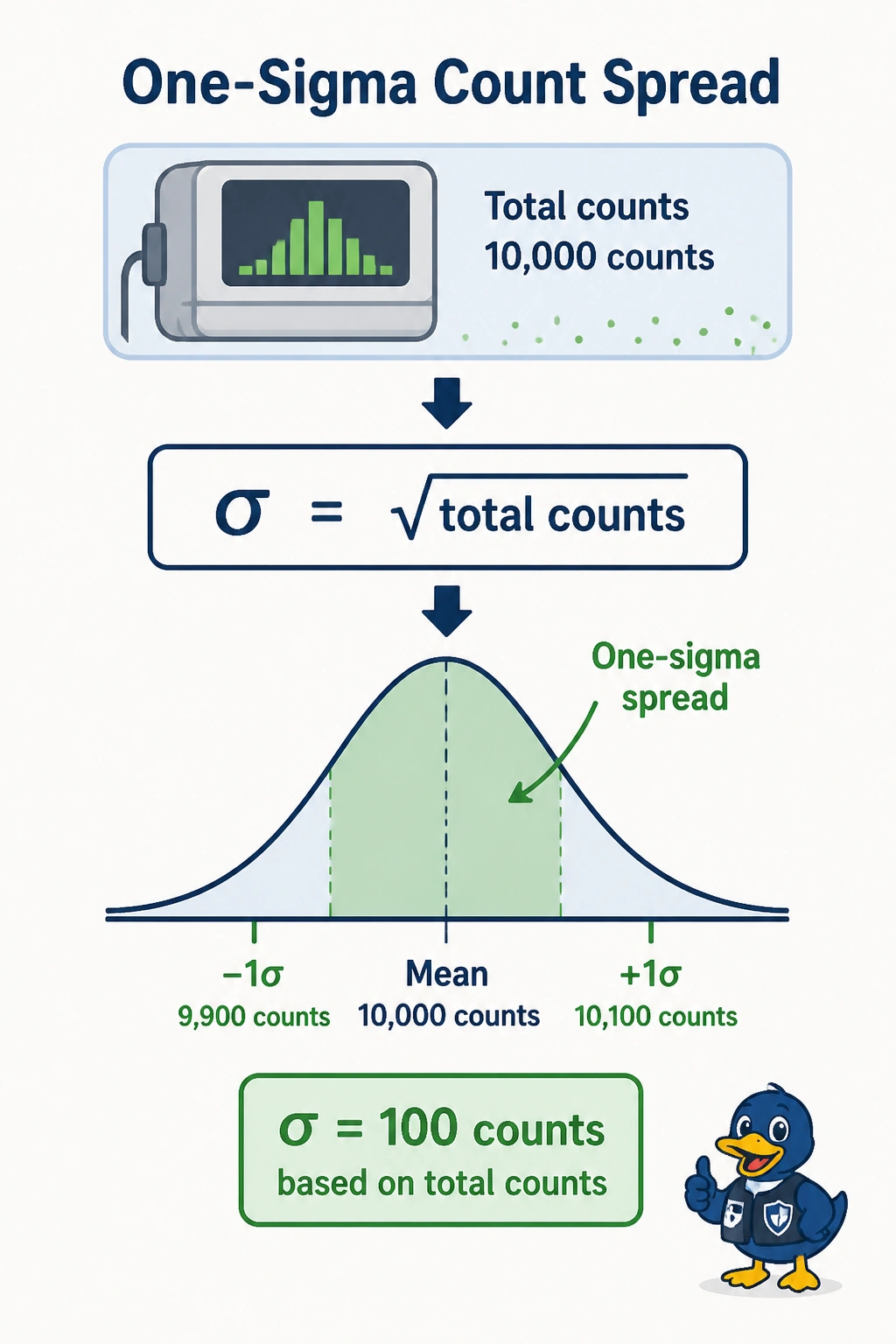
With radioactive decay, your counting uncertainty depends on the total number of events you actually collected, not the clock alone. Taking the square root of 10,000 total counts gives a one-sigma standard deviation of 100 counts. The trap is taking the square root of the count rate per minute instead of the total counts.
Full Explanation
Radioactive decay follows Poisson statistics, where the variance of a total count N equals N and the one-sigma standard deviation equals the square root of N. For 10,000 total counts, the square root of 10,000 is 100 counts based on total counts, which corresponds to a 1 percent relative standard deviation. Choosing 32 counts based on the count rate is a classic error that takes the square root of the 1,000 counts per minute rate rather than the 10,000 total counts collected over 10 minutes. Selecting 1,000 counts based on ten minutes divides the total counts by the 10-minute count time, giving the average count rate rather than the statistical uncertainty. Picking 10 counts based on the count rate divides 1,000 counts per minute by 100 or misapplies a power of ten, understating the true statistical spread by a factor of ten. As a statistical caveat, this simple square-root rule applies to total counts before background subtraction; net count uncertainty must propagate both sample and background variances. As an operational check, verify that total counts are large enough to meet your required precision and run a chi-square test periodically to confirm the scaler follows Poisson behavior.
Prefer to study offline? Printable PDF study book + test engine ($7.50, unofficial). These questions stay free here.