
During a cellular radiobiology review, a health physicist evaluates how sensitivity to low-LET gamma radiation varies across the mammalian cell cycle. In which phase are cells generally the most radioresistant?
Select an answer to reveal the explanation.
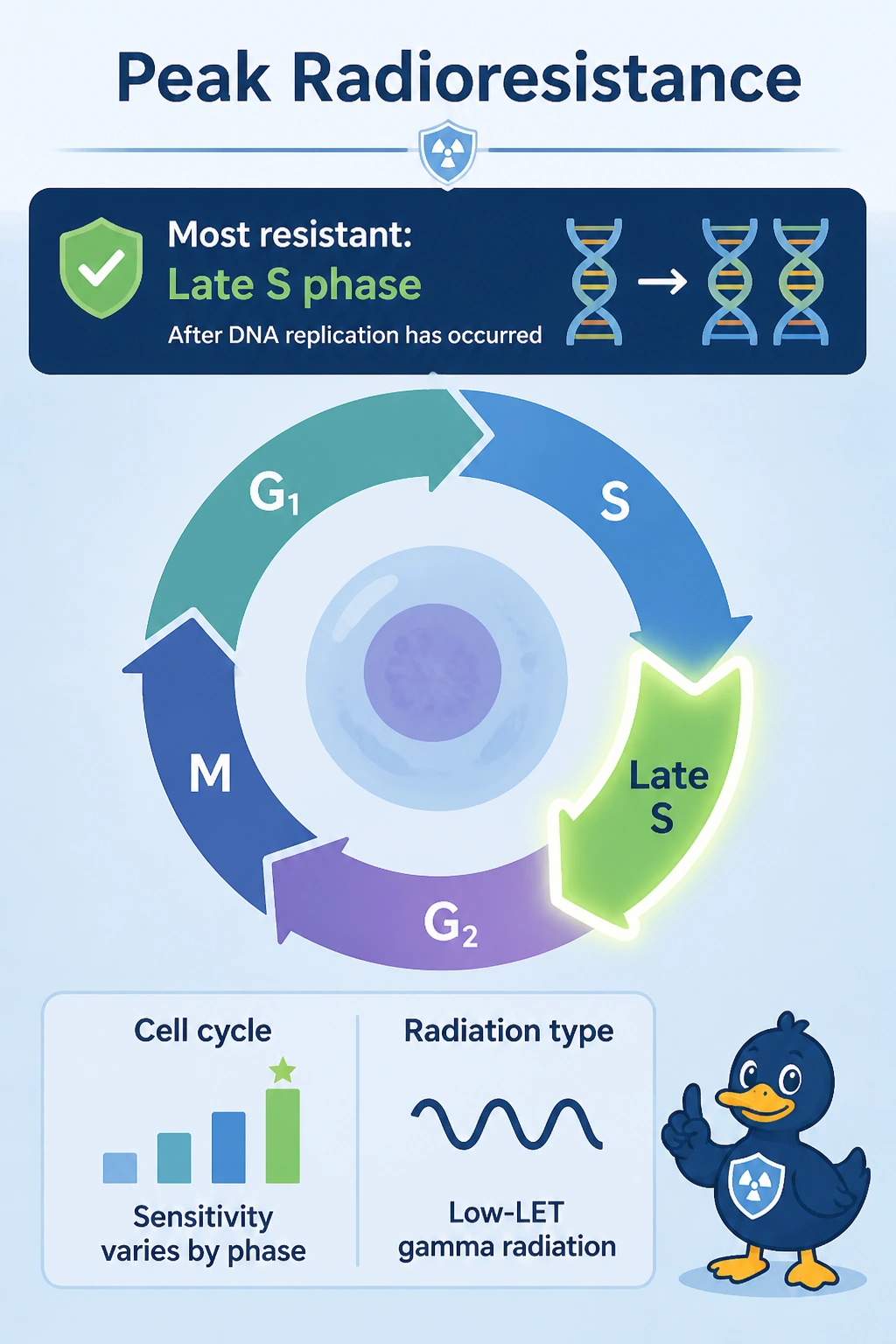
Short Explanation
Think of a cell that has just finished copying its DNA as having a backup blueprint right next to the original. That spare sister chromatid lets the cell repair double-strand breaks far more effectively, though you should not confuse this late synthesis peak in resistance with the fragile division stages.
Full Explanation
Mammalian cells exhibit marked variation in radiosensitivity across the cell cycle, with Late S phase, after DNA replication has occurred consistently showing the highest resistance to low-LET gamma radiation. Once DNA synthesis is nearly complete, each chromosome has an adjacent sister chromatid available as a template for error-free homologous recombination repair, while intracellular radical-scavenging sulfhydryl levels also peak. Mitosis (M phase), when chromosomes are tightly condensed is actually the most radiosensitive phase because condensed chromatin is vulnerable to lethal chromosomal aberrations and has minimal active repair. Late G2 phase, immediately preceding nuclear division is likewise highly radiosensitive because the cell has little time to repair damage before entering mitosis. The G1/S boundary, as the cell commits to DNA synthesis represents a second peak of heightened radiosensitivity rather than resistance as DNA unwinds for replication. As a caveat, cell-cycle age-response variation is substantially flattened for high-LET radiations such as alpha particles and fast neutrons, where clustered DNA damage overwhelms repair pathways. As an operational check in radiation biology or therapy modeling, confirm both the radiation LET and the tissue's proliferative fraction before applying cell-cycle sensitivity factors.
Prefer to study offline? Printable PDF study book + test engine ($7.50, unofficial). These questions stay free here.