
At the molecular level, why are DNA double-strand breaks far more likely to cause cell death or chromosomal aberrations than single-strand breaks?
Select an answer to reveal the explanation.
Short Explanation
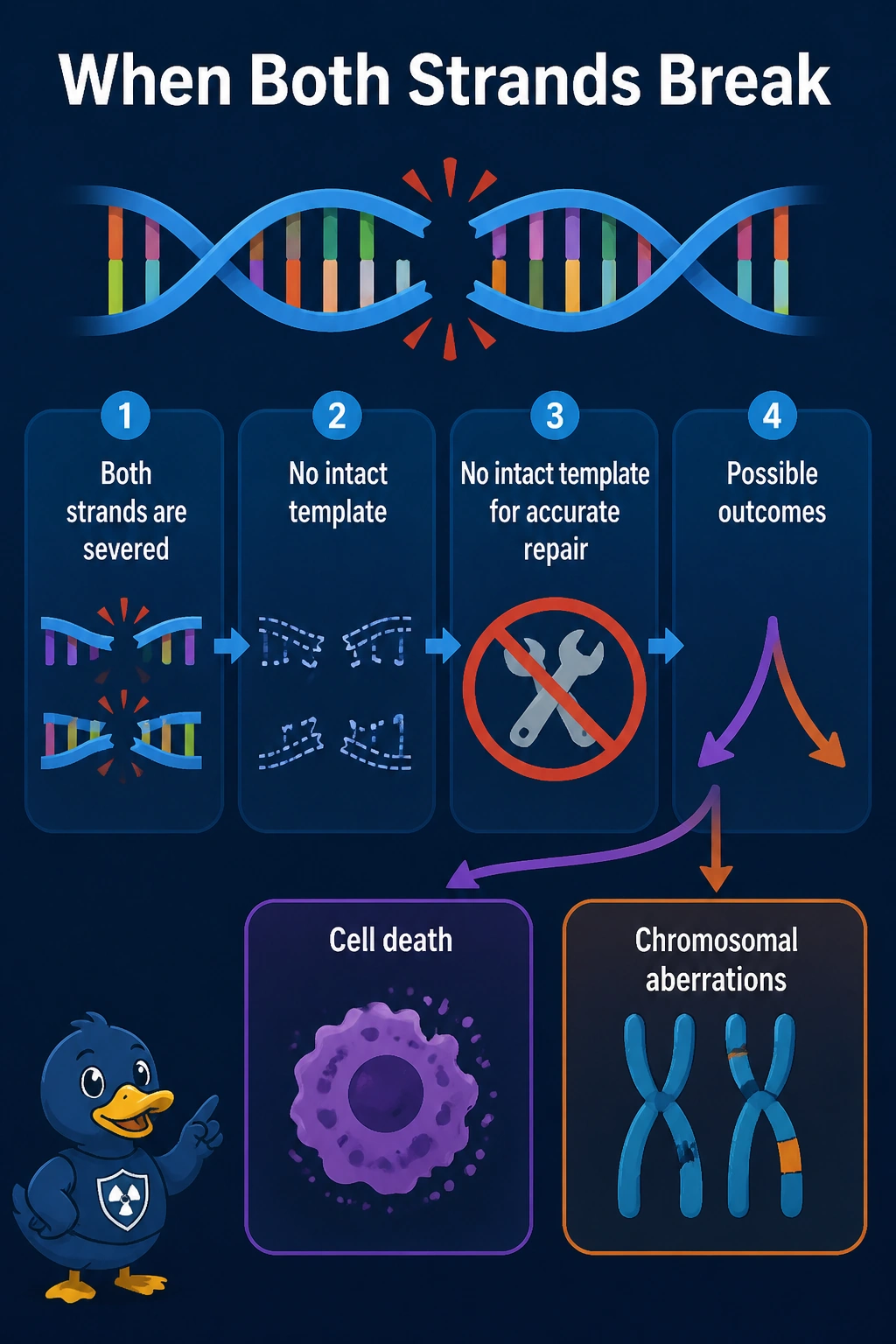
Imagine tearing one rail of a ladder versus snapping both rails in the same spot: one broken rail can be rebuilt using the other side as a guide. When you compare DNA lesions, the trap is forgetting why a missing complementary template turns a repairable nick into a lethal break.
Full Explanation
A single-strand break leaves the opposite DNA strand intact, allowing cellular repair enzymes to use that complementary sequence as an accurate template to restore the original base sequence. When ionizing radiation produces a double-strand break, Both strands are severed, leaving no intact template for accurate repair, which frequently results in misrejoining, chromosomal deletions, or reproductive cell death. Single-strand breaks cannot occur in mammalian cells exposed to low-LET gamma rays is incorrect because low-LET radiation actually produces far more single-strand breaks than double-strand breaks. Double-strand breaks permanently ionize surrounding water molecules in the cytoplasm fails because water radiolysis creates short-lived free radicals that cause DNA damage, rather than DNA breaks ionizing water permanently. Cellular repair enzymes only recognize damage occurring during the mitotic phase is wrong because DNA repair pathways operate primarily during interphase, especially before and during DNA replication. As a caveat, cells do possess non-homologous end joining and homologous recombination mechanisms for double-strand breaks, though error-prone repair remains common. In radiation biology assessments, track high-LET exposure risks carefully because dense ionization tracks cluster breaks on both strands.
Prefer to study offline? Printable PDF study book + test engine ($7.50, unofficial). These questions stay free here.