
In setting occupational and public radiation protection standards for low-dose, low-dose-rate exposures, regulatory agencies such as the NRC rely on the Linear No-Threshold (LNT) model. What does the LNT model assume about stochastic health effects?
Select an answer to reveal the explanation.
Short Explanation
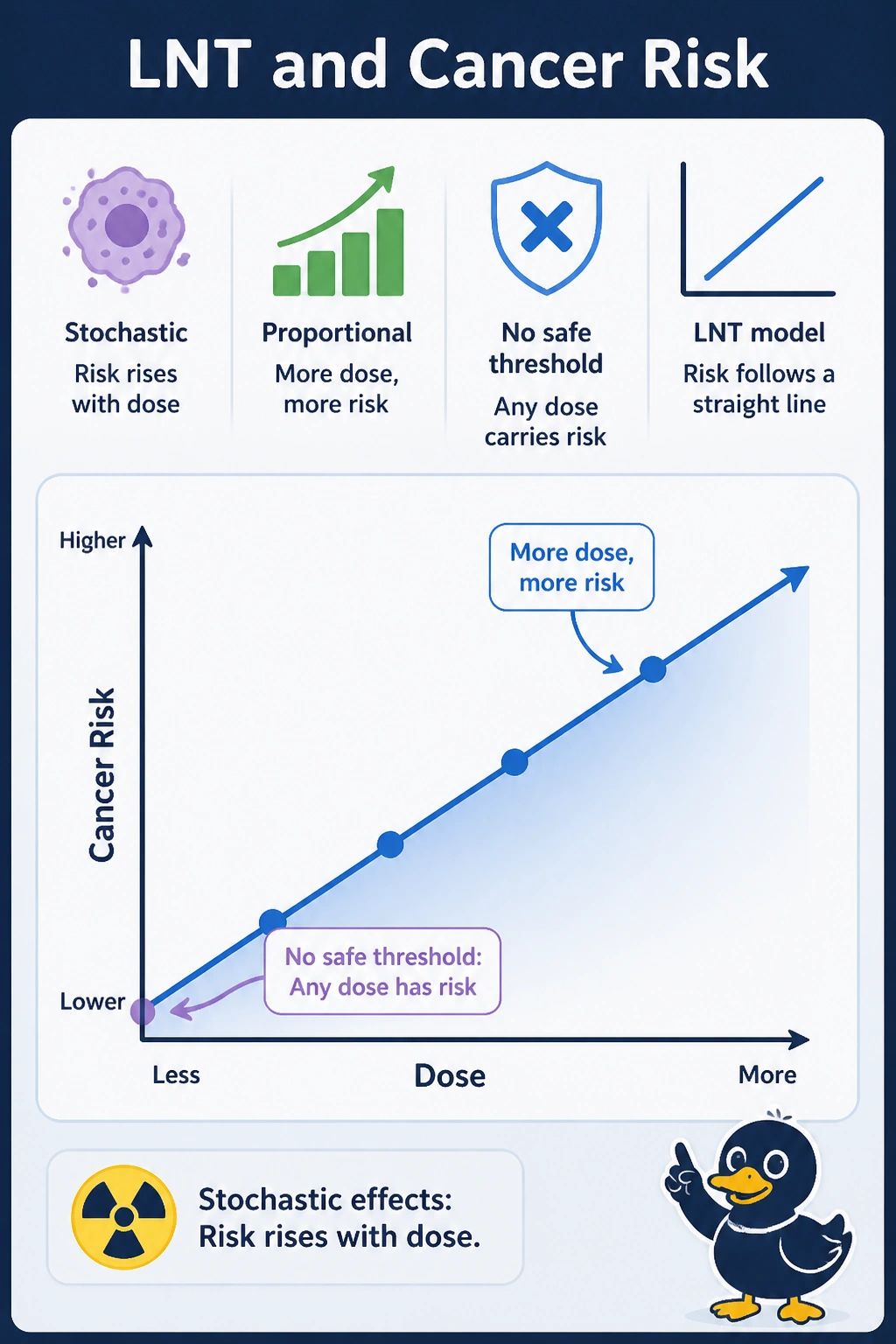
The Linear No-Threshold model draws a straight line from high-dose cancer data all the way down to zero, meaning any dose carries some small risk. Under this conservative framework, your protection standards assume cancer risk is proportional to dose with no safe threshold. The trap is mixing up stochastic cancer risk with threshold-based deterministic tissue injury.
Full Explanation
The Linear No-Threshold (LNT) model is the foundational dose-response assumption used by regulatory bodies like the NRC to set conservative occupational and public dose limits. It extrapolates stochastic health risks linearly from observed high-dose epidemiological data down to zero dose, assuming that "Cancer risk is proportional to dose with no safe threshold" and that every incremental dose adds a proportional increment of probability. "Deterministic tissue injury occurs at any measurable radiation dose" is incorrect because deterministic effects (such as erythema or cataracts) require exceeding a biological threshold dose before clinical symptoms appear. "Low-dose exposures below 100 mSv stimulate protective DNA repair" describes the radiation hormesis hypothesis, which is not adopted by NRC regulations. "Radiation risk increases exponentially above a 50 mSv threshold" describes neither a linear model nor a threshold-free model. As an important regulatory caveat, LNT is a conservative radiation protection policy tool rather than a proven biological fact at very low doses, and it underpins the ALARA requirement. For an operational check, ensure routine dosimetry reviews track cumulative occupational doses against both regulatory limits and site ALARA administrative action levels.
Prefer to study offline? Printable PDF study book + test engine ($7.50, unofficial). These questions stay free here.