
On a chart of the nuclides, stable nuclei with atomic numbers above 20 contain progressively more neutrons than protons. What fundamental nuclear physics principle explains this rising neutron-to-proton ratio?
Select an answer to reveal the explanation.
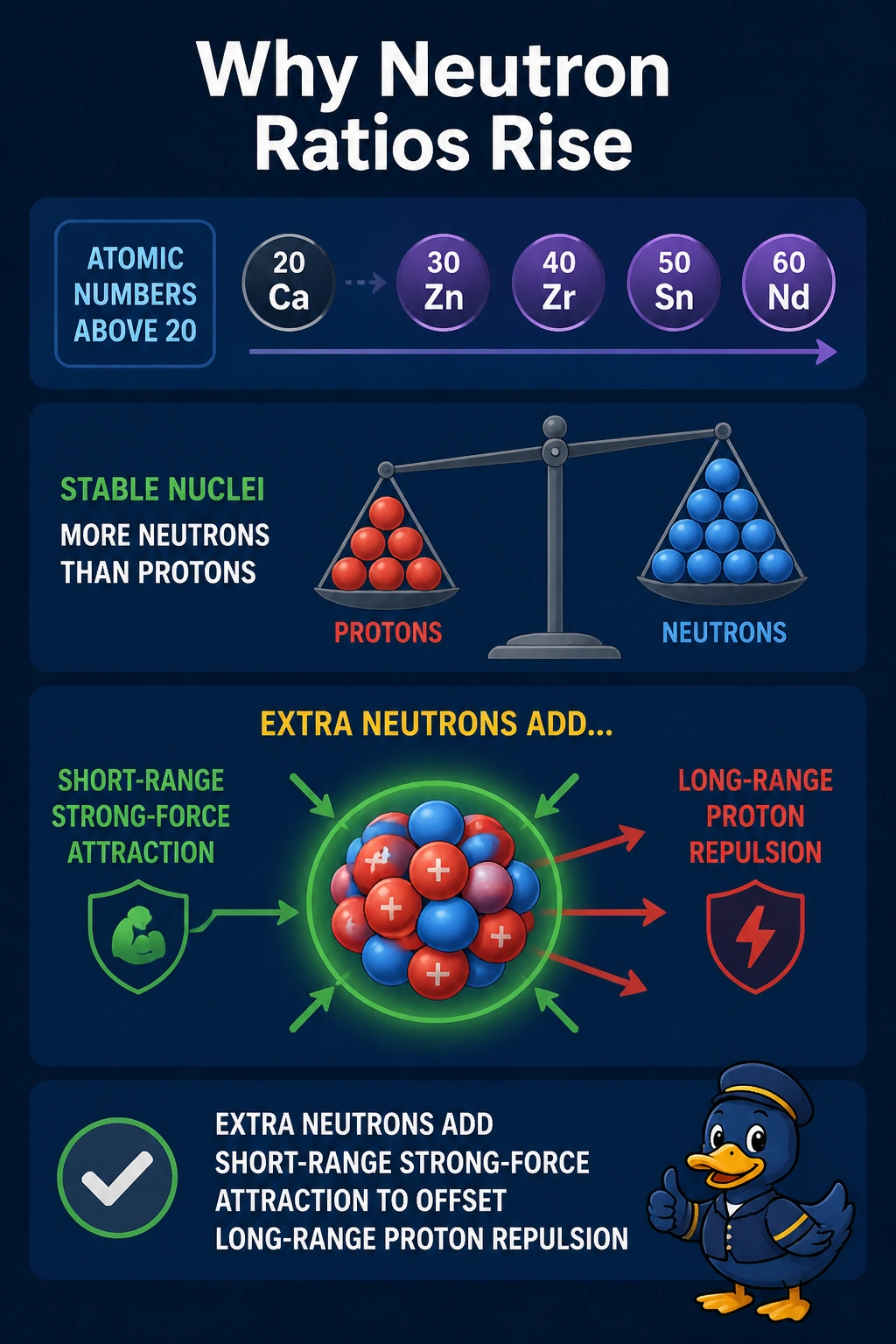
Short Explanation
Inside a heavy nucleus, protons are constantly pushing each other apart with electric repulsion, while the strong nuclear force only reaches next-door neighbors. Adding extra neutrons gives you more strong-force glue without adding more electric push. The trap is thinking neutrons carry a negative charge or weigh less than protons.
Full Explanation
As atomic number increases above roughly 20, stable nuclei require an increasing excess of neutrons over protons because Extra neutrons add short-range strong-force attraction to offset long-range proton repulsion. Every proton in the nucleus repels every other proton via the long-range electrostatic (Coulomb) force, whereas the attractive strong nuclear force acts only between adjacent nucleons; adding electrically neutral neutrons increases nuclear binding without adding Coulomb repulsion. Choosing Protons have a slightly larger rest mass than neutrons, making neutron-rich nuclei lighter is factually backwards, as a free neutron is slightly more massive than a free proton. Selecting Electrons orbiting the K-shell capture excess protons unless neutrons shield the outer shells is incorrect because atomic electrons do not capture protons to stabilize the nucleus, and neutrons do not shield electron shells. Claiming Neutrons carry a slight negative charge that cancels the positive charge of inner-core protons is false because neutrons have zero net electric charge. As an exam caveat, remember that while light stable nuclei sit near a 1:1 neutron-to-proton ratio, heavy stable nuclei like lead-208 approach a 1.5:1 ratio. As an operational check, trace the line of stability on a chart of the nuclides to confirm how beta-minus emitters lie above it and positron emitters lie below it.
Prefer to study offline? Printable PDF study book + test engine ($7.50, unofficial). These questions stay free here.