
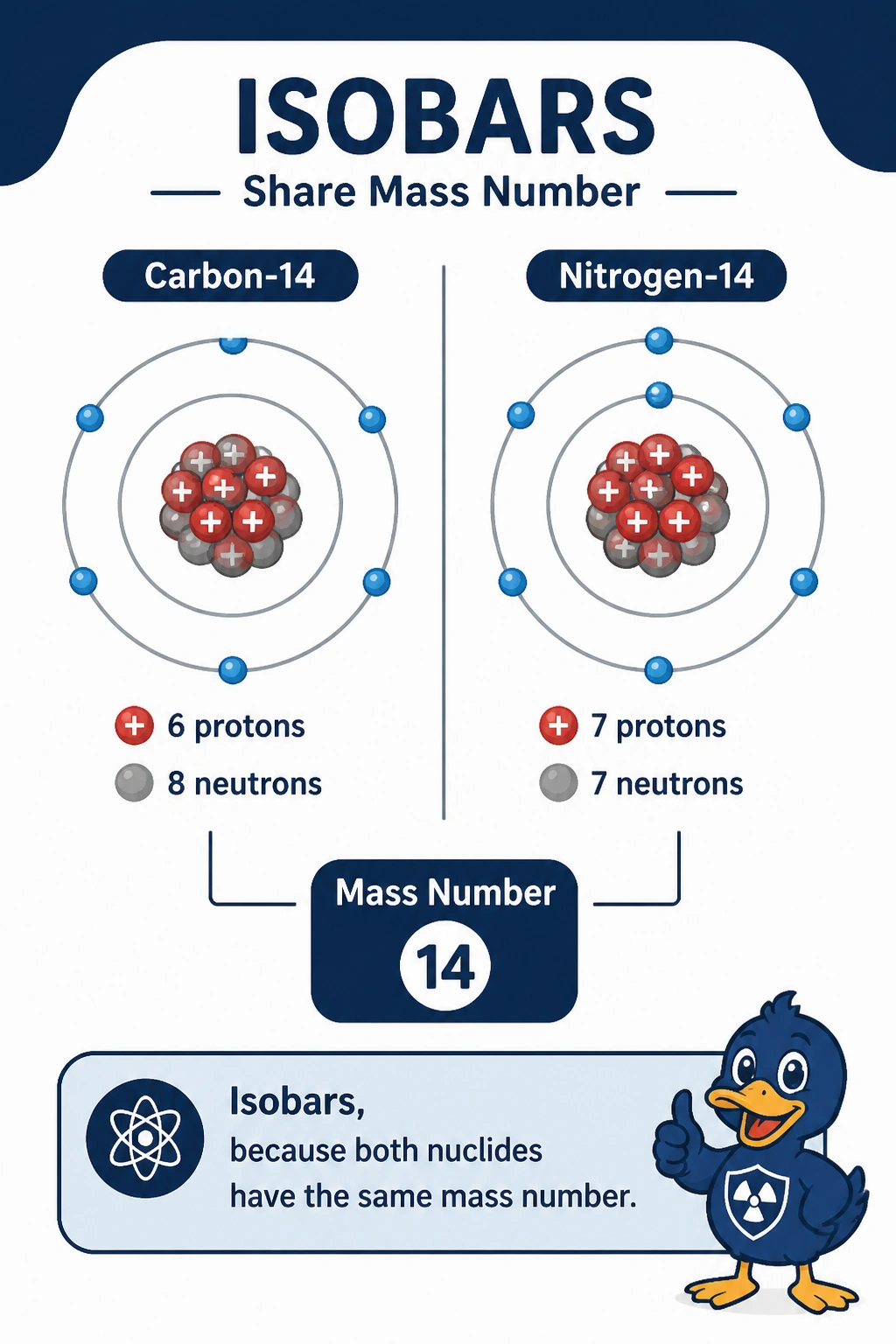
A health physicist compares Carbon-14 (6 protons, 8 neutrons) and Nitrogen-14 (7 protons, 7 neutrons) while reviewing beta-minus decay products. Which nuclear classification describes this pair of nuclides?
Select an answer to reveal the explanation.
Short Explanation
When a nucleus undergoes beta-minus decay, a neutron flips into a proton while the total nucleon count stays locked. Keep your nuclear vocabulary sharp so you do not mix up shared mass number with shared protons or neutrons.
Full Explanation
Carbon-14 has 6 protons and 8 neutrons (mass number 14), and Nitrogen-14 has 7 protons and 7 neutrons (mass number 14). Nuclides of different elements that share the same total number of nucleons are classified as Isobars, because both nuclides have the same mass number. Beta-minus decay always produces an isobaric transition because a neutron converts to a proton, keeping the mass number constant. Calling them Isotopes, because both nuclides have the same number of protons fails because carbon (Z = 6) and nitrogen (Z = 7) have different proton counts. Labeling them Isotones, because both nuclides have the same number of neutrons is wrong because Carbon-14 has 8 neutrons while Nitrogen-14 has 7 neutrons. Selecting Nuclear isomers, because both nuclides share an identical excited state is incorrect because isomers are different energy states of the exact same nuclide with identical proton and neutron numbers, such as Technetium-99m and Technetium-99. As a caveat, isobars have nearly identical atomic masses, though small mass differences drive beta decay from the less stable to the more stable member. As an operational check, sum the protons and neutrons on a chart of the nuclides to confirm diagonal beta-decay chains preserve mass number along an isobar line.
Prefer to study offline? Printable PDF study book + test engine ($7.50, unofficial). These questions stay free here.