
On a chart of the nuclides, a fission product lies above the belt of stability because it has an excess of neutrons relative to protons. Which radioactive decay mode moves this nucleus toward the line of stability?
Select an answer to reveal the explanation.
Short Explanation
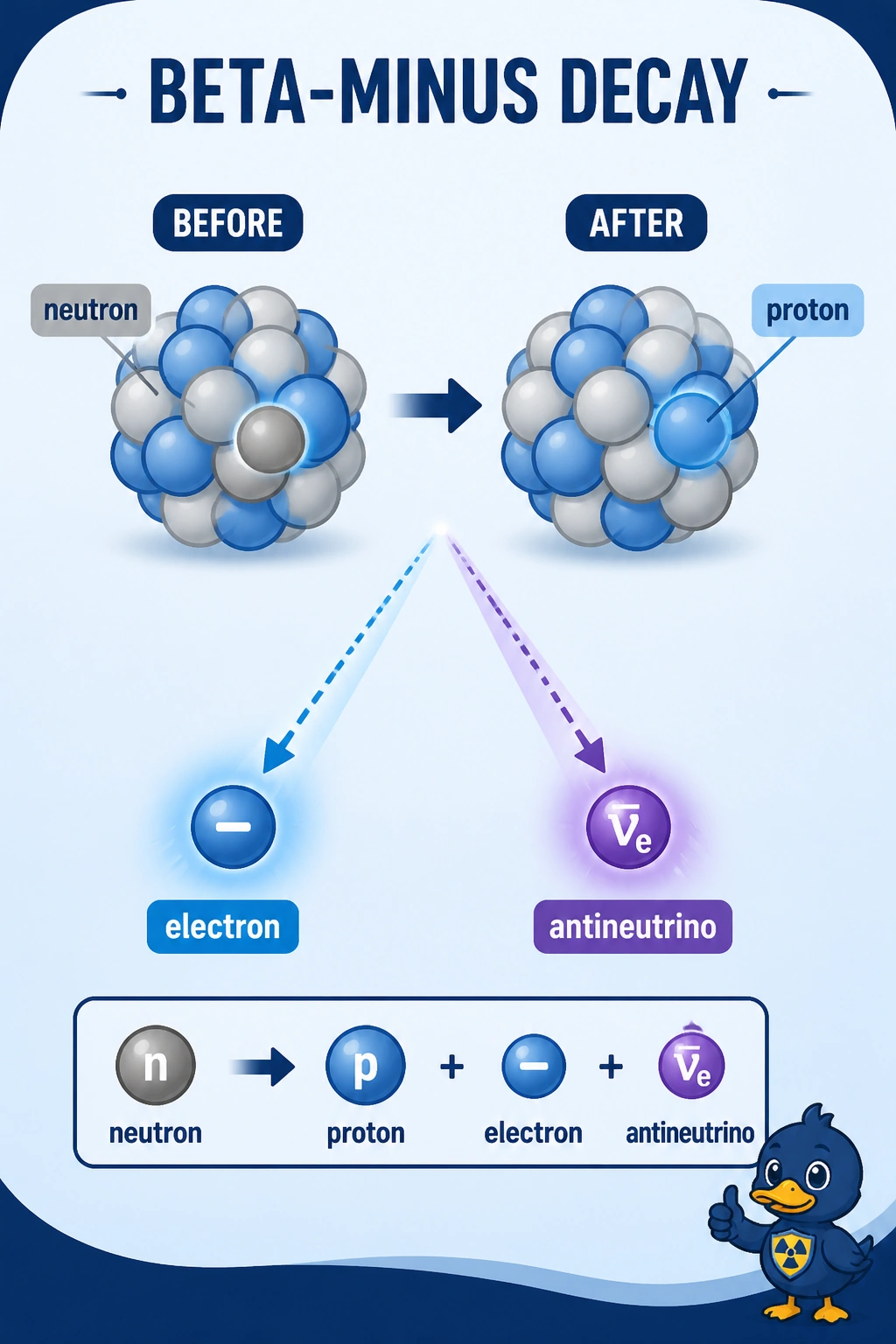
When a fission product has too many neutrons for its proton count, it needs to trade a neutron for a proton to get back onto the belt of stability. Beta-minus decay makes that exact swap for you, raising the atomic number by one while keeping the mass number the same. Watch out for the trap of picking positron emission or electron capture, which do the opposite and push a neutron-rich nucleus further from stability.
Full Explanation
On the Segre chart of the nuclides, stable light nuclei have roughly equal numbers of neutrons and protons, while heavier stable nuclei require a higher neutron-to-proton ratio. Selecting "Beta-minus decay, which converts a neutron into a proton while emitting an electron and an antineutrino" correctly identifies the mechanism that lowers the neutron-to-proton ratio, stepping the nucleus diagonally down and to the right toward the belt of stability. Choosing "Positron emission, which converts a proton into a neutron while emitting a positron" moves a nucleus in the wrong direction, increasing the neutron excess; positron emission occurs in proton-rich nuclides below the stability belt. Picking "Electron capture, which combines an inner orbital electron with a nuclear proton" also converts a proton into a neutron and is limited to proton-rich nuclides. Selecting "Isomeric transition, which releases a gamma photon from an excited nuclear state" only sheds excess nuclear excitation energy without changing the neutron or proton count. As a caveat, beta-minus decay is often followed immediately by prompt gamma emission if the daughter nucleus is left in an excited state. As an operational check, consult a nuclide chart or decay scheme to verify whether beta-only or mixed beta-gamma instrumentation is needed when surveying fission products.
Prefer to study offline? Printable PDF study book + test engine ($7.50, unofficial). These questions stay free here.