
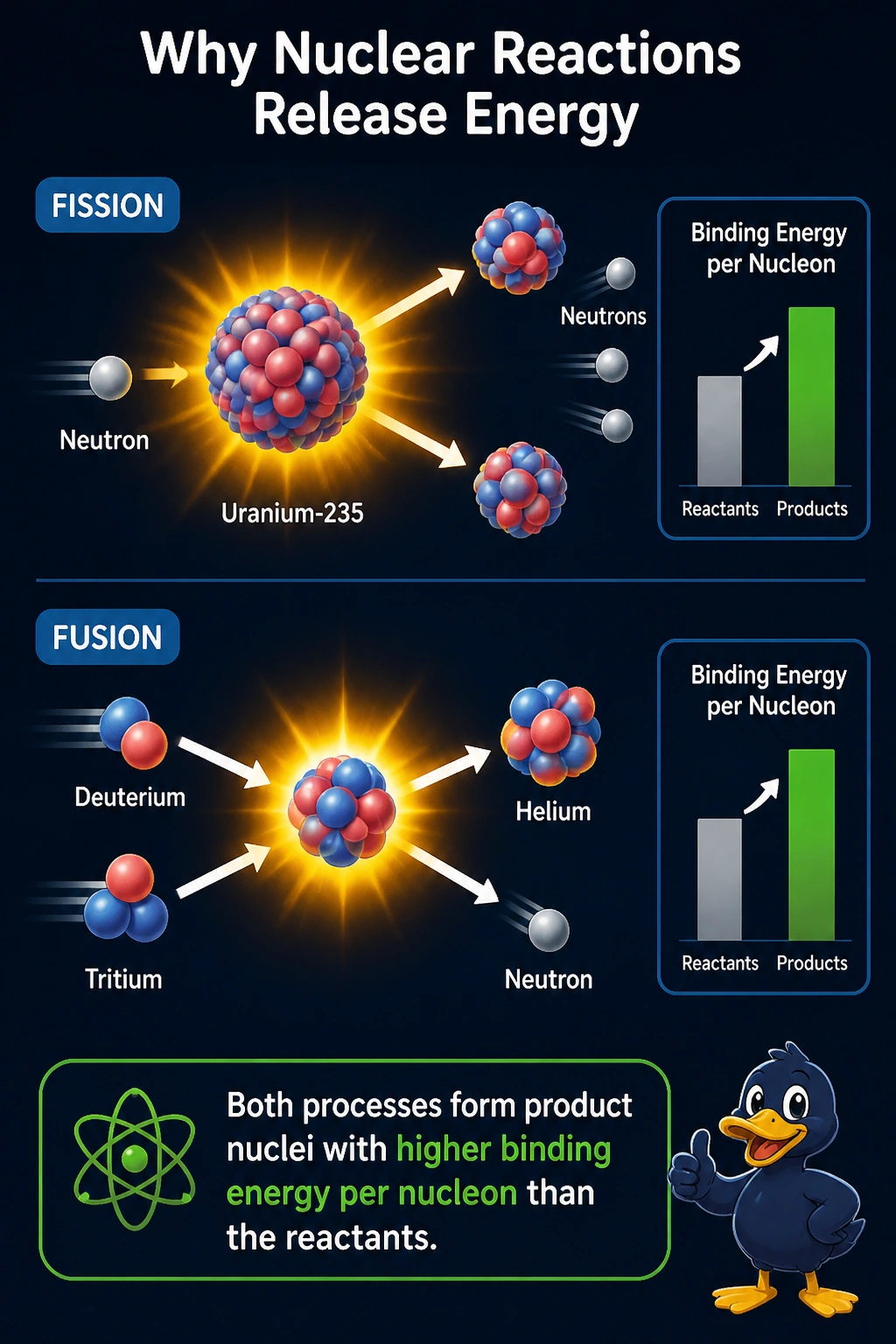
Why do both the nuclear fission of heavy nuclides like Uranium-235 and the nuclear fusion of light nuclides like deuterium and tritium release large amounts of energy?
Select an answer to reveal the explanation.
Short Explanation
Think of the binding energy per nucleon curve as a valley with iron and nickel at the bottom: whether you roll down from the light-element side or the heavy-element side, you move toward tighter nuclear binding. Both fission and fusion release energy because the products have higher binding energy per nucleon and slightly less total mass. Watch out for the trap of confusing higher binding energy with lower stability or unchanged mass.
Full Explanation
Nuclear binding energy per nucleon peaks near mass number 56 to 62 and is lower for both very light nuclei and very heavy nuclei. Selecting Both processes form product nuclei with higher binding energy per nucleon than the reactants is correct because moving toward the peak of the curve increases total nuclear binding energy, which corresponds to a decrease in total rest mass (mass defect) that is released as kinetic energy and radiation via E = mc^2. Selecting Both processes conserve total nuclear mass while converting orbital electrons into gamma rays is wrong because nuclear reactions do not conserve rest mass and the released energy comes from nuclear mass defect, not orbital electrons. Selecting Both processes produce daughter nuclei with lower binding energy per nucleon than the reactants reverses the energy balance; moving to lower binding energy per nucleon would require an input of energy rather than releasing it. Selecting Both processes convert protons into neutrons while keeping the total nuclear mass unchanged is incorrect because fission splits a heavy nucleus without requiring mass conservation, and fusion combines light nuclei with a measurable mass decrease. As an exam caveat, remember that higher binding energy per nucleon means a more tightly bound, lower-mass-per-nucleon nucleus. As an operational check, use mass excess or atomic mass tables rather than integer mass numbers when calculating Q-values for nuclear reactions.
Prefer to study offline? Printable PDF study book + test engine ($7.50, unofficial). These questions stay free here.