
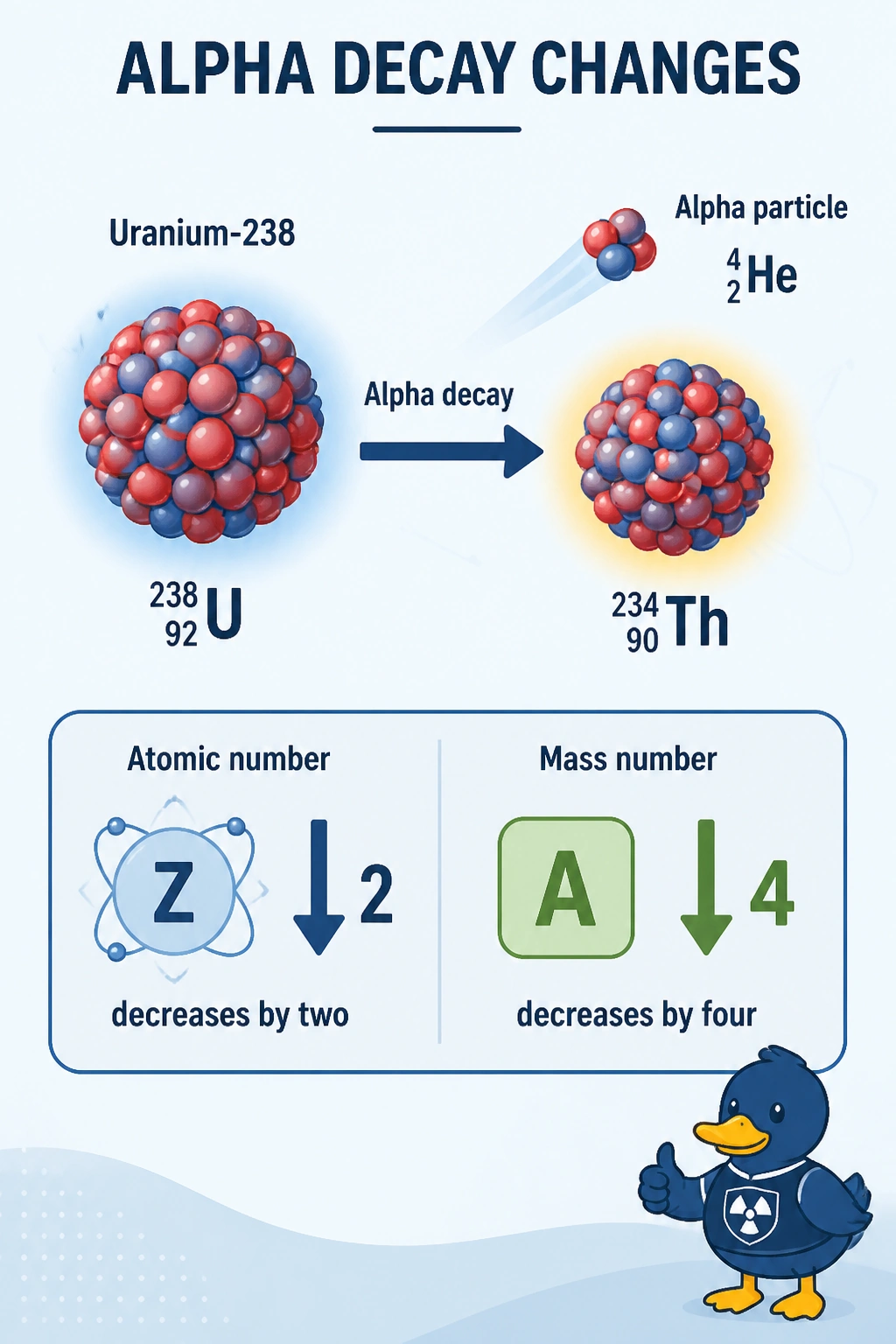
When a heavy radionuclide such as Uranium-238 undergoes alpha decay, how do the atomic number and mass number of the resulting daughter nucleus compare with the parent nucleus?
Select an answer to reveal the explanation.
Short Explanation
An alpha particle is simply a helium-4 nucleus—two protons and two neutrons—packing up and leaving the parent atom. Because you lose two protons and four total nucleons, your daughter drops by two in atomic number and four in mass number; the trap is swapping those two numbers.
Full Explanation
Alpha decay ejects a Helium-4 nucleus composed of two protons and two neutrons, which reduces the proton count by two and the total nucleon count by four, so Atomic number decreases by two and mass number decreases by four. Choosing Atomic number decreases by four and mass number decreases by two reverses the proton count and total nucleon count of the emitted alpha particle. Selecting Atomic number remains unchanged and mass number decreases by four ignores the loss of two positively charged protons, which would leave the element's chemical identity unchanged. Picking Atomic number decreases by one and mass number remains unchanged describes positron emission or electron capture, where a proton converts into a neutron without changing total nucleon count. As a caveat, alpha decay often leaves the daughter nucleus in an excited state that promptly de-excites by emitting a gamma photon or conversion electron, so alpha emitters are not always pure alpha sources. When verifying decay-chain progeny on a chart of the nuclides, always subtract two from Z and four from A for each alpha step before looking up the daughter's half-life and gamma emissions.
Prefer to study offline? Printable PDF study book + test engine ($7.50, unofficial). These questions stay free here.