
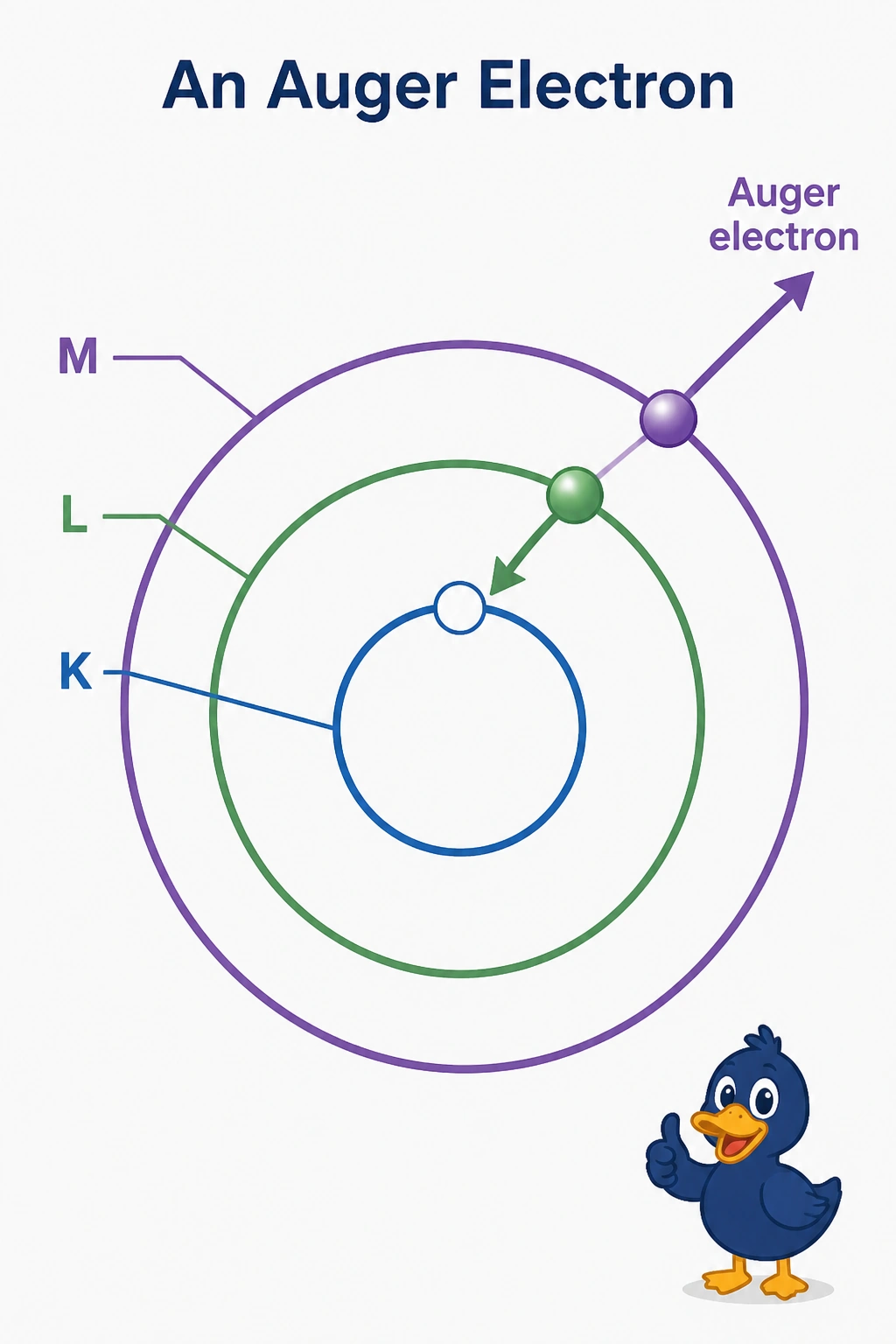
After electron capture creates a vacancy in an atom's K-shell, an L-shell electron drops into the vacancy, and the released binding energy ejects an M-shell electron instead of emitting a characteristic X-ray. What is this ejected orbital electron called?
Select an answer to reveal the explanation.
Short Explanation
When an inner electron drops down, the atom can either flash a characteristic X-ray or hand that energy straight to another orbital electron to kick it out. If you see a kicked-out orbital electron instead of an X-ray, you are looking at an Auger electron; the trap is confusing it with a nuclear beta particle or Compton scatter.
Full Explanation
Following an inner-shell vacancy from electron capture or photoelectric absorption, atomic relaxation occurs either by emitting a characteristic X-ray or by radiationless energy transfer to an outer orbital electron, which is ejected with discrete kinetic energy. This ejected orbital electron is called An Auger electron, and the process dominates in low-atomic-number elements. It is distinct from A Compton recoil electron, which is ejected when an external incident gamma or X-ray photon scatters inelastically off a loosely bound atomic electron. It is also not A beta-minus particle, because beta-minus decay originates inside an unstable nucleus when a neutron converts to a proton, producing a continuous energy spectrum along with an antineutrino. Finally, A pair-production positron is created alongside an electron when a photon of at least 1.022 MeV interacts with a nuclear electric field, not during atomic shell relaxation. As a caveat, Auger electrons have very short ranges and deposit energy intensely within nanometers, which is important in microdosimetry for internal emitters like I-125. When calibrating detectors for electron-capture nuclides, account for both the low-energy X-rays and any Auger electrons able to penetrate the detector window.
Prefer to study offline? Printable PDF study book + test engine ($7.50, unofficial). These questions stay free here.