
During nuclear de-excitation of an excited daughter nucleus, a competing process called internal conversion occurs instead of gamma-ray emission. What is directly ejected from the atom during internal conversion?
Select an answer to reveal the explanation.
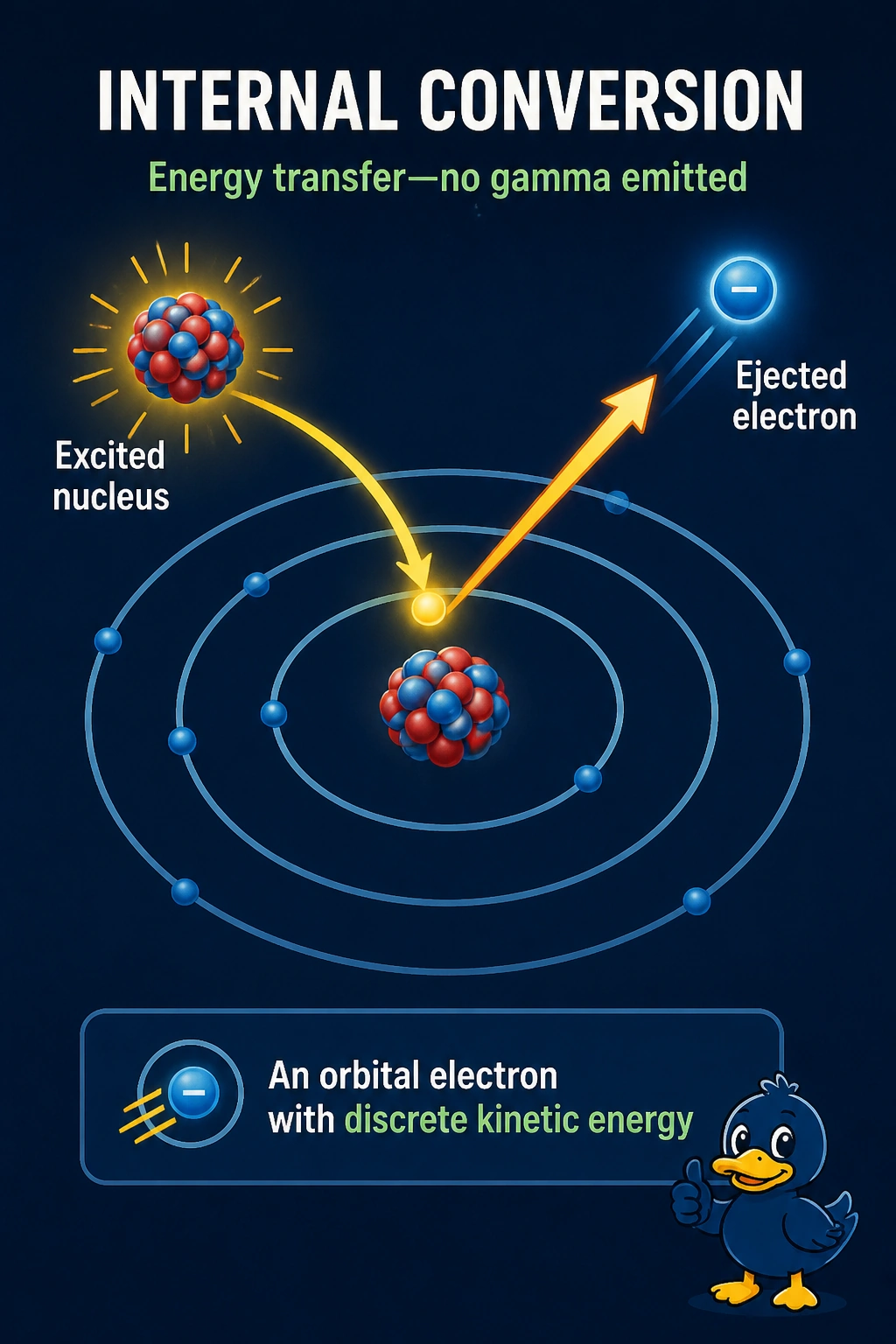
Short Explanation
In internal conversion, an excited nucleus skips emitting a gamma ray and hands its energy straight to one of its own orbital electrons. That gives you an orbital electron with discrete kinetic energy equal to the transition energy minus its binding energy. The trap is confusing this atomic ejection with beta decay, which comes from the nucleus with a continuous spectrum.
Full Explanation
Internal conversion is an electromagnetic de-excitation process that competes directly with gamma-ray emission when a nucleus drops from an excited state to a lower energy state. Rather than radiating a gamma photon, the nucleus transfers its discrete transition energy directly to an inner-shell electron, ejecting "An orbital electron with discrete kinetic energy" equal to the nuclear transition energy minus the electron's shell binding energy. Selecting "A nuclear positron paired with an electron neutrino" describes beta-plus decay, a weak-force nuclear transmutation that changes the atomic number rather than de-exciting an isomeric state. Selecting "A high-energy neutron from the excited target nucleus" describes neutron emission from compound nuclei or spontaneous fission, which alters the mass number. Selecting "A continuous-spectrum beta particle from the nucleus" describes beta-minus decay, where nuclear energy is shared between a beta particle and an antineutrino. As an important caveat, internal conversion leaves an inner-shell vacancy that promptly produces characteristic X-rays and Auger electrons, which must be accounted for in dosimetry and spectroscopy. For an operational check, review the radionuclide decay scheme to include conversion-electron and X-ray yields when calibrating beta-gamma survey instruments.
Prefer to study offline? Printable PDF study book + test engine ($7.50, unofficial). These questions stay free here.