
A health physicist compares the measured mass of a stable Helium-4 nucleus with the sum of the masses of two free protons and two free neutrons. Why is the assembled Helium-4 nucleus lighter than its separate constituent nucleons?
Select an answer to reveal the explanation.
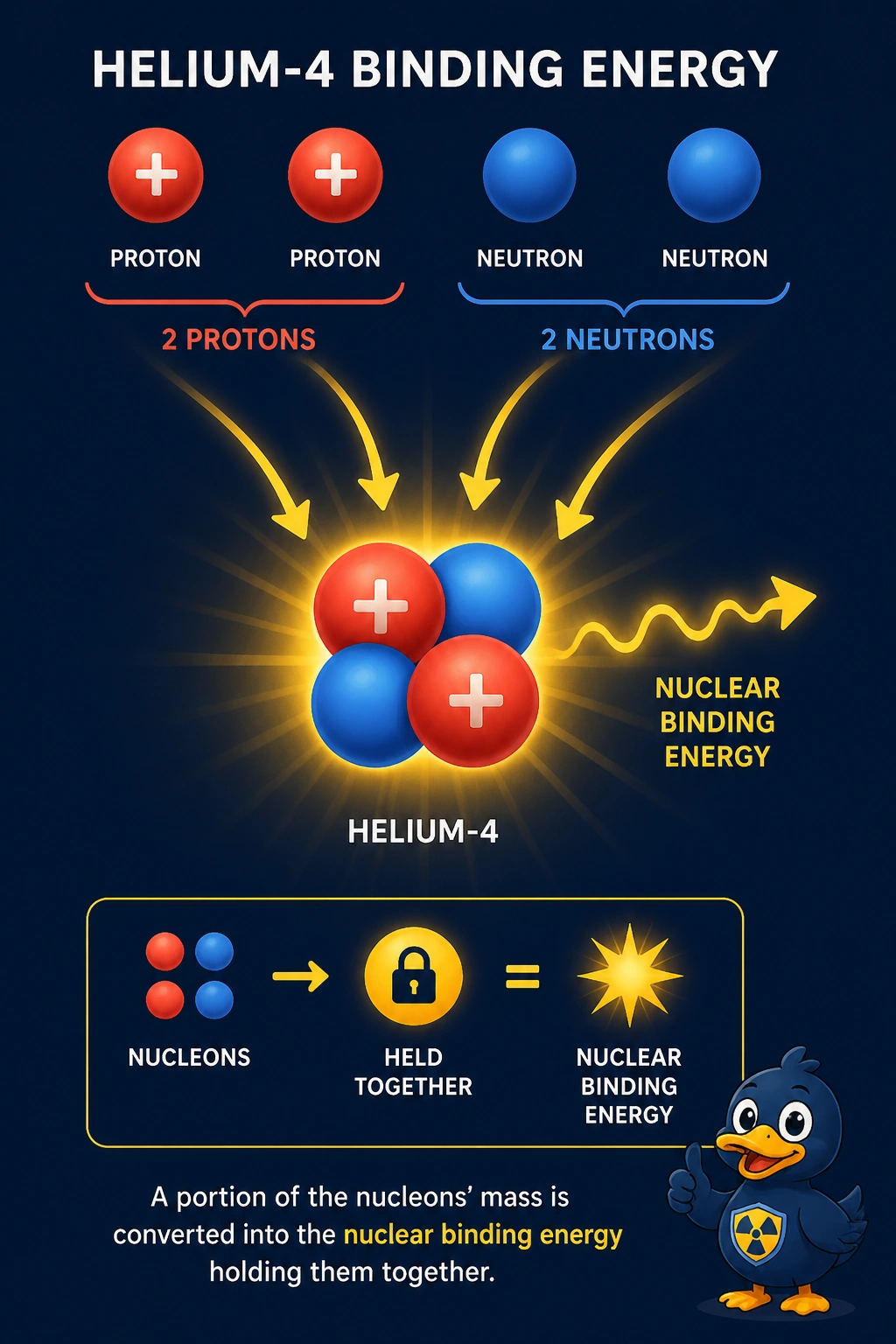
Short Explanation
Picture snapping strong magnets together: energy is released when they lock in place, and you have to supply energy to pry them apart again. Inside an atomic nucleus, that released energy comes directly from a tiny fraction of the nucleons' own mass via Einstein's mass-energy equivalence. Watch out for the trap of blaming electrostatic repulsion or orbital electrons for a purely nuclear mass defect.
Full Explanation
When free protons and neutrons fuse to form a bound nucleus such as Helium-4, the strong nuclear force binds them into a lower-energy configuration. By mass-energy equivalence (E = mc²), the energy released during formation corresponds to a measurable mass defect—the difference between the summed mass of the free nucleons and the smaller mass of the assembled nucleus. Consequently, "A portion of the nucleons' mass is converted into the nuclear binding energy holding them together." The distractor "Two orbital electrons are captured during assembly and annihilate an equal mass of nuclear protons." is wrong because orbital electrons are not annihilated to bind the nucleus. Likewise, "Neutrons lose rest mass when confined inside a nuclear potential well due to electrostatic repulsion." fails because neutrons are electrically neutral and do not experience electrostatic repulsion. The claim "The strong nuclear force converts excess proton charge into massless neutrinos emitted at formation." is false because total electric charge is strictly conserved in nuclear reactions. As a caveat, binding energy per nucleon peaks near iron-56, meaning both light-element fusion and heavy-element fission release energy by moving toward greater stability. As an operational check when reviewing Q-value calculations, verify that you use atomic or nuclear masses consistently without double-counting electron masses.
Prefer to study offline? Printable PDF study book + test engine ($7.50, unofficial). These questions stay free here.