
When an unstable radionuclide undergoes beta-minus decay by emitting an electron and an antineutrino from its nucleus, how do its mass number and atomic number change?
Select an answer to reveal the explanation.
Short Explanation
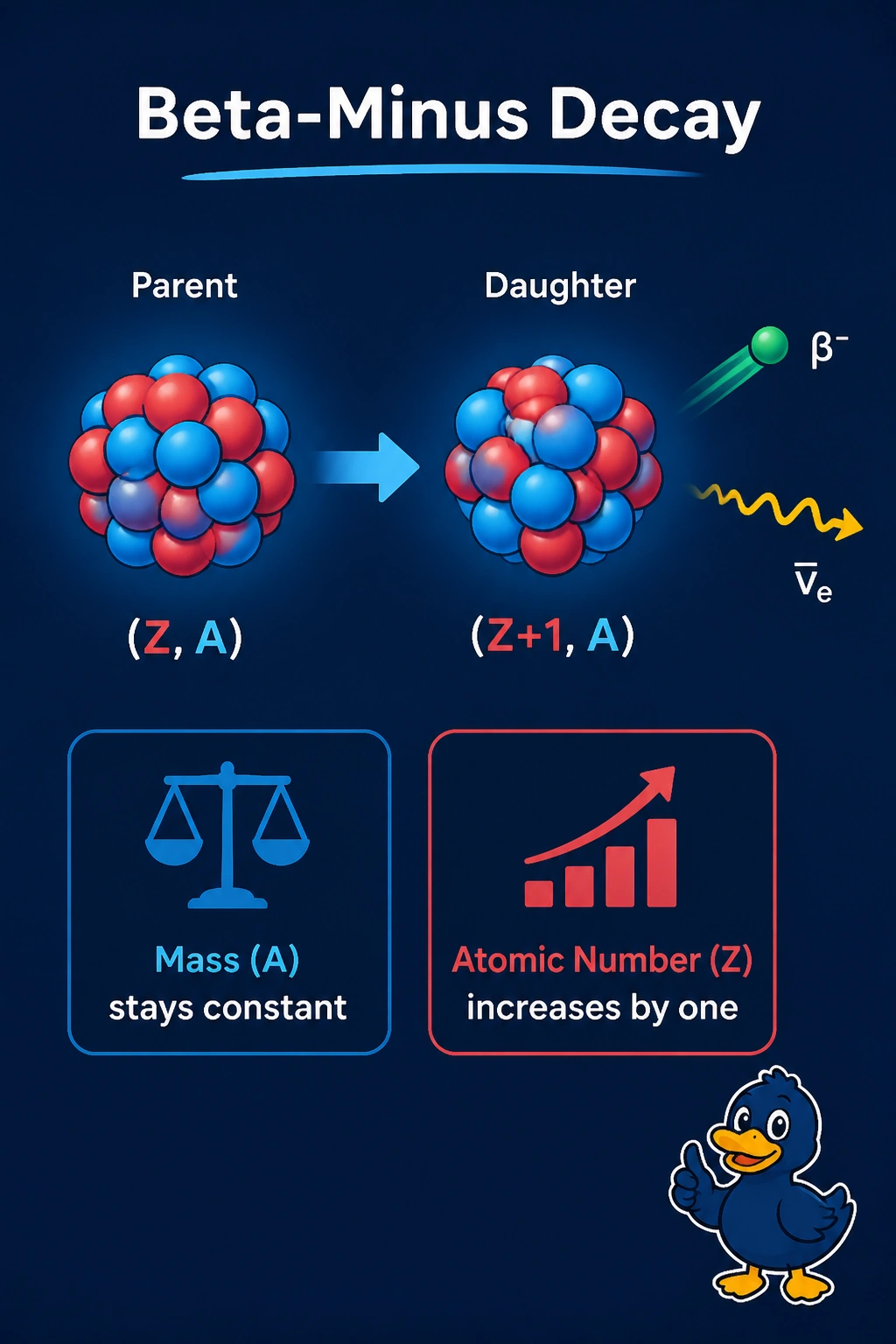
In beta-minus decay, a neutron inside the nucleus trades its neutral charge for a positive one by kicking out a negative electron. That means your total nucleon count stays the same, while the proton count ticks up by one. The classic trap is mixing this up with positron emission, where the atomic number drops instead.
Full Explanation
During beta-minus decay, a neutron inside a neutron-rich nucleus transforms into a proton while emitting a high-speed electron (beta particle) and an electron antineutrino. Because one nucleon simply changes identity from a neutron to a proton, the total number of nucleons—the mass number—remains unchanged, while the addition of a proton causes the atomic number to rise by one, matching Mass stays constant; atomic number increases by one. Selecting Mass decreases by four; atomic decreases by two describes alpha decay, where the nucleus ejects a helium-4 nucleus containing two protons and two neutrons. Selecting Mass stays constant; atomic decreases by one describes beta-plus (positron) decay or electron capture, in which a proton converts into a neutron. Selecting Mass increases by one; atomic stays constant describes neutron absorption (such as an (n, gamma) reaction) rather than radioactive decay. As a caveat, while the mass number stays constant, the daughter nuclide has a slightly lower total rest mass than the parent, with the mass difference released as decay energy. Operationally, knowing that beta-minus decay shifts an isotope up one element helps technologists anticipate daughter ingrowth and chemical behavior in bioassay or effluent samples.
Prefer to study offline? Printable PDF study book + test engine ($7.50, unofficial). These questions stay free here.