
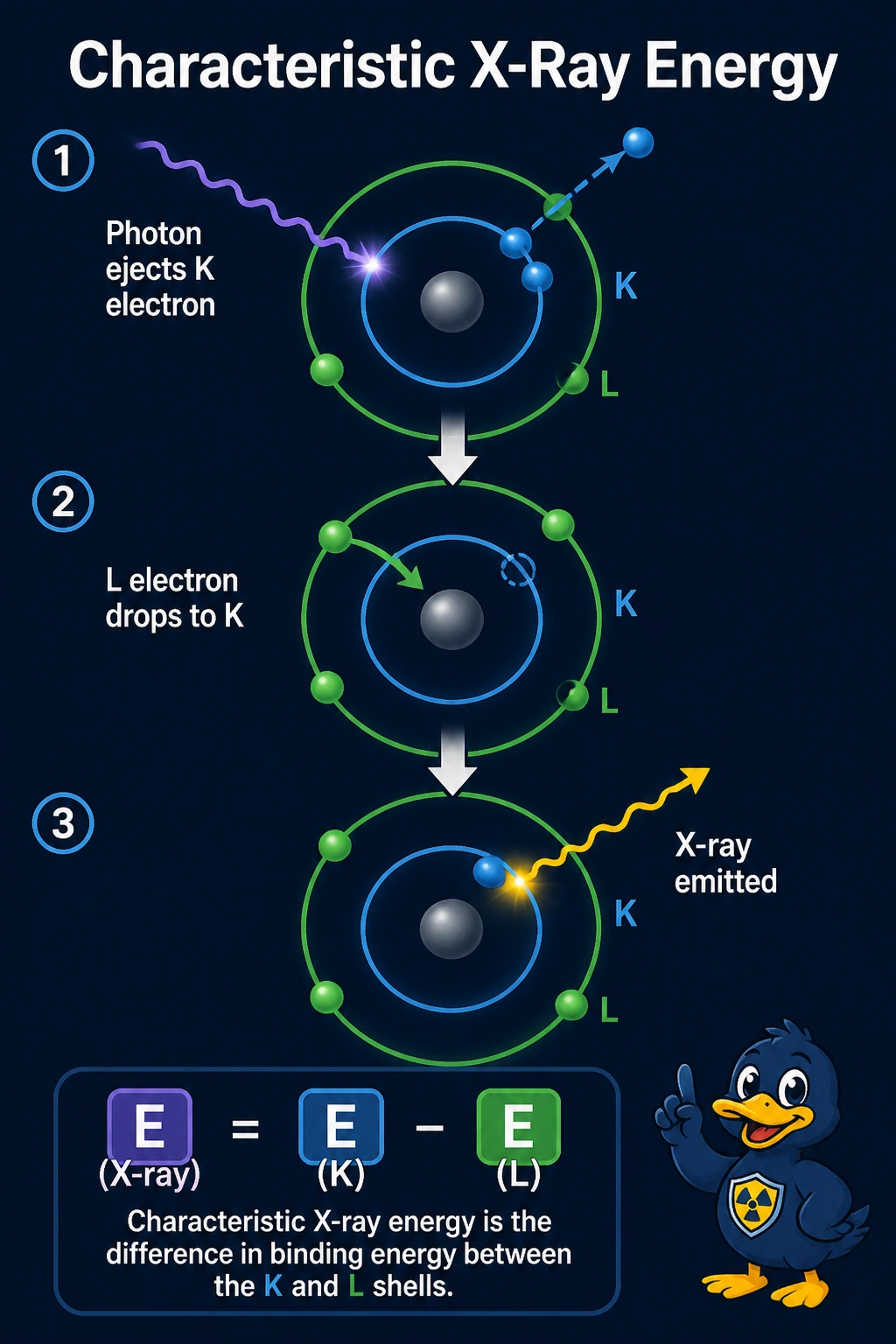
When an incident photon ejects a K-shell electron from an atom and an L-shell electron drops into the vacancy, what determines the energy of the emitted characteristic X-ray?
Select an answer to reveal the explanation.
Short Explanation
Characteristic X-rays work like a musical fingerprint because each element has its own fixed set of electron shell binding energies. When you look at the emitted photon energy, the trap is tying it to the incoming particle's energy rather than the fixed step between the two atomic shells.
Full Explanation
An atom's orbital electrons occupy discrete energy levels fixed by its atomic number, so when an outer-shell electron fills an inner-shell vacancy, the emitted photon carries The difference in binding energy between the two shells. Because those shell energies are unique to each element, the resulting X-rays identify the target material. The kinetic energy of the incident ionizing particle must exceed the inner shell's binding energy to create the initial vacancy, but any excess energy leaves with the ejected photoelectron rather than appearing in the characteristic X-ray. The nuclear binding energy per nucleon of the target nucleus governs nuclear stability and fission or fusion energetics, not atomic electron transitions. The mass number of the target nucleus counts protons plus neutrons and does not determine atomic orbital binding energies. As a physics caveat, the atom does not always emit a characteristic X-ray; especially in low-Z elements, the transition energy can instead eject an outer-shell Auger electron. In practice, verify element identification on a calibrated photon spectrometer by matching measured photopeaks to tabulated K-alpha and K-beta transition energies.
Prefer to study offline? Printable PDF study book + test engine ($7.50, unofficial). These questions stay free here.