
A radiation protection technologist reviewing beta-gamma spectroscopy data notes that alpha emitters produce sharp, discrete energy peaks, whereas pure beta-minus emitters exhibit a broad, continuous energy distribution up to a maximum endpoint energy. What fundamental decay mechanism accounts for the continuous energy spectrum of beta-minus particles?
Select an answer to reveal the explanation.
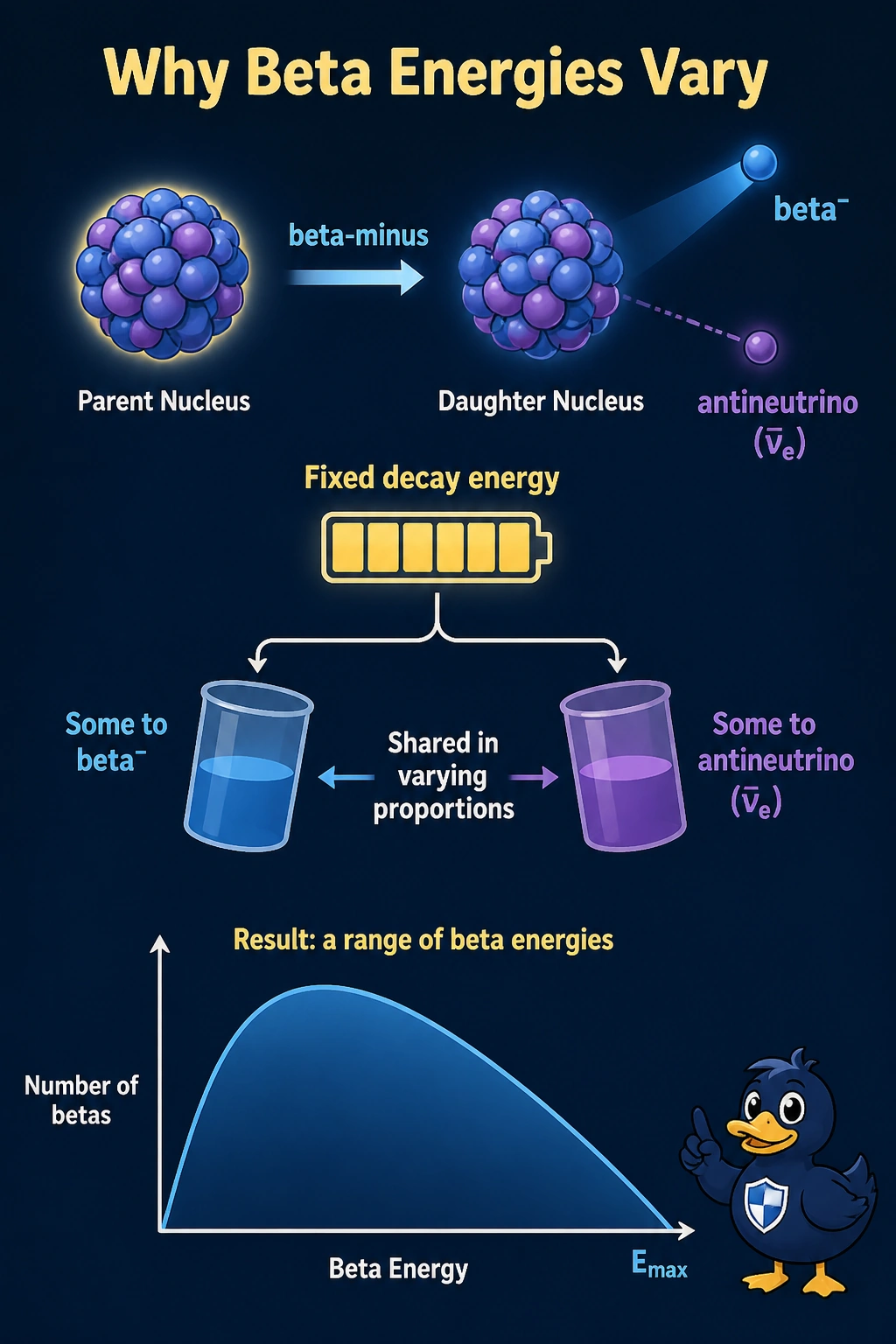
Short Explanation
Think of beta-minus decay like two people splitting a fixed check—when one pays more, the other pays less. Because the transition energy is shared in varying proportions between the beta particle and an antineutrino, your detector sees a continuous spectrum up to the endpoint energy. Don't fall for the trap of blaming source self-absorption or orbital electron deflection; even an isolated atom produces this continuous beta spectrum.
Full Explanation
In beta-minus decay, a neutron converts into a proton while emitting an electron and an antineutrino, creating a three-body final state. The fixed decay energy is shared in varying proportions between the emitted beta particle and an antineutrino. Because the two light leptons split the transition energy statistically while the heavy daughter takes negligible recoil, beta particles emerge from near zero up to the endpoint energy, unlike two-body alpha decay with discrete lines. It is a mistake to assume that Beta particles lose varying amounts of kinetic energy through self-absorption and bremsstrahlung inside the source matrix. Thick-source attenuation only modifies an already continuous spectrum. Likewise, it is wrong to claim that Orbital electrons in surrounding atomic shells deflect the departing beta particle and absorb random amounts of energy. External scattering happens after emission. Finally, nuclear physics rules out that The recoiling daughter nucleus emits variable-energy gamma photons that carry away random fractions of the transition energy. Nuclear gamma transitions occur between quantized levels and emit discrete energies. As a caveat, thick source matrices or detector windows still attenuate low-energy betas. For an operational check, verify your counter's lower-level discriminator with a calibrated beta check source before counting field smears.
Prefer to study offline? Printable PDF study book + test engine ($7.50, unofficial). These questions stay free here.