
A proton-rich radionuclide decays to a daughter nucleus whose mass-energy difference from the parent is 0.80 MeV. Why is electron capture energetically possible for this transition while positron emission is forbidden?
Select an answer to reveal the explanation.
Short Explanation
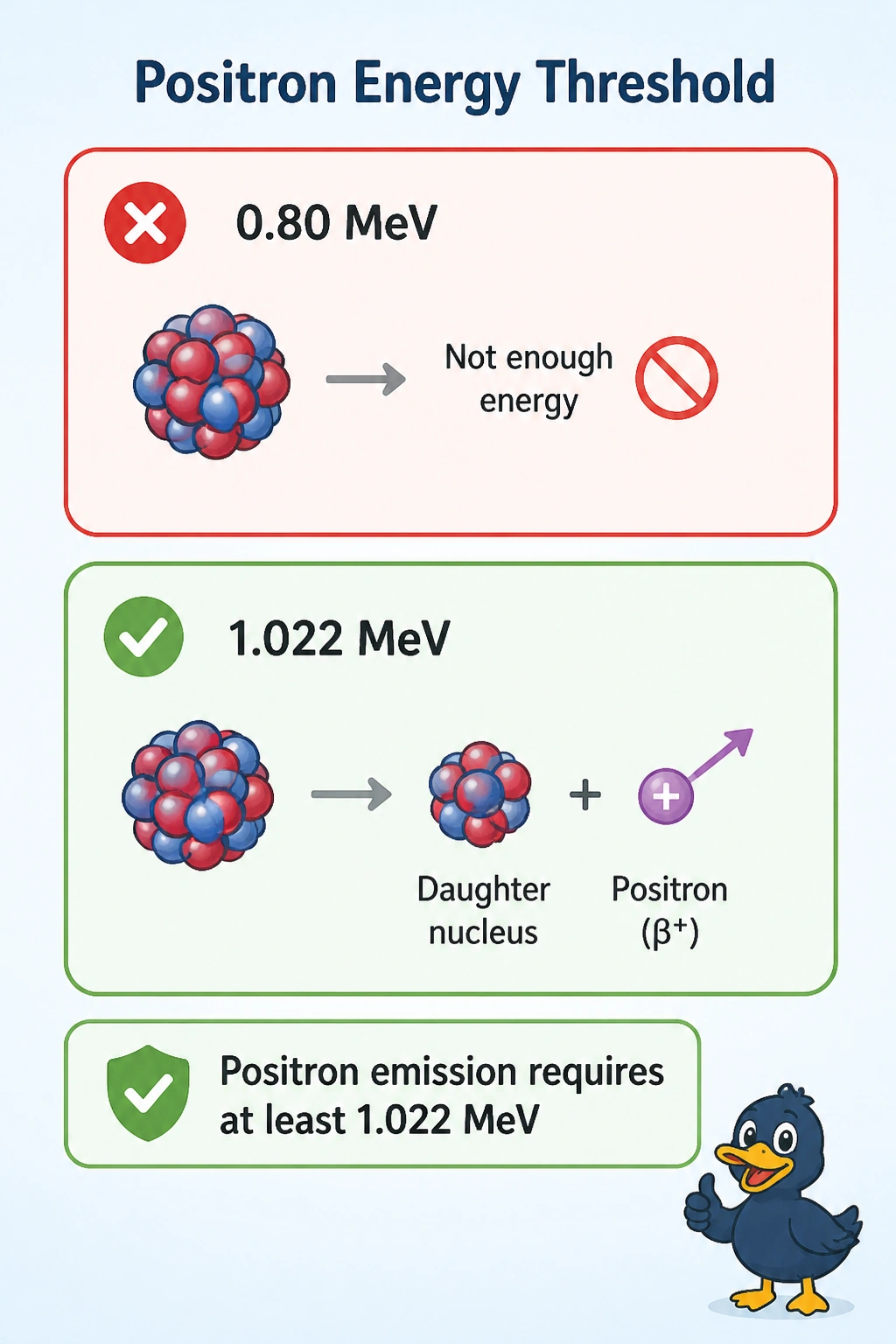
You can think of positron emission as having an entry fee: the transition must supply 1.022 MeV to create the positron and account for the electron-mass difference. With only 0.80 MeV available, electron capture remains energetically possible, while positron emission does not. Remember that atomic mass tables include orbital electrons, which is why this threshold matters.
Full Explanation
Positron emission requires at least 1.022 MeV of transition energy because the decay must account for two electron rest masses when comparing atomic masses. With only 0.80 MeV available, positron emission is energetically forbidden, while electron capture can occur by absorbing an existing inner-shell electron; it needs enough energy to overcome that electron’s binding energy, not a 1.022 MeV threshold. The claim that positron emission only occurs in nuclei with atomic numbers above eighty-two is false: light proton-rich isotopes such as fluorine-18 routinely emit positrons. Requiring an orbital photon of at least 1.022 MeV for electron capture confuses the process with pair production; electron capture has no such threshold. The claim that electron capture increases atomic number by one reverses the nuclear change: converting a proton to a neutron lowers atomic number by one. Exam caveat: even when more than 1.022 MeV is available, electron capture can compete with positron emission, especially in high-Z nuclides. Practical check: when surveying isotopes that decay only by electron capture, use low-energy X-ray or Auger detectors; no 511 keV annihilation photons are emitted.
Prefer to study offline? Printable PDF study book + test engine ($7.50, unofficial). These questions stay free here.