
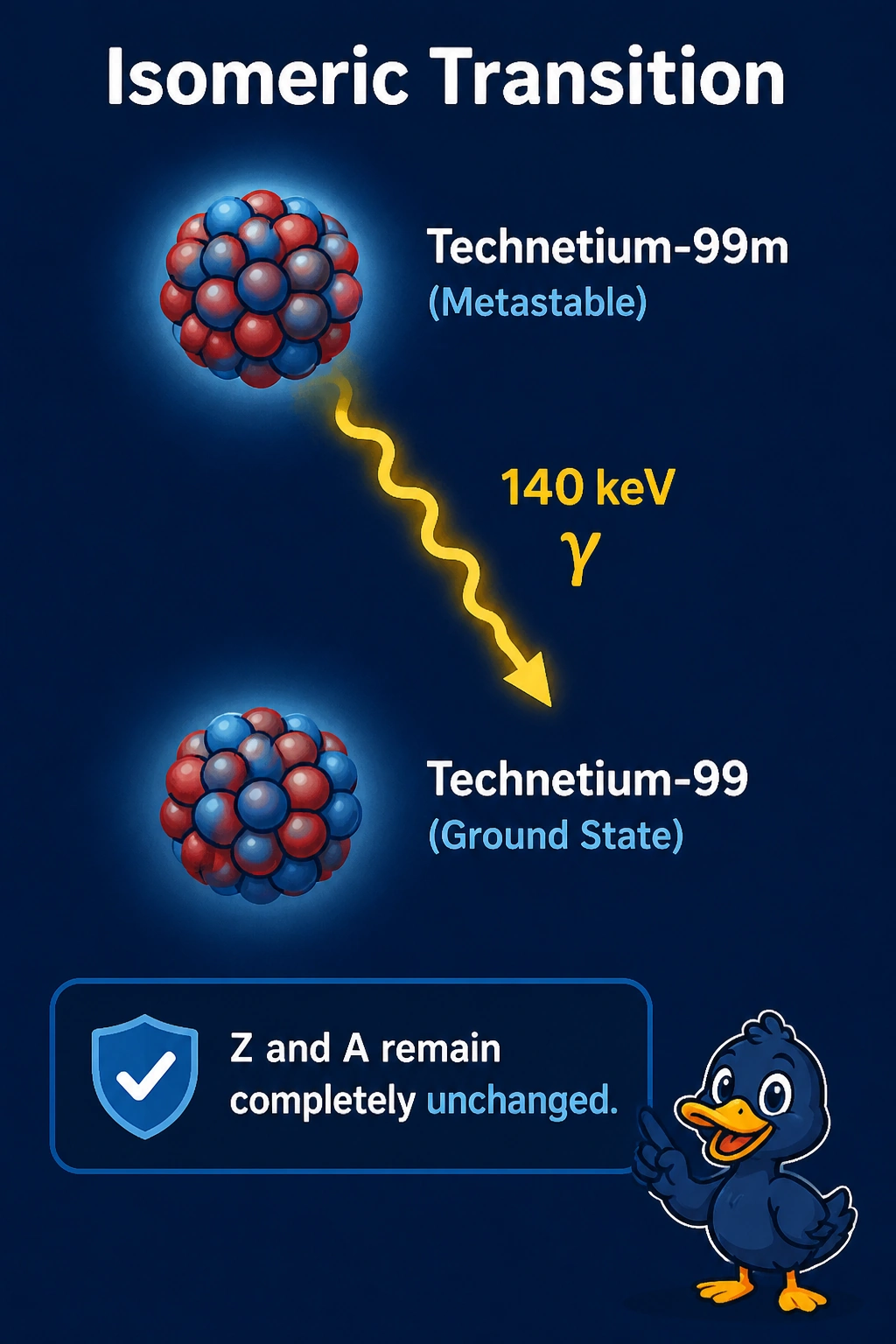
Technetium-99m is a metastable nuclear isomer that decays to ground-state Technetium-99 by emitting a 140 keV gamma photon. How do the atomic number (Z) and mass number (A) of the nucleus change during this isomeric transition?
Select an answer to reveal the explanation.
Short Explanation
Think of an isomer as a nucleus sitting on a high shelf that simply steps down to the floor without swapping any protons or neutrons. When Tc-99m emits its 140 keV gamma ray, your element stays technetium with the same mass, while the trap is confusing it with beta or alpha decay.
Full Explanation
An isomeric transition occurs when an excited, long-lived (metastable) nuclear state drops to a lower energy state by emitting a gamma photon or transferring that excitation energy to an orbital electron via internal conversion. Because no protons or neutrons are created, destroyed, or ejected from the nucleus, Both the atomic number and the mass number remain completely unchanged, leaving the atom as the same element and isotope (Tc-99). Selecting Atomic number increases by one while mass number remains unchanged describes beta-minus decay, in which a neutron converts into a proton. Choosing Atomic number decreases by one while mass number remains unchanged describes positron emission or electron capture, in which a proton converts into a neutron. Picking Atomic number decreases by two while mass number decreases by four describes alpha decay, where a helium-4 nucleus is emitted. As a caveat, internal conversion competes with gamma emission during isomeric transition, producing monoenergetic conversion electrons and characteristic X-rays alongside the 140 keV gamma photons. As an operational check, when calibrating a gamma spectrometer or dose calibrator for Tc-99m, select the 140 keV photon photopeak window and account for any Mo-99 breakthrough.
Prefer to study offline? Printable PDF study book + test engine ($7.50, unofficial). These questions stay free here.