
Two patients need transfer to chairs: one can bear full weight after knee surgery with a walker, and one is ordered non-weight-bearing after a hip fracture and is heavy. Which transfer, gait belt, and lift selection correctly matches weight-bearing status?
Select an answer to reveal the explanation.
Short Explanation
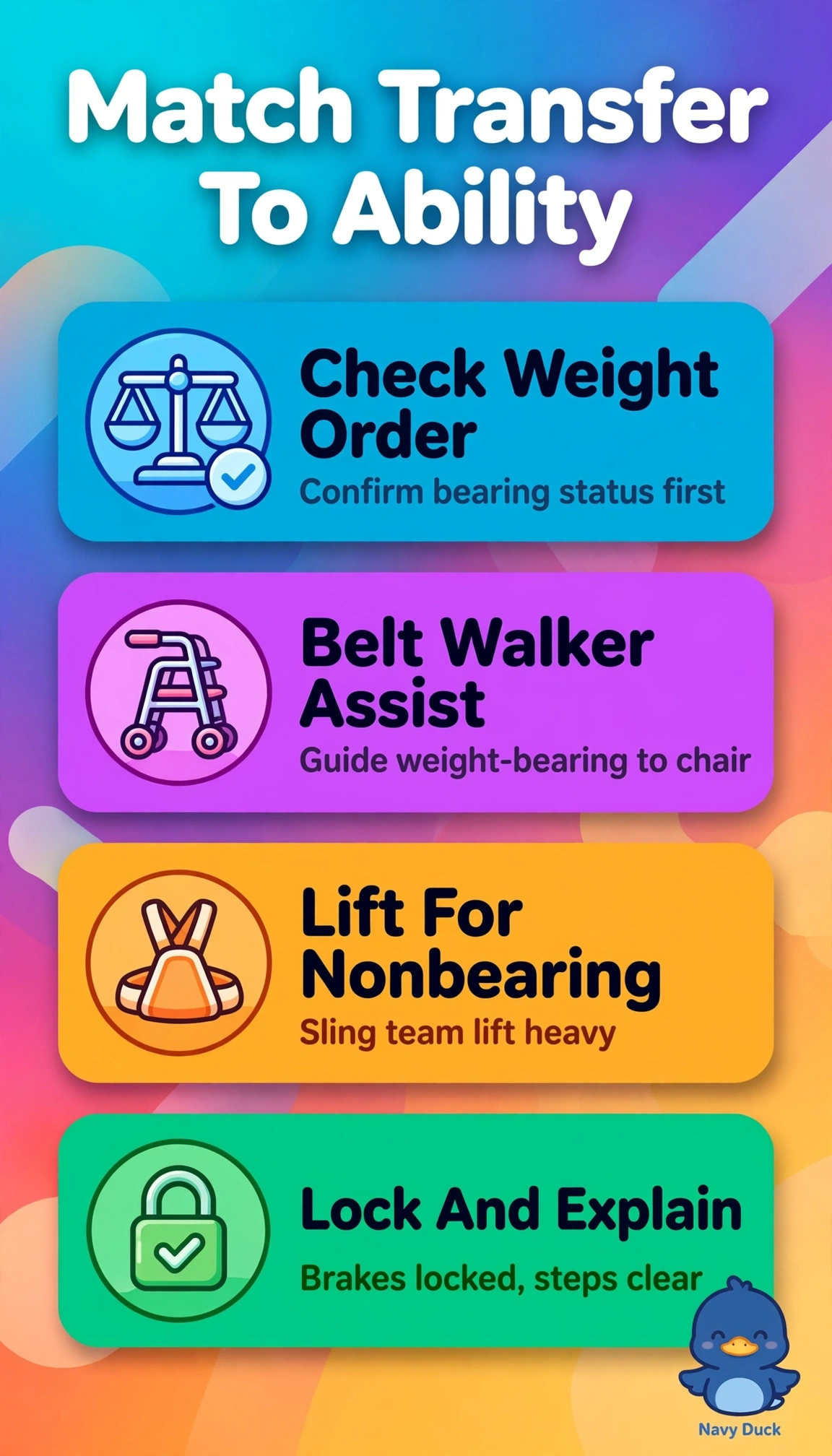
You've got two different jobs here, so you'll match your help to what their legs can do. Your steady patient can walk with you and their walker while you use a gait belt, just like you'd push a light cart by hand but call a forklift for the grand piano — so you'll save mechanical lift teamwork for your non-weight-bearing patient.
Full Explanation
The correct response matches support to tissue healing and safety: full weight-bearing after knee surgery allows assisted ambulation, so a gait belt for cueing and fall protection plus the prescribed walker for wide base of support enables safe progression to the chair, whereas strict non-weight-bearing after hip fracture plus heavy body weight prohibits loading the limb and prohibits manual lifting, requiring a full mechanical lift with trained team to protect fixation and staff. The two-person manual pivot fails on load tolerance because any pivot transfer demands bilateral foot loading for stand and turn, violating non-weight-bearing precautions and risking fracture displacement, fall, and caregiver injury when body weight is high. The sit-to-stand lift fails on least-restrictive care because it substitutes a device for functional walking the first patient can do and still requires partial leg loading and trunk stability, so it both deconditions the knee patient and remains unsafe if applied to a true non-weight-bearing patient. The cane variation fails on device specificity because a cane offers far less stability than a walker after knee surgery and increases fall risk despite correct lift use for the second patient. Exam caveat: treat weight-bearing orders, device names, and heavy as decisive cues and never upgrade activity. Practical check: reconfirm orders, pain, orthostatic symptoms, brakes, sling size, walker height, footwear, and team roles before any move.