
In a busy emergency department bay, a sweaty middle-aged patient reports chest pressure and needs a STAT 12-lead EKG. The chest is hairy with lotion residue, the patient is anxious, and the cardiac monitor shows artifact. Which preparation and placement step best prepares the patient and places 12-lead electrodes for acquisition?
Select an answer to reveal the explanation.
Short Explanation
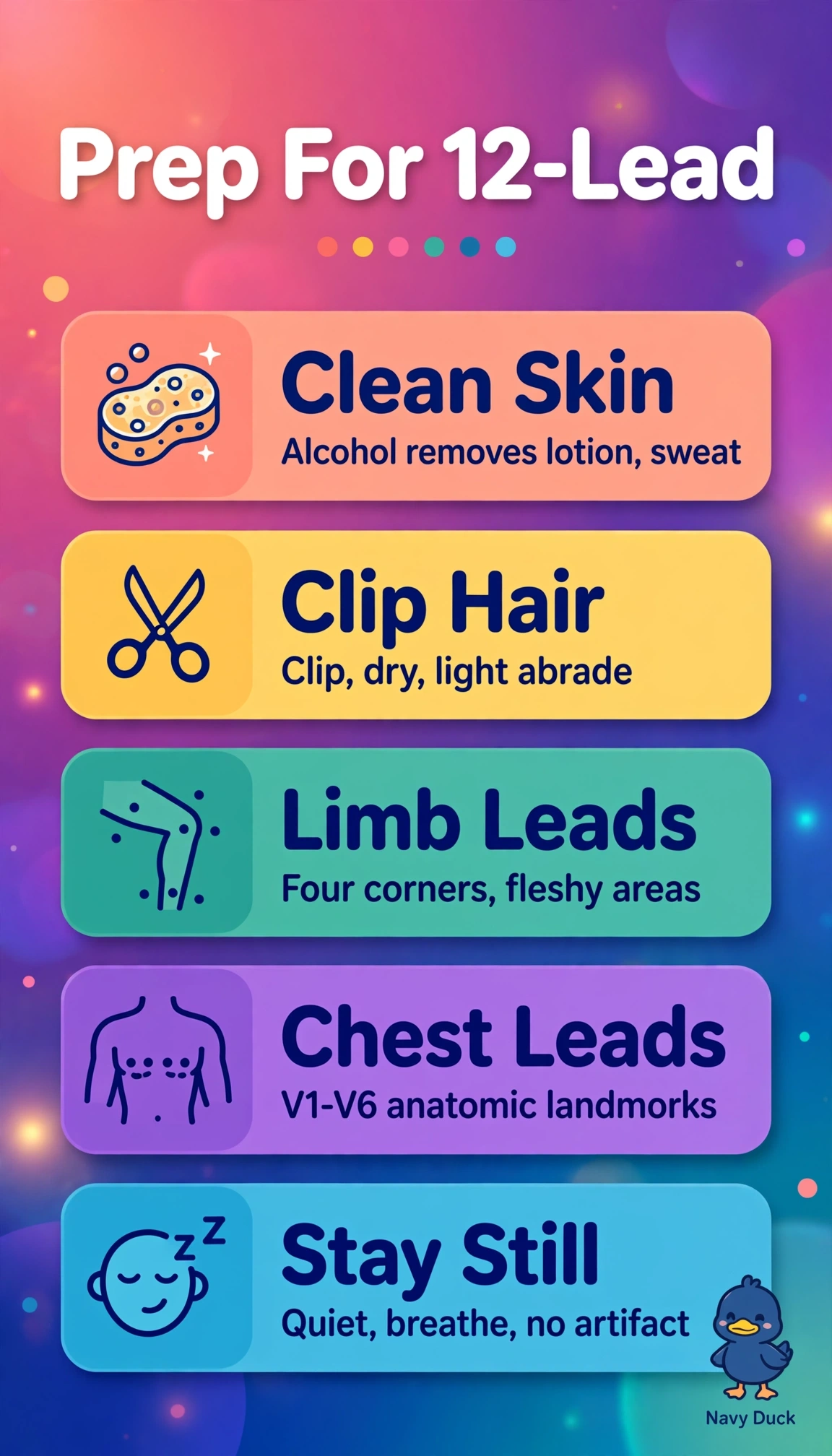
You want those electrodes to get a clean signal, like wiping smudges off your phone screen before a video call. When you remove the lotion, clip excess hair, dry the skin, and place the limb and V1-V6 electrodes anatomically, skin preparation helps turn artifact into a tracing you can trust.
Full Explanation
The correct approach prepares the skin and places a diagnostic 12-lead: alcohol removes lotion residue, clipping controls hair without razor microtrauma, drying removes sweat that can cause baseline wander, and anatomical limb and V1-V6 placement preserves ST-segment accuracy when evaluating possible ischemia. Drying sweat with gauze, clipping hair, reassuring the patient, and placing all electrodes is insufficient because residual lotion can leave an insulating film and high contact resistance, sustaining artifact. Cleaning lotion, clipping hair, drying, and using only three limb electrodes fails because a three-lead monitor shows rate and rhythm but cannot provide the twelve views and precordial ST patterns needed to assess possible coronary occlusion. Cleaning, shaving the chest smooth with a razor, drying, and placing V1-V6 fails because shaving risks microabrasions and infection; clipping achieves good adhesion more safely. The exam caveat is that urgency does not justify substituting monitoring for a diagnostic tracing or skipping skin preparation when artifact and ischemic symptoms coexist. Practically, verify clipped, dry skin and firm electrode contact; check V1 at the right sternal fourth interspace, V2 opposite, V4 at the midclavicular fifth interspace, and V5-V6 anterior to the midaxillary line. Keep the patient still and breathing quietly, then reacquire if baseline wander persists.