
A busy PCT must give a routine fingerstick glucose test to a patient who shares a last name with the roommate, with wristbands, charts, and labeled meters available. Which two-identifier verification best prevents misidentification before testing?
Select an answer to reveal the explanation.
Short Explanation
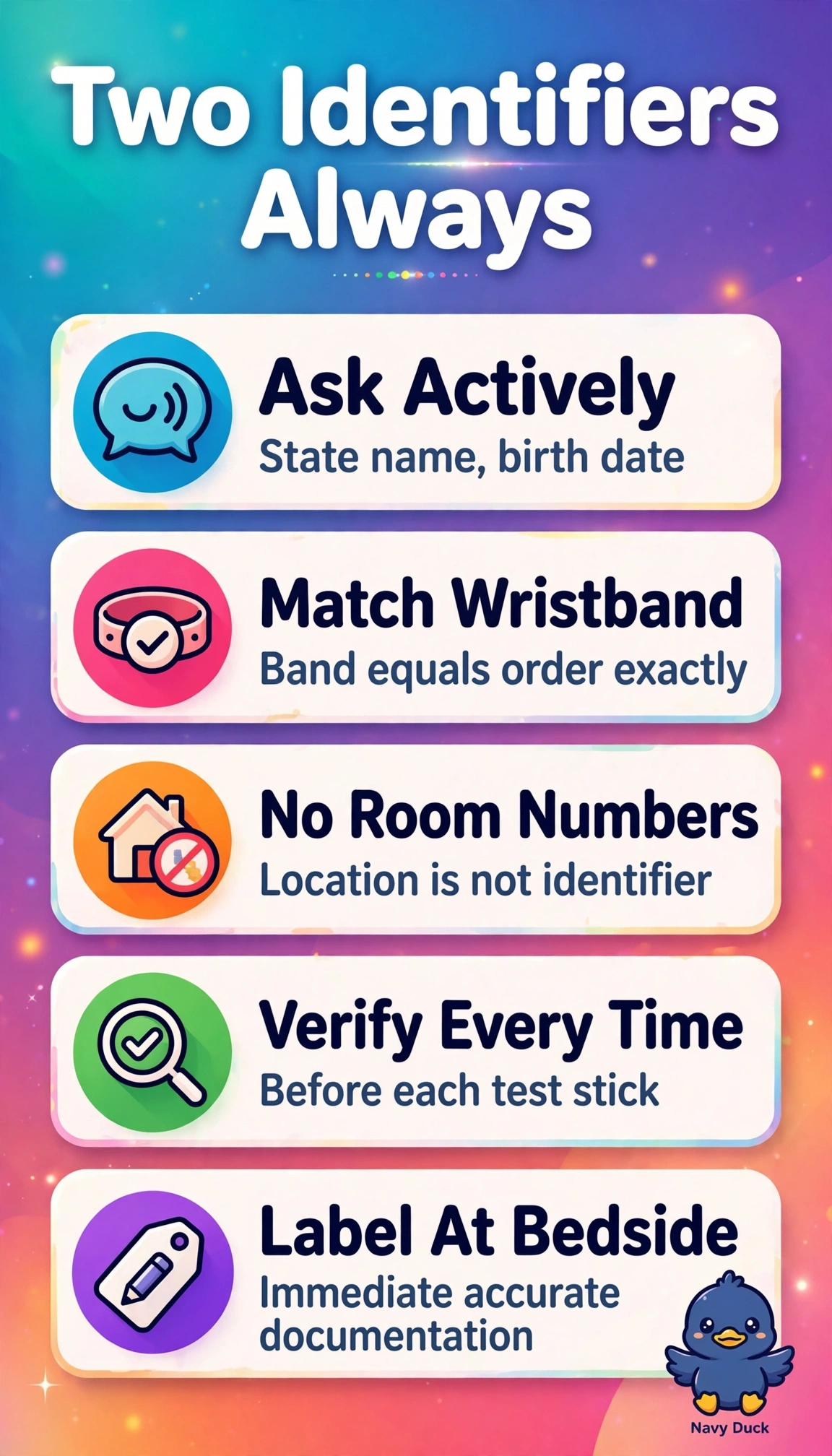
On a hectic floor, look-alike names can get mixed up like neighboring mailboxes. Have your patient state their full name and birth date, match both to the wristband and order, and label the result at the bedside to protect the right pairing.
Full Explanation
Professional standards require two person-specific identifiers to be actively confirmed with the patient and matched to both the wristband and the written order before a bedside test, with immediate labeling to preserve traceability. Asking the patient to state their full name and birth date, reconciling both against the wristband and order, and labeling the result at the bedside addresses the shared-surname risk with the roommate. Using room number instead of birth date fails because location is transient and shared, so two people in one room could still be confused. Asking for the right spoken identifiers and matching the wristband to the order but labeling the batch at the nurses station fails on timing and traceability: delay or batch handling between testing and labeling invites a mix-up, especially during a rush with same-name patients and labeled meters. Checking name and birth date on the wristband and chart without asking the patient to speak fails on active engagement; passive review cannot detect a mislabeled band or chart and bypasses the independent patient voice needed to close the loop. As an exam caveat, yes-no confirmation of a stated name and reliance on room, bed, or diagnosis as an identifier are insufficient, even with otherwise careful steps. As a practical check, have the patient spell or state both identifiers, read the band yourself, reconcile it to the order, and label the result before leaving the bedside.