
A PCT/A cares for a postoperative adult with a nasal cannula at low flow, an incentive spirometer at bedside, and orders for oral suction as needed plus turn, cough, and deep breathe every two hours. Which support best ensures safe oxygen, spirometry, suction, and TCDB exercises?
Select an answer to reveal the explanation.
Short Explanation
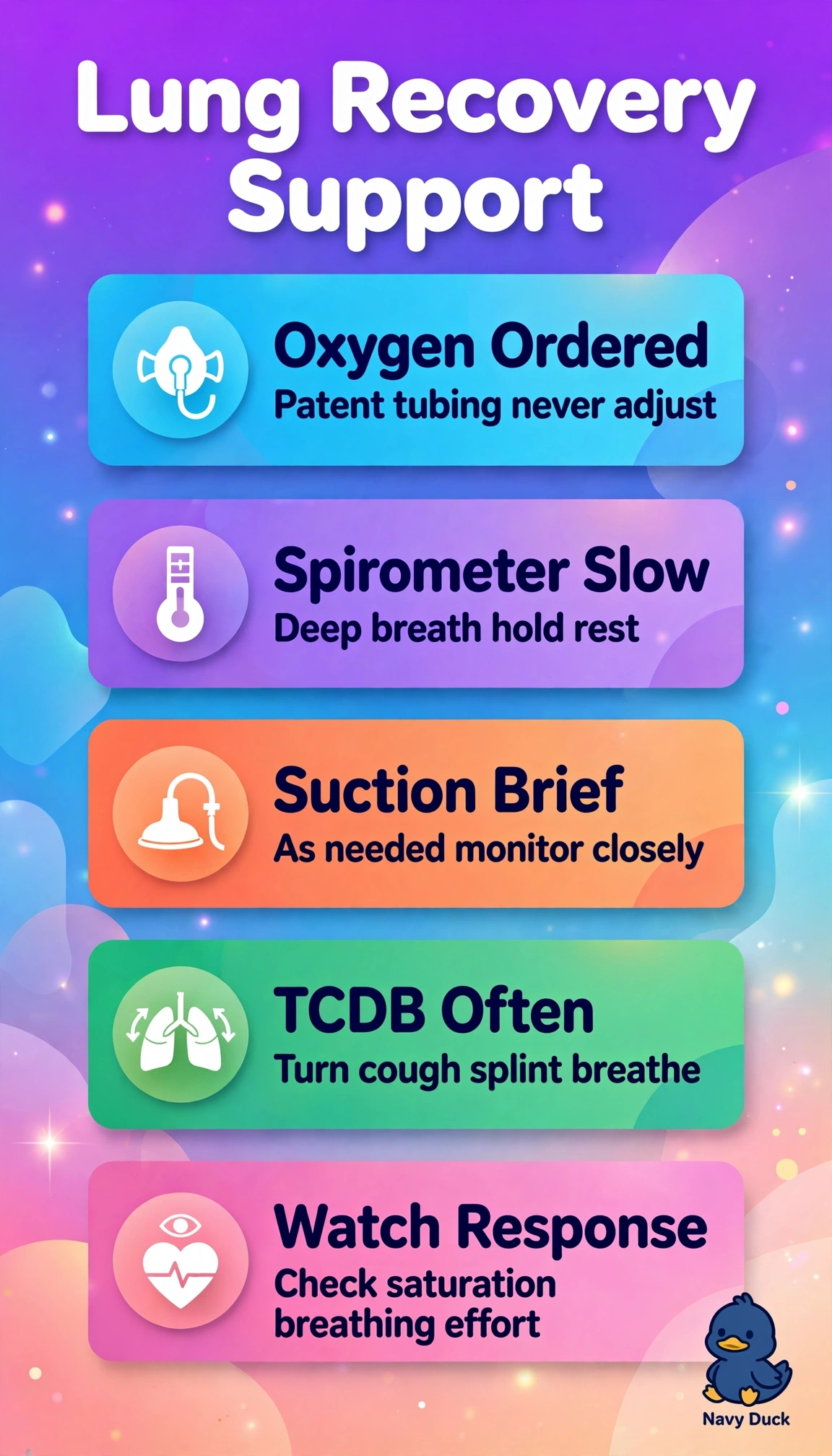
You are coaching lungs to reopen gently without drying or tiring them. Guide slow breaths, keep oxygen flowing clear, and suction short and sweet. Steady coaching beats forcing volumes.
Full Explanation
Safe support requires keeping oxygen delivery at ordered flow without adjustment, ensuring tubing is unkinked, prongs positioned, and humidification and skin checks maintained, coaching incentive spirometry with upright posture, slow deep inhalation to raise the indicator, brief hold, and rest to prevent hyperventilation, applying oral suction only as needed with clean technique, brief passes, and monitoring for gagging, desaturation, or distress, and assisting turn, cough, and deep breathe with splinting, pain control coordination, and ambulation as ordered. Raising flow without order risks hypercapnia and oxygen toxicity in susceptible patients, rapid puffing fails to sustain alveolar recruitment, and prolonged continuous suction causes mucosal trauma and hypoxia. Removing oxygen during exertion causes desaturation, setting maximal goals causes fatigue and poor technique, and routine deep suction violates as-needed principles. Coiled tubing occludes flow, shallow sips fail to prevent atelectasis, and delaying TCDB misses the critical early postoperative window. Exam caveat often tests never changing flow and brief suction with monitoring, and practical check is to verify saturation, respiratory rate, and lung sounds before and after interventions.