
In a post-surgical unit, an alert adult on 2 liters nasal cannula is due for turn, cough and deep breathe exercises and incentive spirometry, reports incisional pain rated 5 of 10, and has oral secretions pooling without distress. Which combined respiratory support sequence best reflects correct oxygen, spirometry, suction and TCDB use?
Select an answer to reveal the explanation.
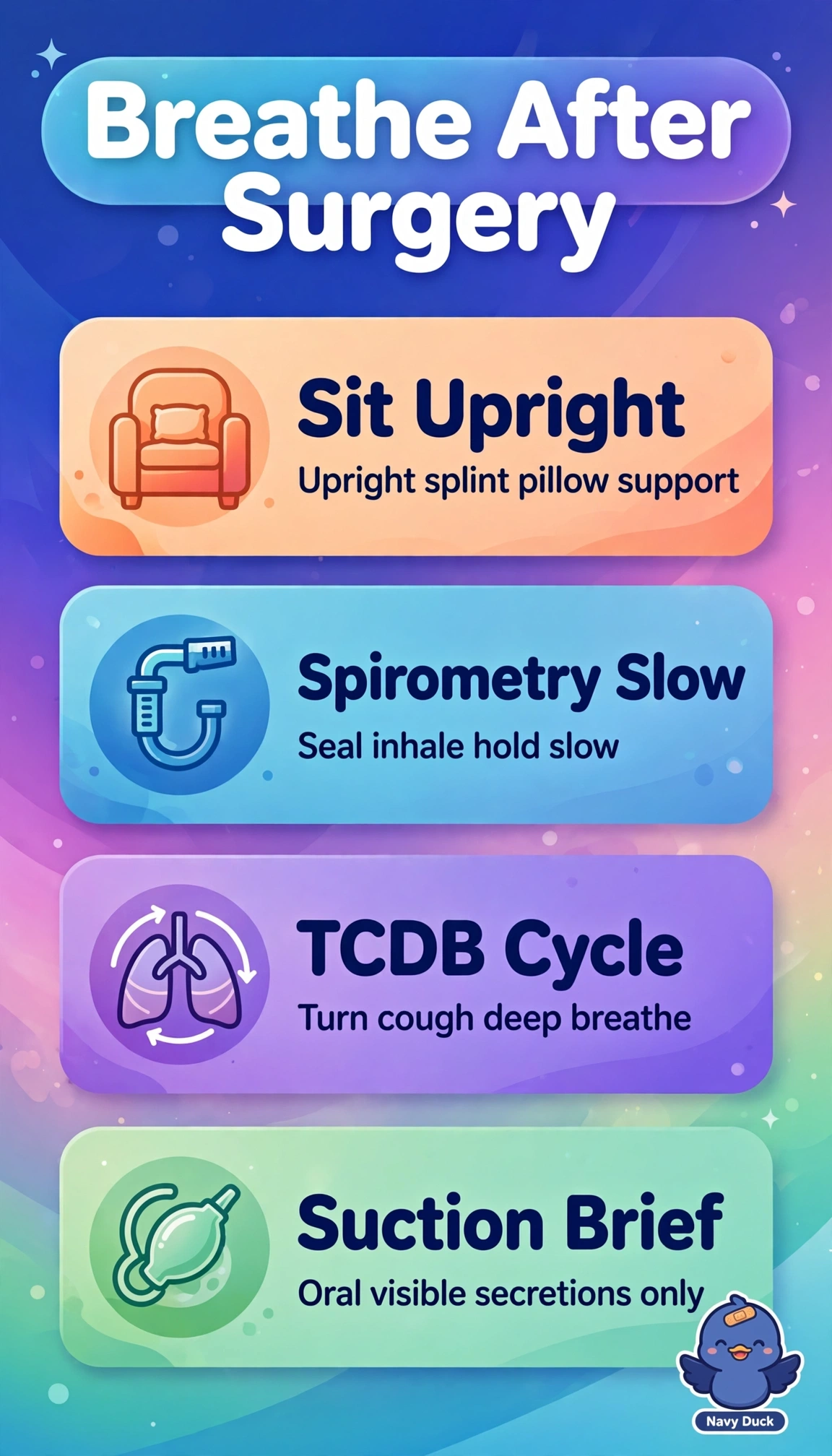
Short Explanation
You’ll breathe easier sitting upright with your pillow pressed close, then take slow, sustained spirometry breaths and cough to help reopen tiny air sacs. Splinting eases your incisional pain so you can do TCDB effectively before briefly clearing pooled secretions with oral suction.
Full Explanation
The correct sequence keeps the 2 liters nasal cannula in place, positions you upright to support ventilation and secretion movement, uses pillow splinting to ease 5 of 10 incisional pain, then combines slow, sustained maximal inspiration with an inspiratory hold for incentive spirometry and turn-cough-deep-breathe (TCDB), followed by brief oral suction for pooled secretions. Briefly removing the cannula is inappropriate because prescribed postoperative oxygen should continue during exertion; interruption can risk desaturation. Nasotracheal deep suctioning is not indicated for an alert adult with oral pooling and no distress or artificial airway; it can cause mucosal trauma, laryngospasm, vagal bradycardia, and hypoxemia. Omitting pillow splinting fails to support ventilation: moderate incisional pain can limit diaphragmatic movement and full expansion, producing low volumes, a weak cough, and retained atelectasis. An exam caveat is not to increase oxygen flow, use deep suction, or substitute rapid spirometry puffs without an indication or order; maintenance care emphasizes oxygen continuity, a good seal, slow inspiration, and reassessment. A practical check is upright positioning at 45–90 degrees, oxygen on with stable oximetry, firm splinting, a spirometer seal with a slow rise and 3-second hold for about 10 repetitions, then huff-cough and oral suction for under 15 seconds, with reassessment of lung sounds, saturation, and pain.