
On a busy morning, a PCT/A must draw two tubes from a dehydrated older adult with fragile veins for timed labs, using a small needle and proper order, with labels printed at the nurse station. Which collection approach best avoids hemolysis, QNS, and labeling errors?
Select an answer to reveal the explanation.
Short Explanation
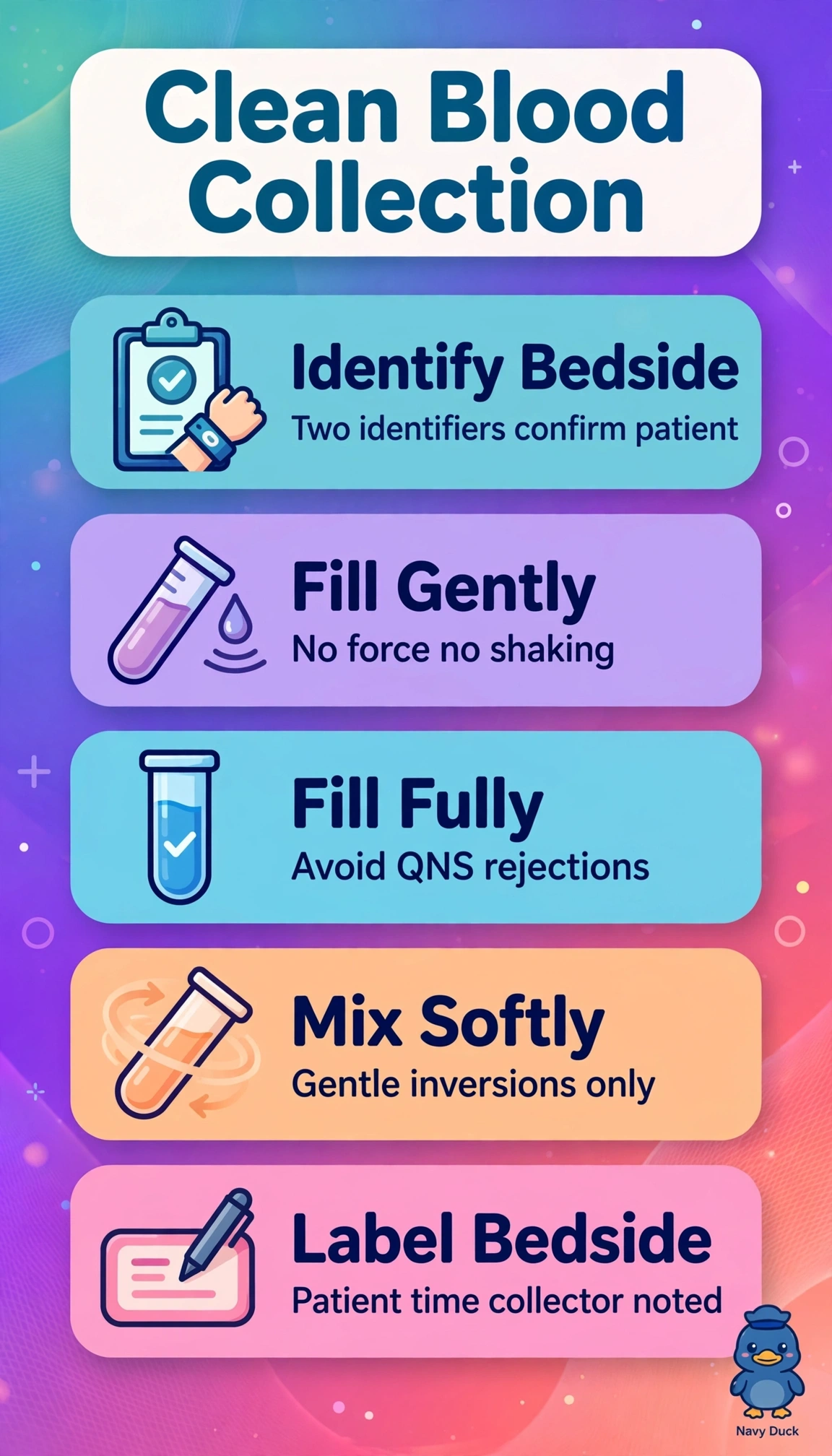
You are protecting fragile cells from rough handling and mix-ups. Treat the draw like glass that cracks with shaking and vanishes with short fills. Gentle fills plus bedside labeling keep results true.
Full Explanation
The correct approach protects fragile veins while preserving sample integrity and identification because bedside identity verification prevents misidentification, warming a cool hand of a dehydrated older adult promotes vasodilation and blood flow to allow complete fills without prolonged tourniquet time or probing, gentle vacuum through a small needle with complete fills and gentle mixing prevents shear-induced hemolysis and maintains proper blood-to-additive ratios, correct order prevents carryover, and immediate bedside labeling after collection closes the identification loop for timed specimens. Returning to the nurse station to label, even when labels were printed there and the collection technique is otherwise ideal, breaks this closed loop and invites mislabeling or wrong-patient labeling during a busy morning with multiple timed draws. Accepting smaller partial fills to spare the vein feels protective but creates quantity-not-sufficient specimens and underfilled tubes where excess additive alters results and may require recollection, which is especially risky for timed labs. Collecting when convenient rather than at the ordered time preserves technique and labeling but invalidates the clinical purpose of timed labs for therapeutic monitoring or serial trends. For exams, remember that preprinted labels never justify labeling away from the patient, and bedside labeling means in the presence of the patient immediately after collection. As a practical check, confirm full fill to the indicator line, gentle inversion per tube type, exact draw time documentation, and that labeled tubes match the wristband before leaving the bedside.