
A PCT is sitting with a stable medical patient who suddenly becomes hard to arouse, speaks with new slurred words, shows one-sided facial droop, cannot lift one arm evenly, and breathes short and fast. Which change report signals possible stroke needing rapid response?
Select an answer to reveal the explanation.
Short Explanation
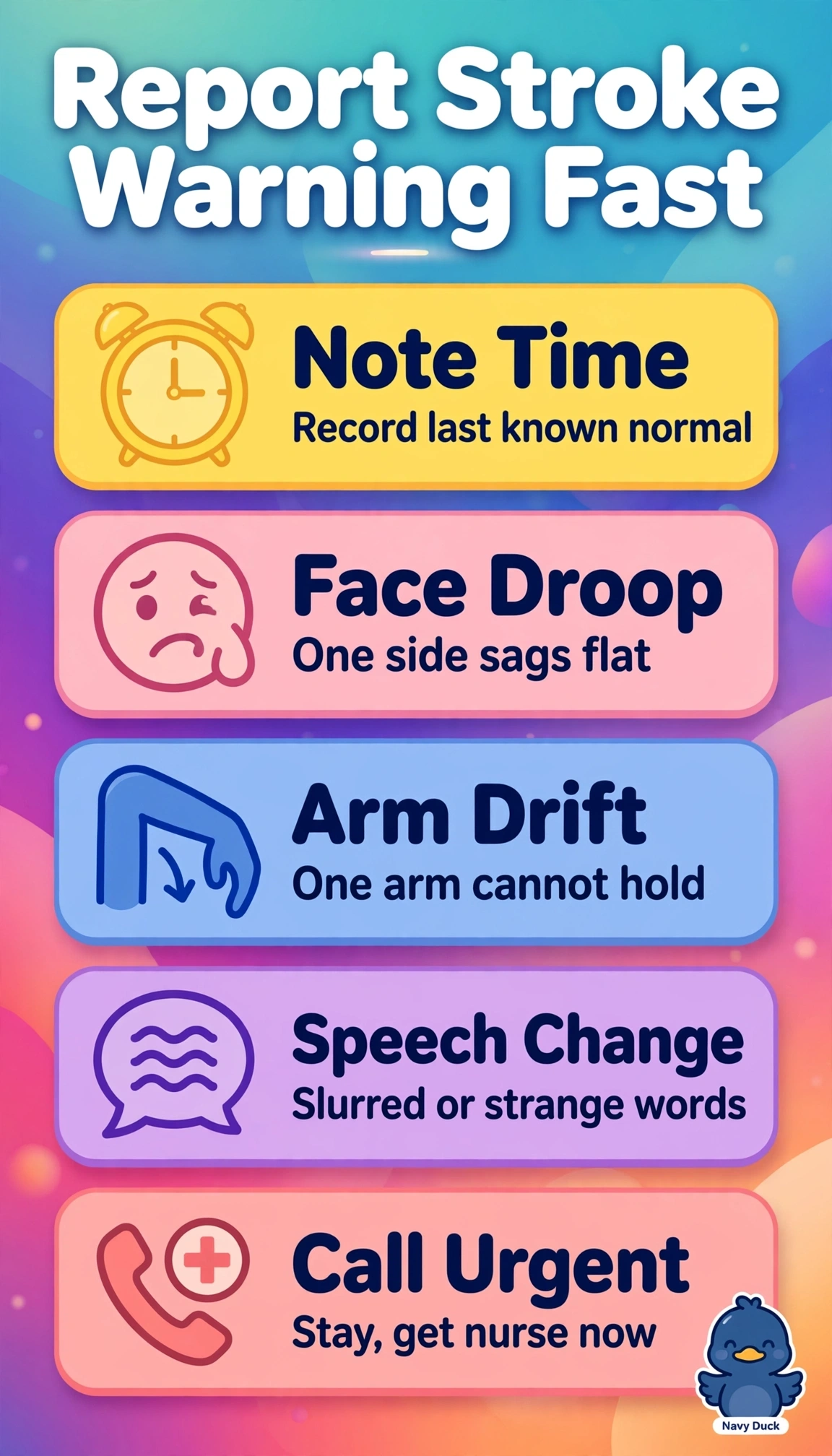
You're the team's eyes here, so you'll want to call out those new FAST changes right away with when they started. It's like pulling a fire alarm with the exact room number — you've given them everything to move fast and protect the brain.
Full Explanation
The correct report is right because it bundles all defining stroke cues from the stem into an urgent communication: sudden difficulty arousing indicating altered consciousness plus new slurred speech, unilateral facial droop, and uneven arm drift indicating focal cortical dysfunction, with explicit immediacy that triggers rapid response where time-dependent evaluation and intervention preserve brain. One plausible but incorrect report correctly identifies the new focal triad yet defers it to routine morning rounds follow-up, which fails the concept of acuity because suspected stroke cannot wait for next-shift surveillance and requires immediate escalation. Another plausible but incorrect report correctly captures sudden unresponsiveness with short fast breathing as acute respiratory distress requiring prompt action, which fails the concept of neurologic specificity because it omits the lateralizing facial and limb deficits and slurred speech that distinguish stroke from primary respiratory compromise. A third plausible but incorrect report correctly conveys sudden onset, depressed responsiveness, slurred speech, droop, and urgency but describes symmetric fatigue, which fails the concept of focality because stroke is defined by unilateral, asymmetric loss rather than bilateral generalized weakness. An exam caveat is that shortness of breath often tempts selection of a respiratory answer, yet when tachypnea coexists with new lateralizing deficits the priority tested is stroke recognition and time of onset. A practical check at the bedside is to stay with the patient, note the exact last-known-well time, keep NPO and safe, and escalate immediately using concise SBAR with BE FAST elements without leaving to monitor routinely.