
A PCT cares for a post-surgical patient on bed rest whose left calf is more swollen than the right, pits with pressure, and the left foot is pale, cool, and slow to pink up, plus a urine sample looks cloudy with a strong odor. Which observation set should the PCT report promptly as impaired circulation with edema?
Select an answer to reveal the explanation.
Short Explanation
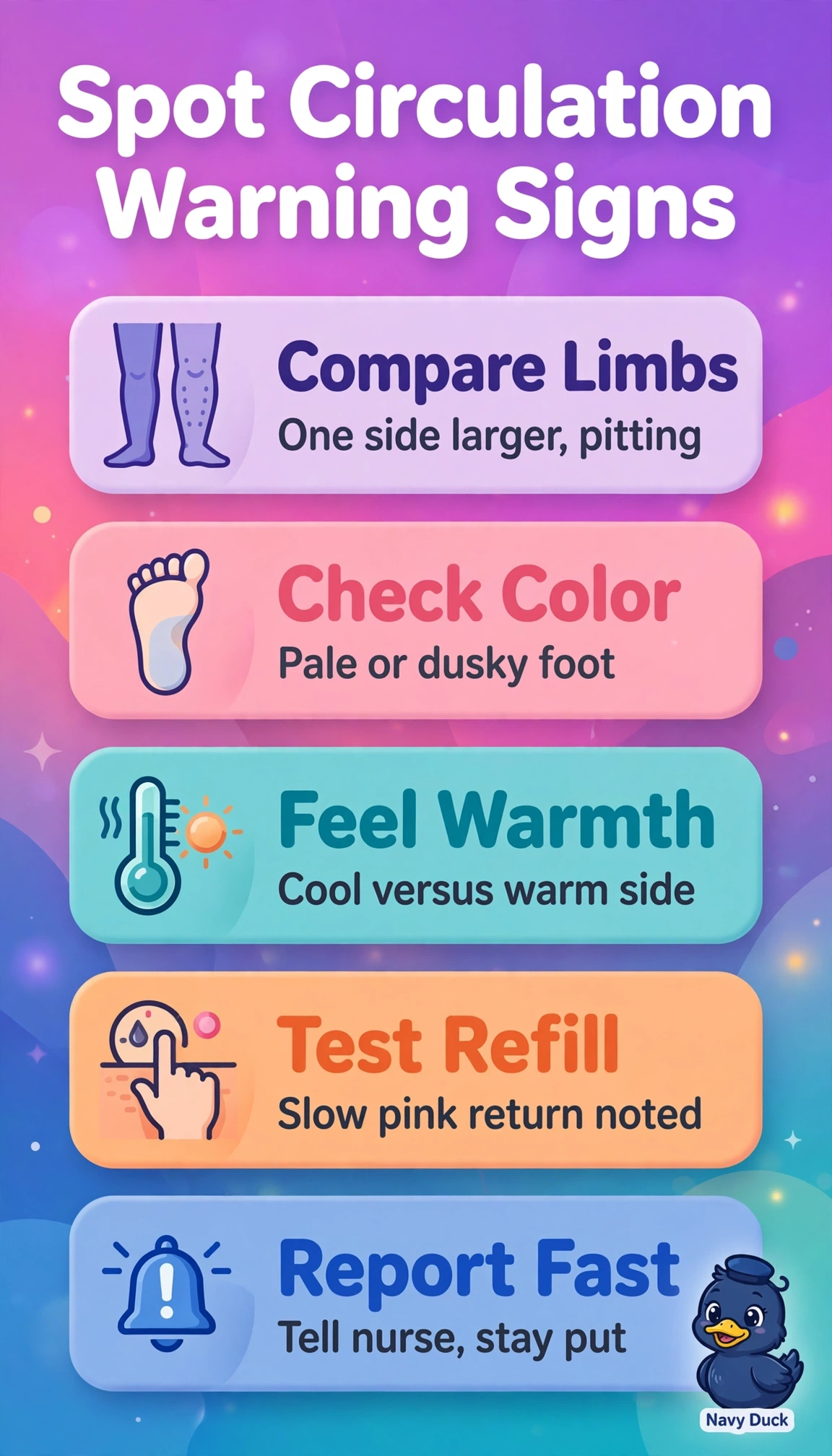
You're connecting the dots when you pair that swelling with a pale, cool foot and slow pink-up. It's like noticing both a puddle and a kinked hose, which points to circulation trouble you'll want to report fast.
Full Explanation
The correct observation clusters unilateral pitting edema with ipsilateral arterial insufficiency signs, which together define impaired circulation requiring prompt nurse notification in a post-surgical bed-rest patient at risk for venous obstruction and perfusion compromise. Pitting that indents on pressure confirms interstitial edema, while concurrent pallor, coolness, and slow return of color after blanching confirm reduced distal blood flow rather than simple dependent swelling. The firm nonpitting variant fails because nonpitting reflects a brawny lymphatic or chronic tissue change that does not indent, contradicting the stated pits with pressure finding and indicating a different pathophysiology. The variant with normal rapid refill fails because return in under three seconds denotes intact microvascular perfusion, which contradicts the described slow to pink up and removes the circulation-impairment criterion despite matching swelling and temperature. The bilateral variant fails on laterality because symmetric swelling with bilateral perfusion changes implies a systemic process such as cardiac, renal, or medication-related overload rather than the left-greater-than-right presentation that suggests localized venous or arterial compromise. An exam caveat is to avoid being diverted by the cloudy strong-smelling urine, which should be reported separately as a possible urinary issue but does not establish circulation with edema. A practical check is to expose both legs equally, palpate temperature from thigh to foot, press the pretibial area for five seconds to confirm a persistent pit, and time toe capillary refill while noting calf pain, numbness, or increasing asymmetry for the nurse.