
A PCT transports a portable EKG machine to a busy medical unit for a routine 12-lead EKG on a stable adult with a regular rhythm, and the last tracing looked wide and stretched with depleted paper. Which machine operation produces a standard diagnostic tracing for interpretation?
Select an answer to reveal the explanation.
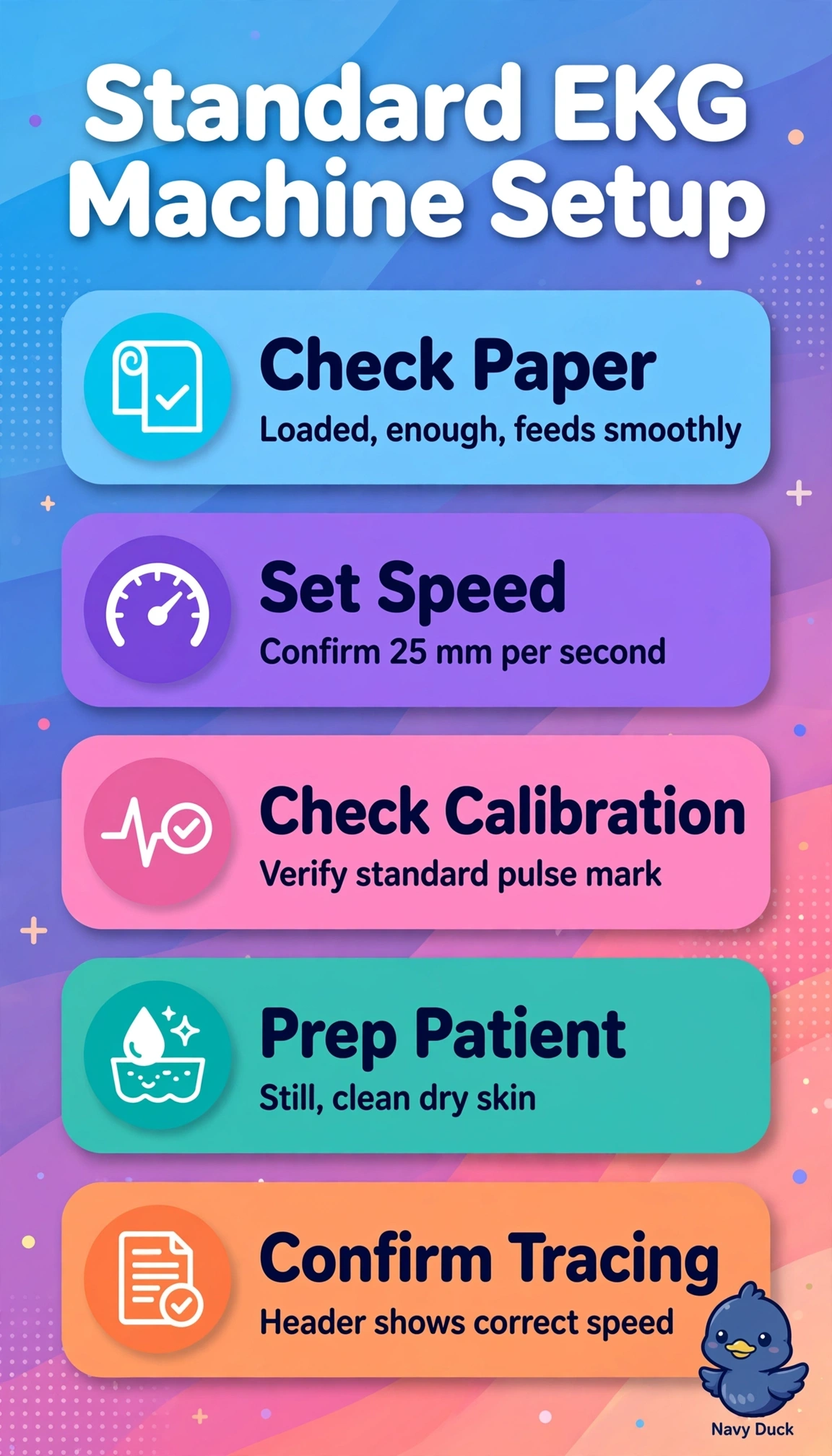
Short Explanation
Standard settings are your common language with the reader. Confirming speed at 25 mm per second keeps every heartbeat drawn to the same scale.
Full Explanation
Standard adult resting 12-lead interpretation assumes 25 mm per second and 10 mm per mV calibration with sufficient paper, which preserves interval duration, QRS width, and amplitude for comparison, and the clues of wide stretched complexes plus depleted paper point to correcting speed and supply before recording. The 50-mm-per-second tracing fails by speed concept because doubling speed stretches waveforms horizontally, widening QRS to mimic conduction delay while consuming extra paper and preventing standard measurement, although faster speed is legitimately used for detailed arrhythmia inspection when explicitly ordered. The tracing without rechecking calibration fails by standardization concept because prior adjustment or drift alters QRS height and ST assessment even when speed and paper are correct, so routine tracings require confirming the 1-mV test pulse yields 10 mm. The double-gain tracing fails by amplitude concept because 20 mm per mV doubles voltage height used for low-voltage evaluation but overstates hypertrophy and distorts ST criteria on a routine standard record. Exam caveat is to accept nonstandard speed or gain only when the vignette explicitly orders that modification or describes tachycardia needing spread detail or low voltage needing enhancement. Practical check is to inspect the calibration rectangle, confirm the display reads 25 speed and 10 gain, and ensure gridded paper feeds smoothly before recording.