
During a routine 12-lead ECG on an anxious adult who is shivering, talking, and breathing deeply in a cool room with nearby electrical equipment, the tracing shows wandering baseline, fuzzy thick lines, and sharp spikes. Which artifact correction sequence best produces a clean EKG acquisition?
Select an answer to reveal the explanation.
Short Explanation
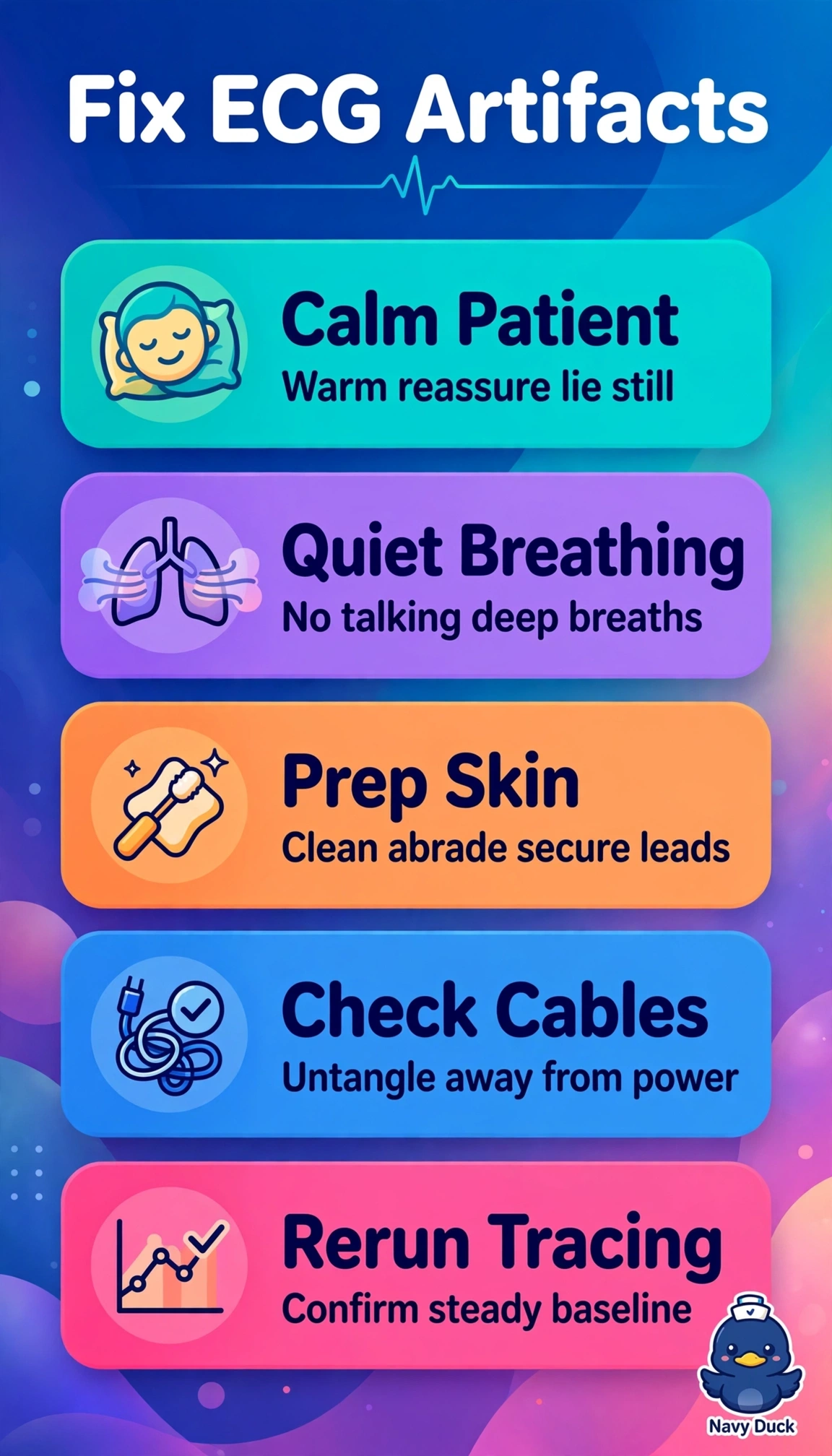
You’re quieting several sources of artifact at once. Warm and reassure the patient, help them lie still and quiet, and re-prep and secure the leads before you re-record: clean input beats trying to filter a messy signal.
Full Explanation
The sequence that warms and reassures the patient, asks them to lie still and quiet, re-preps the skin, secures the leads, and then reruns the tracing addresses each source of artifact. Warming and reassurance reduce shivering and sympathetic muscle tension, which create fuzzy, thick somatic-tremor artifact. Stillness, quiet, and normal breathing limit movement, speech-related muscle activity, and deep respiratory excursion that can make the baseline wander. Skin preparation and secure electrodes restore low-impedance contact and help prevent dropout and drift. Sharp spikes can suggest alternating-current interference from nearby electrical equipment, so separate the ECG setup from that interference as appropriate. Repeating the ECG in the cool room without warming may leave shivering-induced muscle artifact unresolved; reassurance and good electrode contact do not keep a cold patient from shivering. Allowing continued talking can maintain jaw, facial, and respiratory muscle activity, producing thick, irregular fuzz despite skin preparation and secure leads. Recording during continued deep breathing allows rhythmic chest movement and electrode tug to persist, so the baseline may keep drifting despite still limbs and secure leads. On an exam, recognize that patient-centered corrections address the source rather than merely masking artifact; filters can distort ST segments. In practice, verify paper speed, gain, calibration pulse, and patient identity, and confirm that the baseline stays stable for several seconds before recording.