
A PCT cares for a postoperative patient ordered for sequential compression devices and anti-embolism stockings, plus another patient with a wrist splint and knee immobilizer after a fall. Skin checks show intact skin with mild leg swelling. Which application sequence best ensures safe and effective device use?
Select an answer to reveal the explanation.
Short Explanation
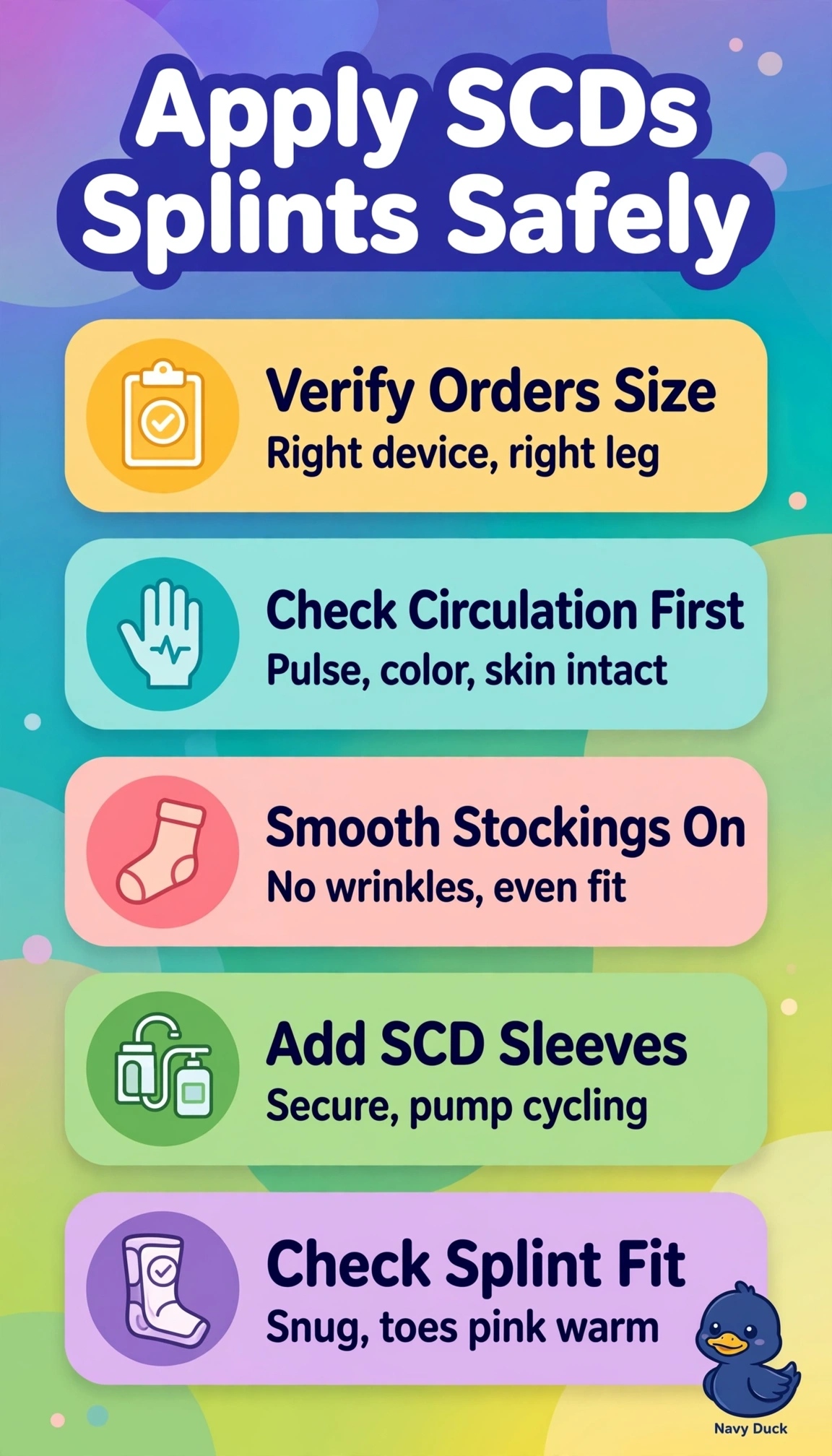
Smooth and snug beats wrinkled and tight when you're fighting clots. Checking circulation first makes your sequential care both safe and effective.
Full Explanation
Correct sequence works because it combines order verification, circulation assessment, correct layering, and review of both orthopedic devices, which is required when one patient needs venous thromboembolism prophylaxis and another needs immobilization with intact skin and mild swelling still present. Verifying orders confirms correct patient and current prescription, while checking leg circulation through pulse, color, warmth, sensation, and pain screens for ischemia or suspected clot that must be reported before compression. Smooth wrinkle-free stockings applied first provide graduated compression and protect skin, with SCD sleeves placed over them to deliver intermittent compression effectively without bunching or excess pressure, and checking wrist splint and knee immobilizer fit maintains alignment without neurovascular compromise. Applying SCD sleeves under stockings fails on layering principle because sleeves are engineered to function over stockings and reversal causes uneven pressure, slippage, and reduced venous return. Checking only the wrist splint fails on completeness because the scenario assigns both splint and immobilizer and the unchecked knee device retains risk for pressure injury and circulation impairment. Applying devices without checking leg circulation fails on assessment principle because even familiar compression tasks require baseline vascular status when swelling is present. An exam caveat is that intact skin does not alone authorize compression when orders and circulation findings govern safety. A practical check is to smooth wrinkles, reassess toes for color, temperature, sensation and movement, ensure SCD tubing is unkinked and cycling, and confirm one to two finger clearance under splint and immobilizer edges, reporting abnormalities promptly.