
On a medical unit, an older adult after prolonged bed rest for pneumonia can initiate right shoulder flexion halfway but tires quickly, has no acute pain or dislocation, follows commands, and needs to regain endurance without shoulder injury. Which range-of-motion approach should the PCT use to support safe shoulder recovery?
Select an answer to reveal the explanation.
Short Explanation
You're the spotter, not the lifter, when muscles are waking up. Teamwork through active-assistive motion builds endurance without overworking that tired shoulder.
Full Explanation
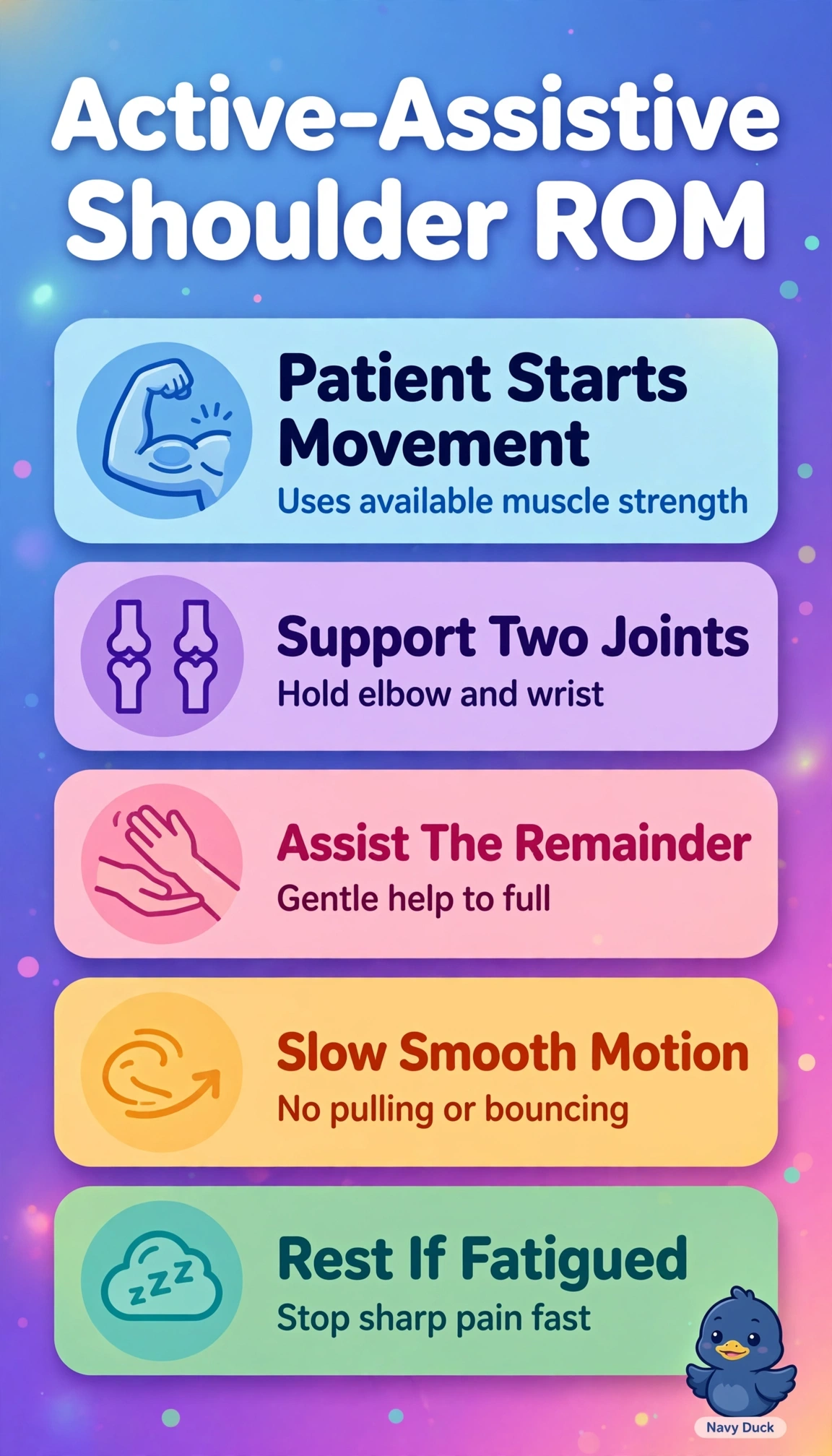
The correct approach is active-assistive motion because the patient can initiate contraction through part of the range but lacks endurance, so the PCT supporting the joints and supplementing only the remainder maintains muscle engagement, prevents disuse and avoids overexertion while protecting alignment. Performing the movement fully for the patient without effort describes passive motion and violates the participation concept because it removes voluntary activation needed for strength and endurance when the patient is capable of partial movement. Leaving the patient to lift repeatedly alone until exhaustion describes unsupervised active motion and violates the assistance and fatigue management concept because it risks compensation, pain and injury despite encouraging independence. Grasping the hand and pulling quickly overhead violates the joint protection and controlled movement concept by creating traction and ballistic stretch that can injure capsule and tendons even though full motion is achieved. Exam caveat is to stop for sharp pain, dizziness or resistance, never force beyond natural range and clarify orders for post-surgical precautions, and practical check is to support above and below the joint, move slowly through comfort, breathe normally and document tolerance.