
A 56-year-old patient arrives to the clinic for a routine 12-lead EKG, has chest hair, light lotion on the skin, and reports a racing heartbeat but is stable, clean, and able to lie still. The machine has new electrodes, skin prep pads, and 3-, 5-, and 12-lead cables. Which patient preparation and electrode placement action best ensures accurate 12-lead acquisition?
Select an answer to reveal the explanation.
Short Explanation
An EKG only sees what your skin prep lets it see. Clean, dry, anatomic placement turns squiggles into a trustworthy heart story.
Full Explanation
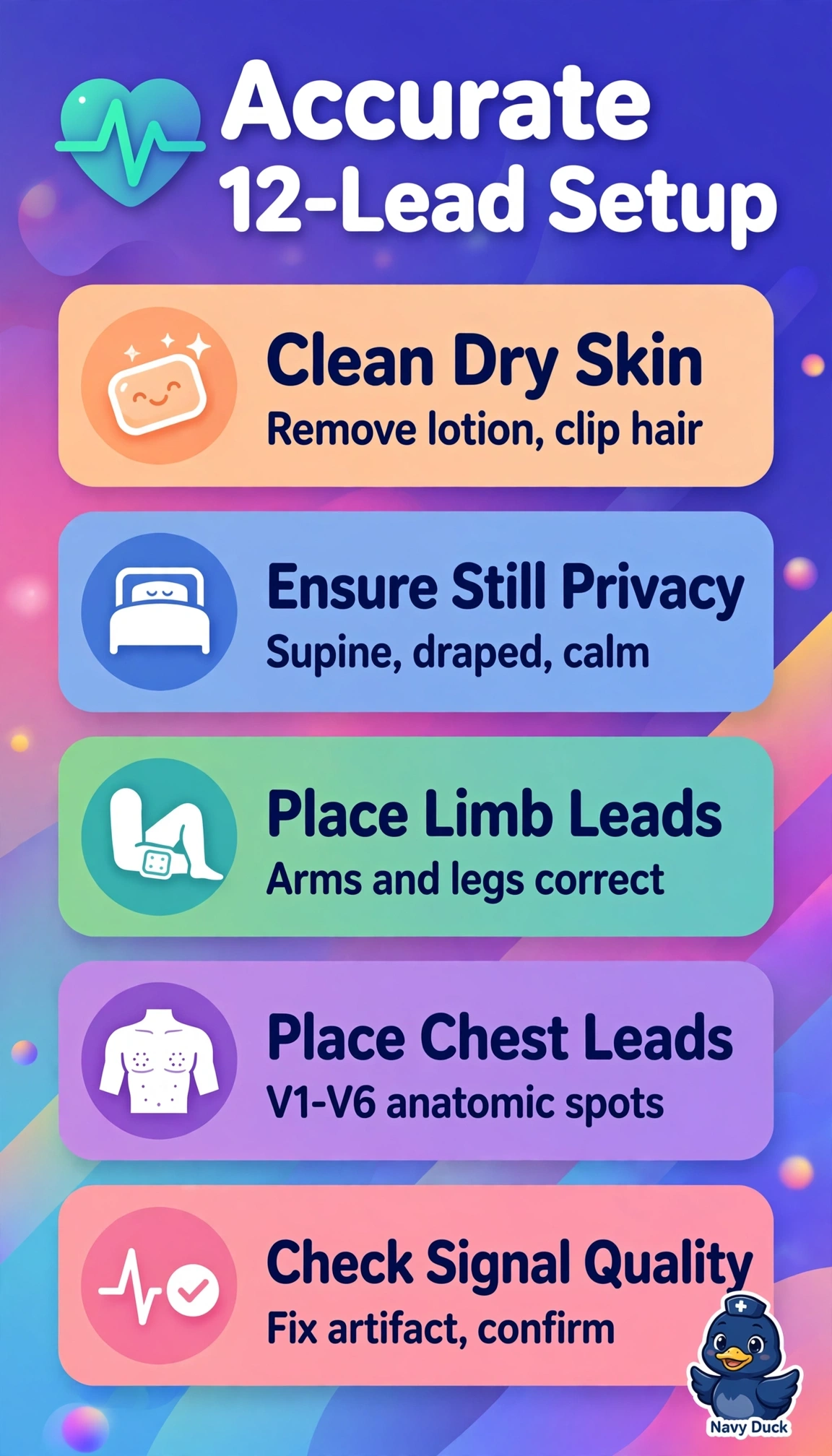
The correct response succeeds because routine resting 12-lead interpretation depends on low skin impedance and standard anatomy: removing light lotion with skin prep pads, clipping excess chest hair, using new electrodes, ensuring privacy with the patient supine and still, and placing precordial and distal limb electrodes in true anatomic positions together preserve voltages, axis, and ST-T morphology. The continuous rhythm assessment with a 5-lead cable fails by lead-set concept because although 5-lead monitoring is standard for observing reported racing heartbeat and trends, it cannot supply the calibrated 12-direction spatial views required for a routine diagnostic 12-lead. The torso placement for 12-lead limb electrodes fails by placement concept because although moving limb electrodes to the torso as in Mason-Likar or stress protocols is commonly used to limit limb movement artifact, it systematically shifts QRS amplitude, frontal axis, and repolarization and therefore invalidates comparison to standard resting criteria. The mild prep that leaves lotion to avoid irritation fails by skin-interface concept because although gentle handling suits sensitive skin, residual lotion and unclipped hair preserve oil and air gaps that raise impedance, causing baseline wander, poor R-wave progression, and false artifact that mimics noise or ischemia. An exam caveat is that stable palpitations, cleanliness, and ability to lie still do not convert a requested routine 12-lead into monitoring, exercise, or sensitive-skin-modified study, so select the standard resting method when those cues are given. A practical check is to confirm dry degreased skin, fresh adherent electrodes without tenting over hair, supine stillness with arms relaxed, and a calibration-quality tracing without wander before accepting the recording, repeating prep if needed.