
The emergency department asks you to collect a urine drug screen ordered as legal evidence after a workplace accident, with a supervisor observing and special seals available. The patient is able to provide a sample privately with precautions. Which chain-of-custody practice should you maintain for this forensic specimen?
Select an answer to reveal the explanation.
Short Explanation
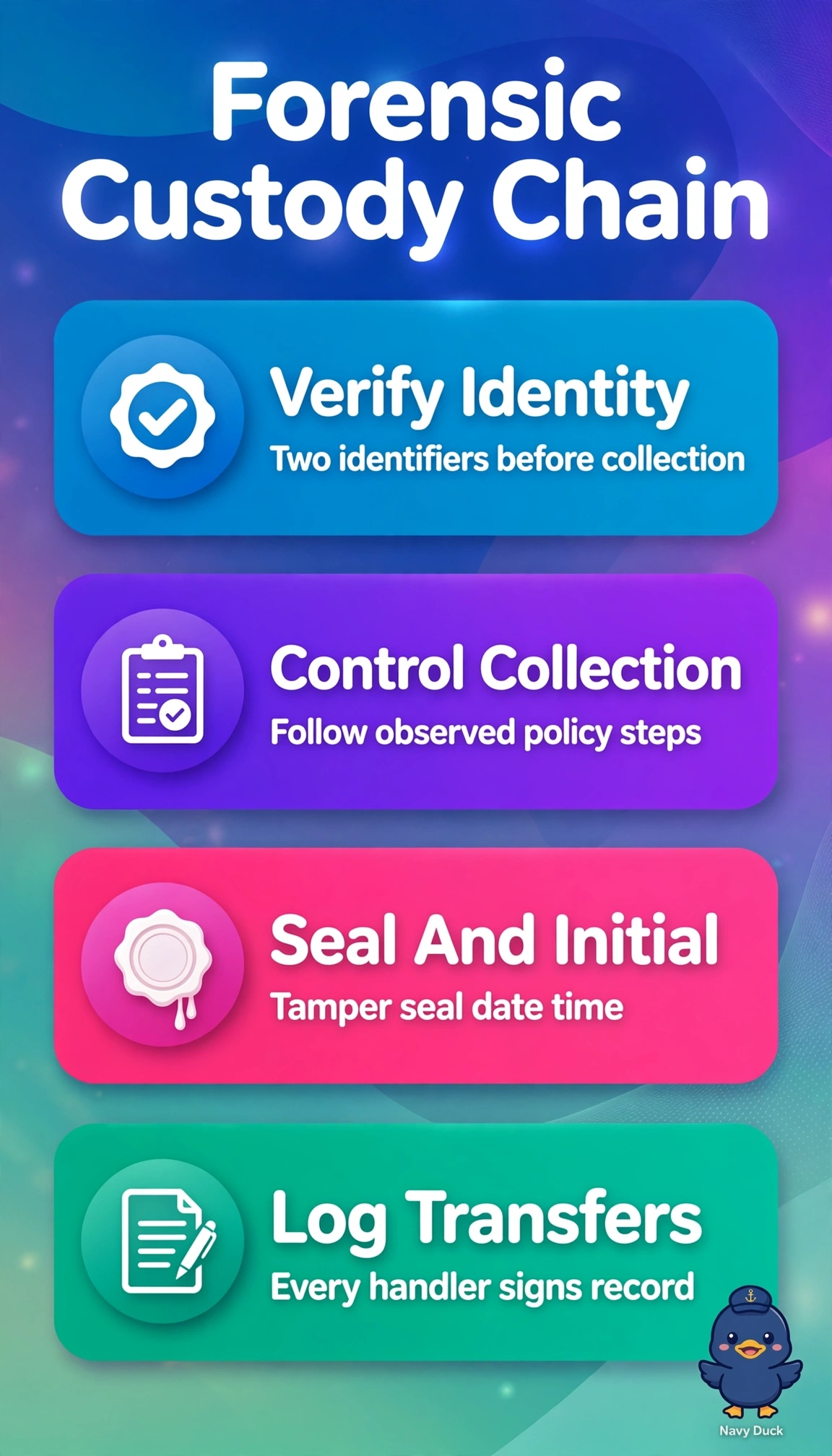
You've got to treat that sample like a relay baton you'll never let out of your sight. You'll verify your patient's ID, follow your policy for observed collection, then seal, initial, and chart each handoff to keep that chain-of-custody rock solid.
Full Explanation
For a urine drug screen ordered as legal evidence after a workplace accident, the specimen must remain unbroken from donor to laboratory, which requires positive identity verification, collection under direct observation per policy using stated privacy precautions with a supervisor present, immediate closure with tamper-evident special seals initialed across the seal, and contemporaneous documentation of every transfer with date, time, handler and purpose to prove authenticity and preserve admissibility. A routine approach using only a standard laboratory label despite proper observation and transfer notes satisfies identification and workflow but fails tamper-evidence conceptually because without initialized seals any opening, dilution or substitution is undetectable and the available forensic safeguards are unused. An approach that maintains identification, sealing and logging but allows fully private unobserved voiding for comfort satisfies dignity and continuity but fails observation conceptually because forensic validity depends on policy-defined witnessing to prevent adulteration or substitution, which routine clinical privacy does not provide. An approach that completes verification, observation and sealing but forwards the container by routine transport without a custody log satisfies integrity at collection but fails continuity conceptually because any undocumented handling gap breaks chain of custody and allows legal challenge even if delivery is prompt. For examinations, do not confuse efficient compassionate clinical urinalysis with forensic toxicology, where witnessed integrity and paperwork outweigh speed and maximal privacy. As a practical check, match photo ID to requisition, obtain observer signatures, initial across the intact seal, and start the custody form at the bedside so no movement occurs off record.