
A hospital technician witnesses a 60-year-old visitor collapse in the lobby, who is unresponsive, pulseless, and not breathing normally, while a second staff member brings the AED and a code is called. The floor is hard and the area is clear of hazards. Which first aid and BLS response per AHA guidelines should the technician provide?
Select an answer to reveal the explanation.
Short Explanation
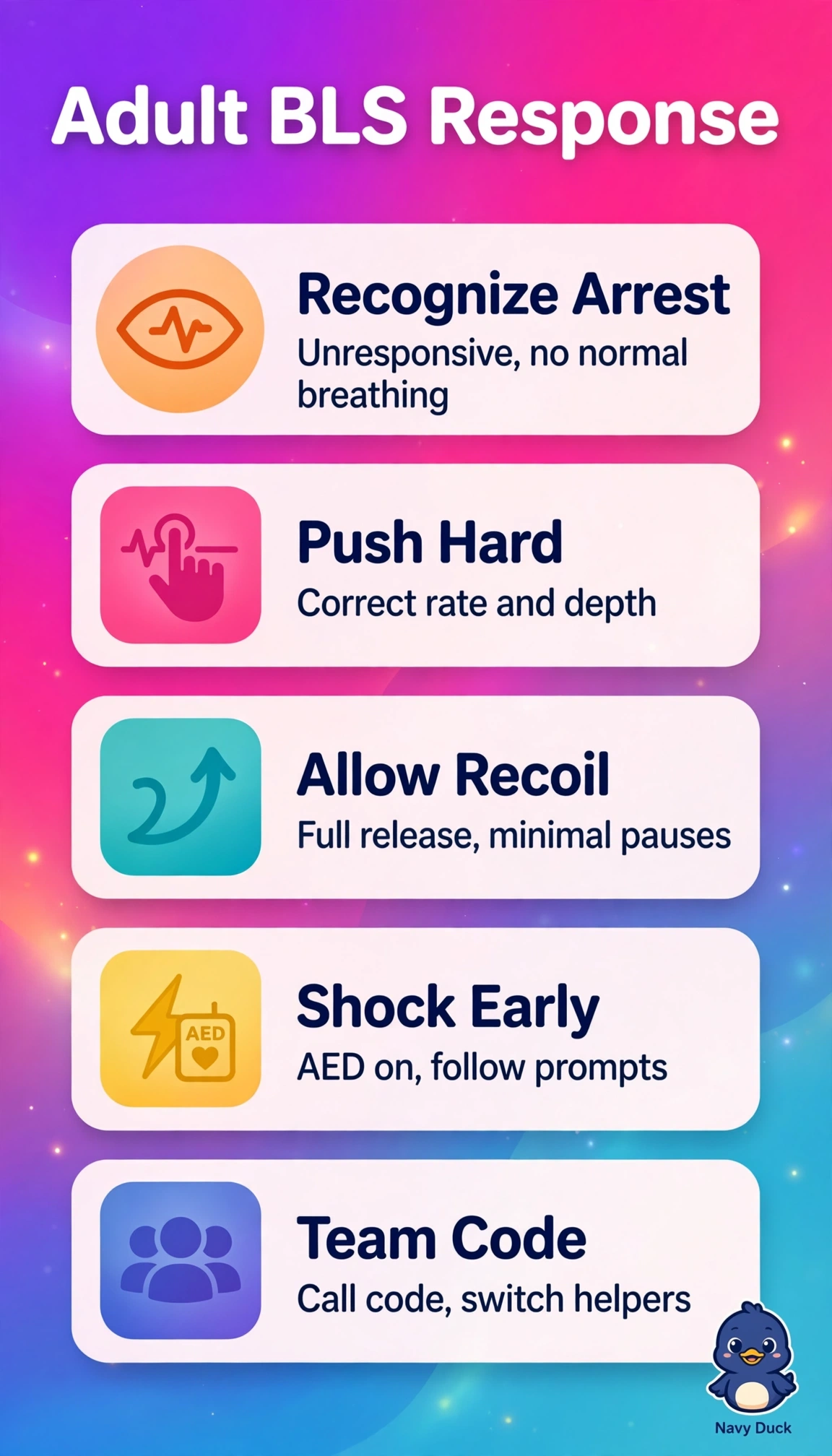
You've got to keep your patient's blood moving until help arrives, like you're hand-pumping water when the power's out. Push hard and fast with full recoil, then don't hesitate to use the AED as soon as it's ready.
Full Explanation
For witnessed adult collapse with unresponsiveness, pulselessness, and absent or agonal breathing on a firm hazard-free surface, AHA adult BLS requires immediate high-quality chest compressions at 100-120 per minute and 2 to 2.4 inches depth with full recoil and minimal interruptions plus early AED use as soon as available because perfusion and rapid defibrillation determine survival and shockable rhythms deteriorate each minute while the activated code team provides advanced backup. The airway-breaths-first approach fails by sequence concept because C-A-B replaces A-B-C for adult sudden arrest, with breaths-first reserved for hypoxic events like drowning, so opening the airway and giving two breaths before compressions needlessly delays circulation when immediate compressions and AED are indicated. The recovery-position approach fails by assessment concept because lateral positioning is for unresponsive victims with a pulse and normal breathing to protect the airway, whereas pulseless abnormal breathing defines arrest requiring supine positioning for compressions and pads, so observing without CPR permits anoxic injury. The defer-AED approach fails by defibrillation concept because any trained responder should power on the AED, attach pads, and follow prompts immediately rather than maintaining compressions alone for the code team, since CPR preserves viability but does not terminate ventricular fibrillation. An exam caveat is that agonal gasps count as not breathing normally and pulse checks must not exceed ten seconds, a frequent trap testing hesitation versus action. A practical check is to confirm unresponsiveness, activate response and obtain the AED, confirm pulselessness and abnormal breathing within ten seconds, begin central chest compressions on the hard surface, and apply the AED on arrival with immediate resumption of compressions after analysis or shock.