
A technician must collect morning labs from a dehydrated older adult with fragile veins after one unsuccessful attempt, needing sufficient volume and accurate labels for two tubes. The patient is identified, alcohol is available, and the bedside printer works. Which collection practice best avoids hemolysis, insufficient quantity, and labeling errors?
Select an answer to reveal the explanation.
Short Explanation
You treat veins and samples gently because rough handling breaks cells. Clean technique plus bedside labeling protects accuracy like sealing and addressing an envelope at the door.
Full Explanation
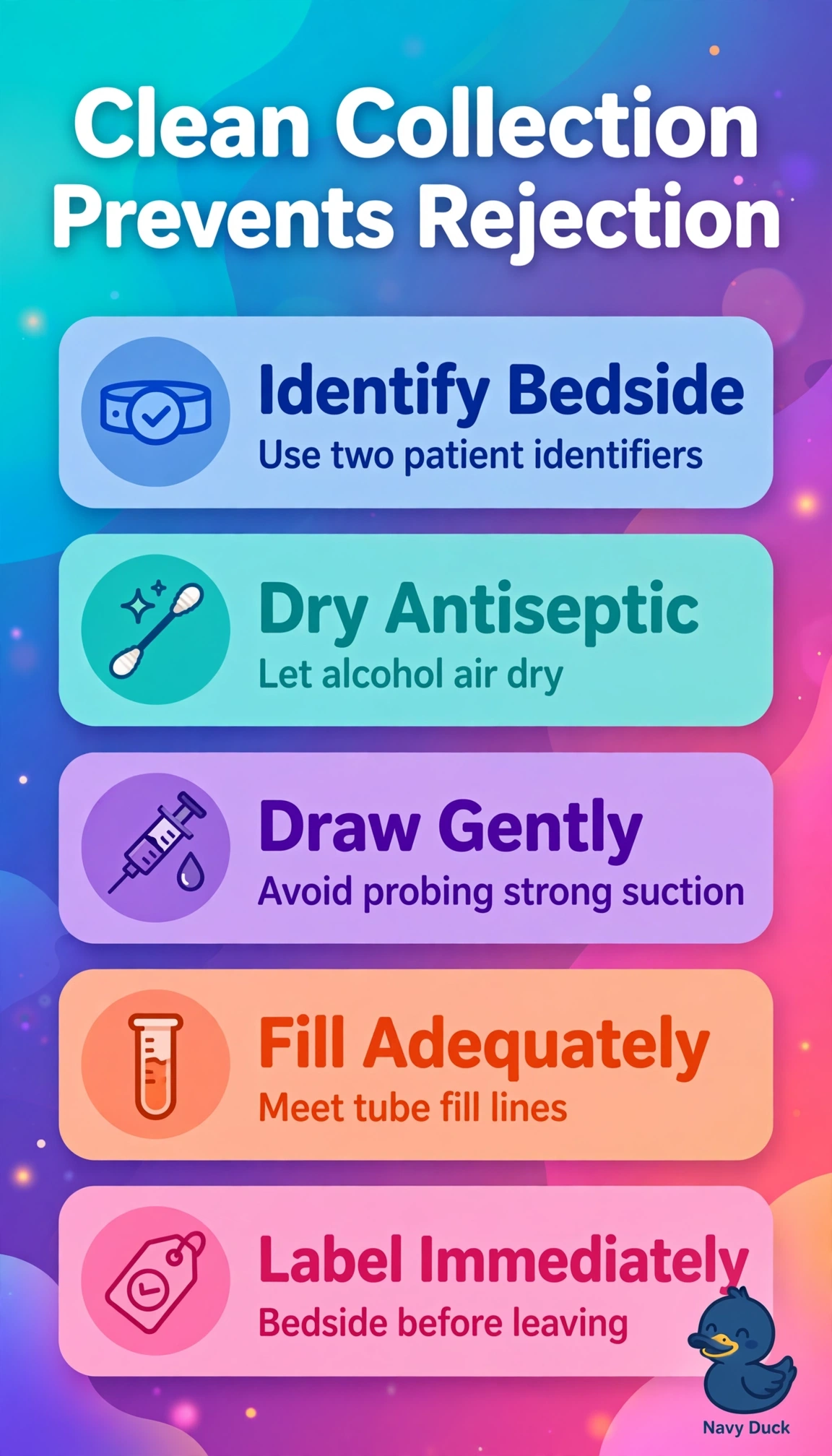
The correct practice combines four safeguards that together prevent hemolysis, insufficient quantity, and labeling errors in a dehydrated older adult with fragile veins after one failed attempt: allowing alcohol to dry avoids alcohol-induced hemolysis and movement, gentle draw and careful handling avoids shear stress and vein collapse, filling tubes to the required volume preserves additive ratios and avoids recollection, and labeling at the bedside preserves positive identification for two tubes. Collecting while the site is still slightly damp otherwise follows good technique with gentle flow, full fill, and bedside labeling, yet residual alcohol can enter the sample and lyse cells while causing stinging, so efficiency undermines hemolysis control. Using firm rapid suction to secure volume is a familiar difficult-draw workaround and maintains dryness, fill, and bedside labeling, yet high negative pressure collapses fragile veins and shears erythrocytes, creating hemolysis despite adequate quantity. Labeling promptly at the station after a gentle, dry, well-filled draw preserves accuracy in many workflows, yet moving away from the bedside breaks point-of-collection identification for multiple tubes and risks swaps or delays even when identification was initially correct. Exam caveat: select the answer satisfying every stated goal when the stem explicitly provides enabling cues like available alcohol and a working bedside printer. Practical check: visually confirm dryness, observe steady flow, verify fill lines before gentle mixing, and apply labels at the bedside with verbal recheck.