
In an outpatient clinic you must obtain temperature, pulse, respirations, and blood pressure on a frightened 4-year-old and then on an 85-year-old with fragile skin and hearing loss. Both need accurate baselines today. Which vital-signs approach best adapts technique for pediatric, geriatric, and special populations?
Select an answer to reveal the explanation.
Short Explanation
Small arms and fragile skin need different handling, not more force. Right technique with calm pacing gives numbers you can actually trust.
Full Explanation
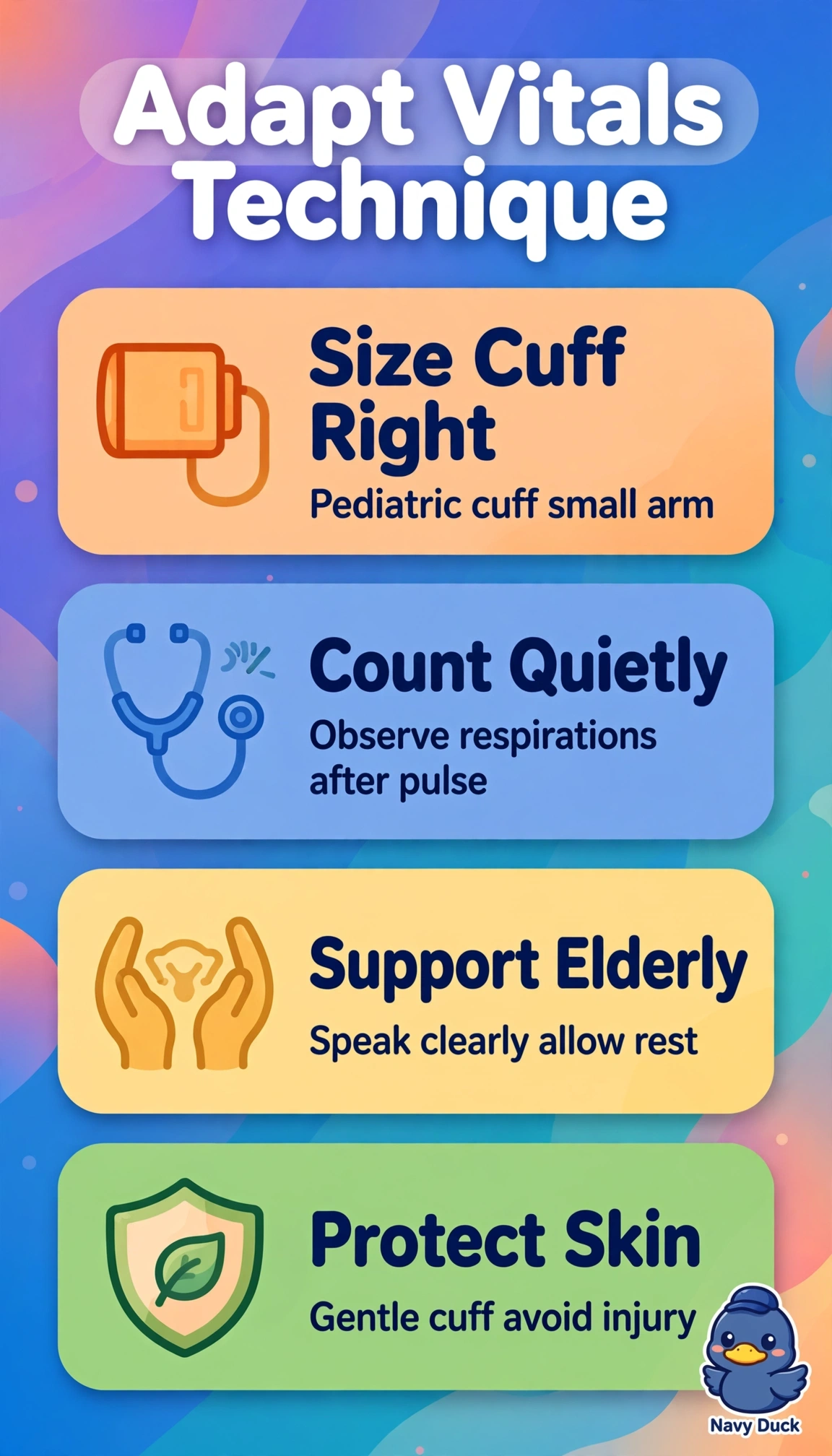
The correct approach works because it matches equipment and communication to age-specific physiology and psychosocial needs, with a properly sized pediatric cuff preventing falsely elevated blood pressure, discreet respiration observation preventing voluntary rate changes in a frightened preschooler, clear face-to-face speech improving comprehension with hearing loss, and extra time permitting trust, gentle handling of fragile skin, and accurate baselines. The routine that is otherwise ideal but uses rapid instructions to maintain schedule fails on sensory adaptation, since hurried, unfaced speech degrades understanding, lip-reading cues, and cooperation in an older adult with presbycusis despite good time management. The routine that is otherwise ideal but counts respirations openly fails on developmental adaptation, since staring at the chest and announcing the count alerts the anxious 4-year-old and provokes conscious breathing changes that invalidate the baseline. The routine that is otherwise ideal but uses one standard adult cuff for consistency fails on sizing and safety, since an oversized cuff mismeasures pressure in a small child and risks inaccurate readings and excess tissue pressure on a frail arm. A common exam caveat is that efficient, standardized workflows look correct but exam questions reward adaptation to the stated vulnerability over speed or uniformity. A practical check is to confirm cuff width is about 40% of arm circumference, observe respirations covertly while appearing to take the pulse, face the older adult, speak in clear lower tones, and recheck any unexpected vital sign after calming.