
In a same-day surgery center, a middle-aged adult needs two evacuated tubes, has a large hematoma in the left antecubital fossa, has fluids infusing in the right forearm, and offers a soft hand vein below the infusion site without edema. Which venipuncture device selection best demonstrates correct capillary and venipuncture technique?
Select an answer to reveal the explanation.
Short Explanation
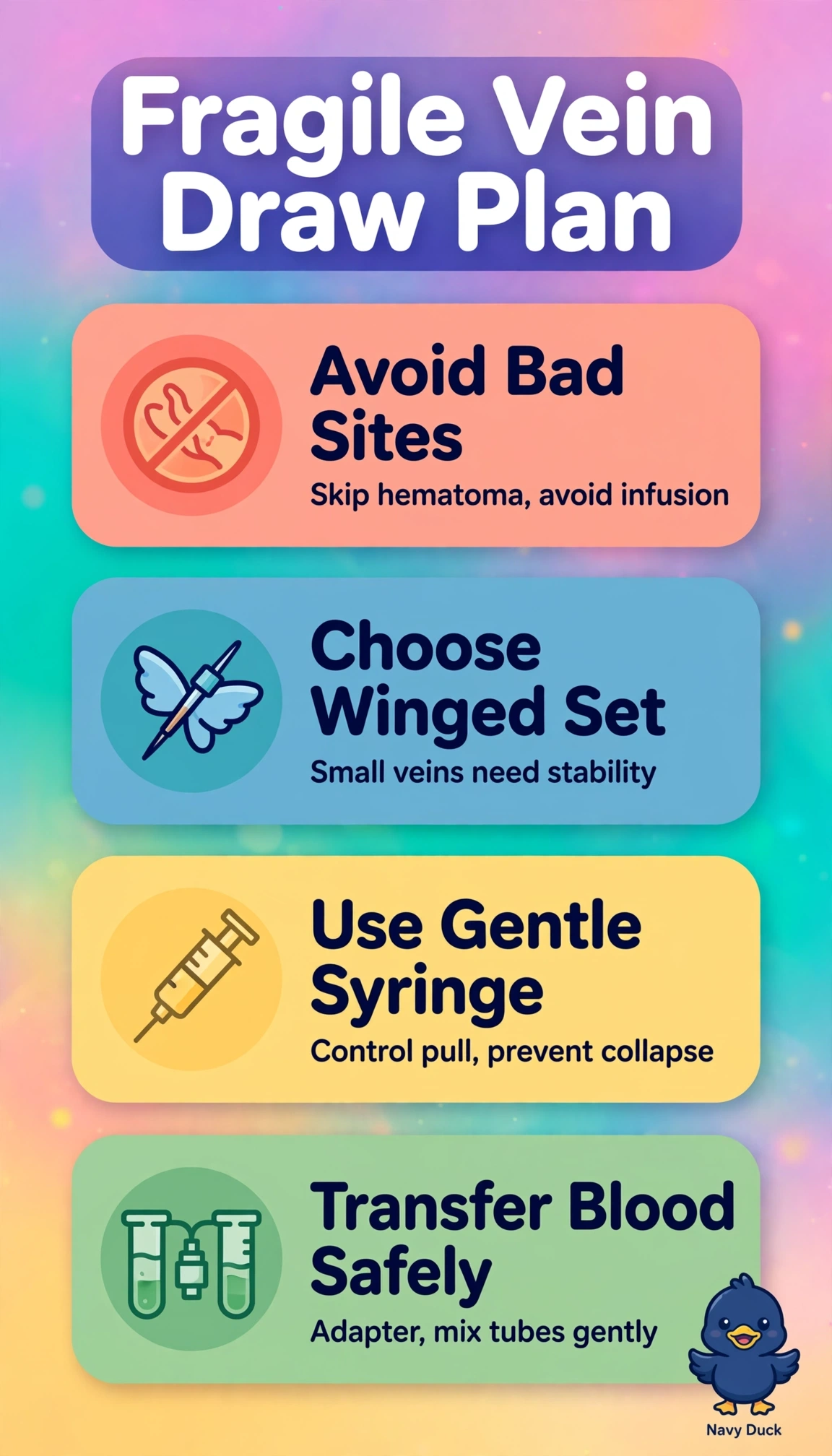
You’re matching the tool to that delicate vein. A winged set plus syringe gives you feather-light suction, like sipping through a straw instead of a shop-vac, and that’s your control advantage.
Full Explanation
The correct selection succeeds because the unaffected distal hand vein avoids both the left-sided hematoma and dilution from the right forearm infusion while the winged set with syringe provides low-pressure controlled aspiration ideal for soft small hand veins, followed by safe adapter transfer that preserves vacuum, additive ratios, and closed-system safety. The direct vacuum holder approach on the same hand vein fails on device-vein matching because fixed evacuated pressure can collapse fragile veins and cause pain, hemolysis, or short draws despite correct site selection. The winged syringe approach above the infusion fails on fluid interference because proximal venous blood is diluted and chemically altered by infusate, invalidating electrolytes, glucose, and counts even when technique and transfer are flawless. The fingerstick micro-collection approach fails on volume and container requirements because properly warmed capillary collection yields only microliter specimens that cannot fill two evacuated tubes with correct blood-to-additive ratios. An exam caveat is that same-arm draws are only acceptable distal to a temporarily stopped infusion with approval and documentation, never proximal while fluids run and never through hematoma, edema, or compromised vessels. A practical check is to re-identify the patient, assess both arms, limit tourniquet time, anchor gently without collapsing the vein, confirm free venous return, release the tourniquet before withdrawal, engage safety immediately, and transfer gently via the syringe adapter without forcing the plunger.