
A PCT is recording a resting 12-lead ECG on a middle-aged adult in a chilly outpatient room who is shivering, chatting, and holding tense arms overhead, and the tracing shows irregular jagged spikes with a thick fuzzy baseline while all electrodes remain firmly attached. Which somatic artifact correction should the technician apply first to obtain a clear tracing?
Select an answer to reveal the explanation.
Short Explanation
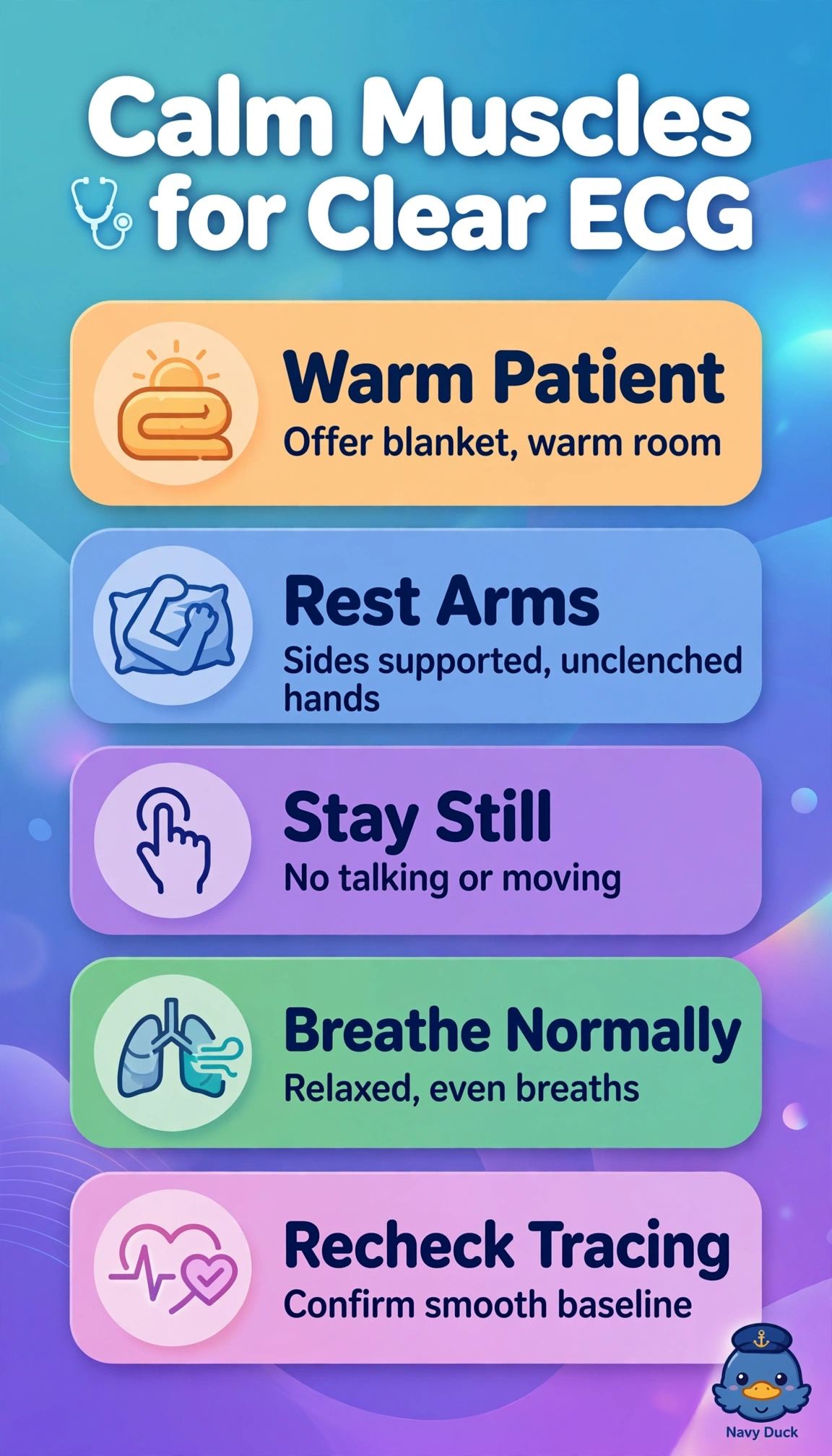
You caught the clue: shivering and talking can both create muscle noise. Lowering your arms, keeping still and quiet, and getting warm relaxes the muscles so you can record a clearer somatic signal.
Full Explanation
The correct approach reduces somatic muscle artifact, which can produce irregular jagged spikes and a thick, fuzzy baseline when skeletal muscles contract. In this patient, tense elevated arms load the shoulder and arm muscles, talking activates facial, jaw, and respiratory muscles and can cause movement, and cold-induced shivering creates generalized tremor. Lowering the arms to the sides, keeping the patient still and quiet, and providing warmth addresses all three sources. Keeping the patient warm and quiet while the arms remain elevated fails because sustained shoulder and postural tension can continue to produce artifact. Lowering the arms and providing warmth while allowing conversation fails because talking keeps orofacial, neck, and chest muscles active and may cause motion; conversation cannot replace brief quiet during acquisition. Lowering the arms and keeping the patient warm, still, and silent while rechecking electrode contact and placement targets poor contact or a wandering baseline, not the stated muscle activity: the electrodes are firmly attached, and shivering will persist without warmth. An exam caveat is to match every stated condition rather than choose a familiar intervention that leaves one artifact source intact. For a practical check, pause, help the patient relax the jaw and shoulders, place the arms comfortably at the sides, apply blankets and reduce drafts, then reacquire the ECG and confirm a stable baseline without muscle fuzz.