
A PCT provides morning care for an 82-year-old patient on prolonged bed rest who has limited mobility, incontinence, and a sacral area showing intact skin with non-blanchable redness and warmth. The skin is dry elsewhere and the patient reports tenderness when turned. Which skin-care and breakdown identification action best addresses this sacral finding?
Select an answer to reveal the explanation.
Short Explanation
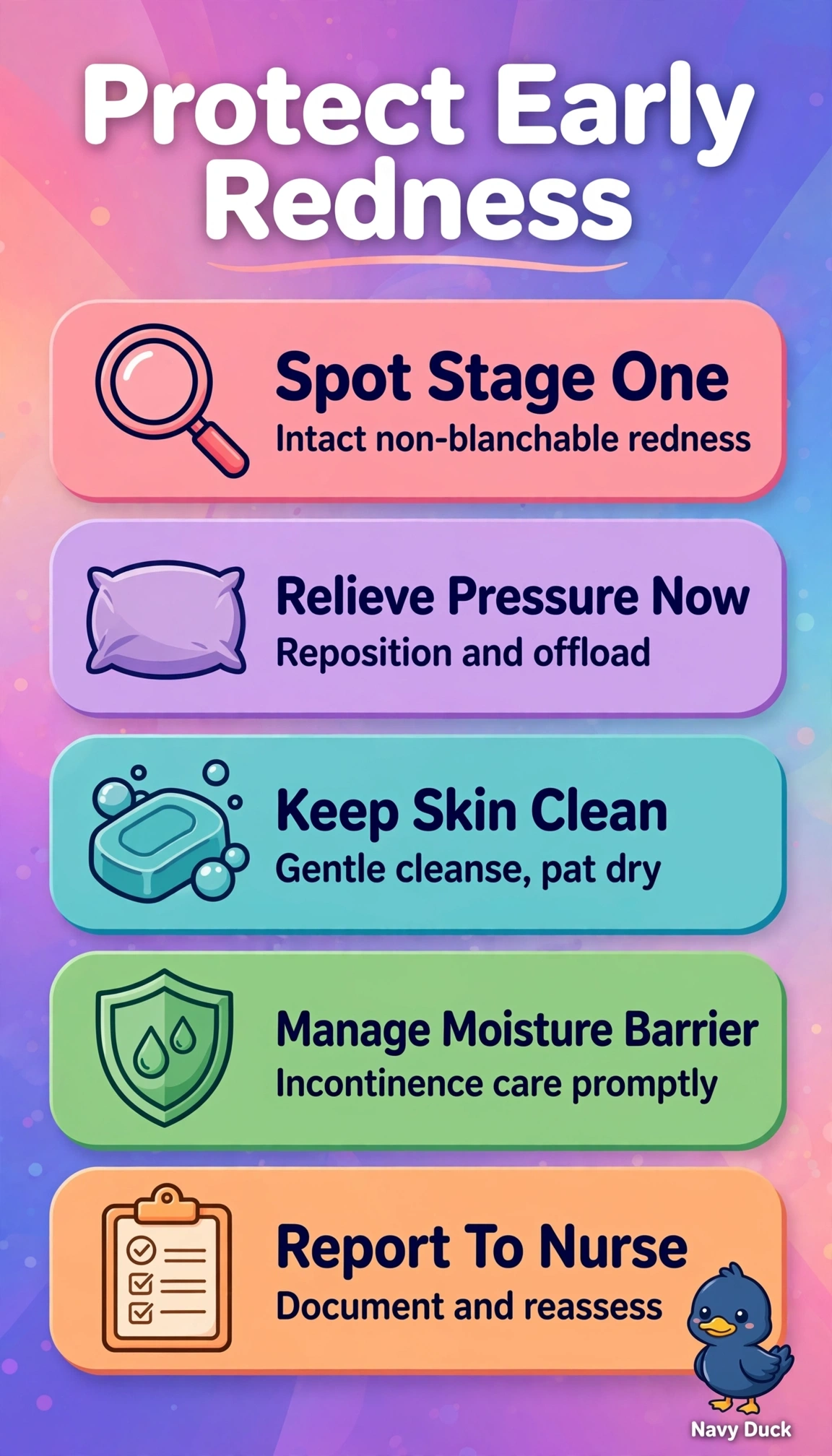
Intact but angry skin is waving a red flag you can still answer. Offloading pressure plus gentle protection stops a stage 1 spot from deepening.
Full Explanation
The sacral finding of intact skin with non-blanchable redness, warmth and tenderness over a bony prominence during prolonged bedrest with limited mobility matches suspected stage 1 pressure injury from sustained pressure and shear, so relief of pressure with scheduled repositioning, gentle cleansing without friction, light moisturization for dry skin, prompt incontinence care with barrier, and timely nurse notification support perfusion and prevent progression. The dermatitis interpretation correctly addresses incontinence with barrier cream and repositioning for diffuse moist erythema in perineal folds, but fails here by concept because localized non-blanching sacral redness indicates pressure ischemia rather than moisture irritation alone. The stage 2 interpretation correctly addresses shallow open loss with gentle cleansing and offloading for blisters or abrasions, but fails here because intact skin by definition excludes open partial-thickness loss. The deep tissue interpretation correctly addresses purple or maroon intact discoloration with offloading and close monitoring, but fails here because described redness lacks the characteristic dark hue of deep damage. As an exam caveat, always integrate blanch response, intact versus open status, color, and bony location before staging. As a practical check, test blanching lightly, confirm sacral offloading, and report persistence, dark change, or opening at once.